
Experiential learning is practice plus reflection that builds real capability, not just knowledge recall. It only works as intended when you confirm two things first: that there’s an actual capability gap, and that learning is the right fix for it rather than a process or tooling problem. Used correctly, it’s the strongest lever for complex judgment work and for driving adoption of new software or workflows.
TL;DR:
- Experiential learning should only be implemented after confirming a genuine capability gap and ensuring it addresses the root cause rather than a process or tooling issue.
- The most effective formats include stretch assignments, simulations, in-app sandboxes, and peer coaching, each suited to different types of skill deficiencies.
- Costs vary significantly, from low-cost in-app guidance to high-cost live simulations, with diagnosis and evidence-gathering essential to prevent wasted resources.
- Metrics such as time to competence, error rates, and support ticket volumes provide stronger proof of capability improvements than completion or satisfaction scores.
- Ownership by frontline managers and active employee participation are critical, with culture shift requiring deliberate practices like embedded reflection and psychological safety.
Table of Contents
- What Does Experiential Learning Look Like in the Workplace?
- Why Does Experiential Learning Matter More Than Passive Training?
- Should You Build an Enablement Play or Fix Something Else First?
- How Do You Design an Experiential Learning Program That Transfers?
- Which Format Fits Your Constraints: Simulations, AI Roleplay, or Apprenticeships?
- What Metrics Actually Prove Experiential Learning Worked?
- Who Should Own Experiential Learning: L&D, Managers, or Executives?
- How Do You Build a Culture That Sustains Experiential Learning?
- What Does an Experiential Learning Program Actually Cost?
- The ROI Case for Diagnosis-First Design
- How Cognistry Supports Diagnosis-First Enablement Plays
- Sources
- FAQ
What Does Experiential Learning Look Like in the Workplace?
Experiential learning in the workplace takes a handful of recognizable forms, each suited to a different kind of capability gap. The common thread: people act, get feedback, and reflect before the next attempt.
- Stretch assignments and apprenticeships. A junior analyst runs a client presentation solo for the first time, with a manager debriefing afterward on what landed and what didn’t.
- Simulations and role play. A new supervisor practices a termination conversation against a trained actor or AI persona that pushes back realistically, not one that just nods along.
- In-app walkthroughs and sandboxes. A finance team practices month-end close in a sandboxed version of a new ERP system before it goes live.
- Peer coaching and communities of practice. Sales reps trade real call recordings weekly, dissecting what worked in each pitch.
Each format maps to a different diagnosis: stretch assignments for judgment under real stakes, simulations for high-risk conversations, sandboxes for tool adoption, and peer coaching for continuous refinement after the initial skill is in place.
Why Does Experiential Learning Matter More Than Passive Training?
Experience-driven development is the primary way people actually build capability at work, according to Center for Creative Leadership research on talent management. Well-designed stretch assignments and on-the-job experience shape promotability and engagement far more reliably than classroom instruction alone.
The core finding: CCL’s research ties challenging assignments directly to promotability ratings and engagement when they’re embedded into how talent systems actually work, not bolted on as separate training events.
For judgment-heavy tasks, active practice beats passive content because judgment is a skill built through repetition and correction, not information absorbed once. Practitioner guidance on scaling experiential learning backs this up for software rollouts specifically. Set expectations honestly: experiential learning complements process redesign and formal instruction. It doesn’t replace a broken workflow or bad documentation.
Should You Build an Enablement Play or Fix Something Else First?
Before you design a single simulation, run three diagnostic questions. Skipping this step is how organizations end up training people to work around a broken process instead of fixing it, a risk Cognistry’s own diagnostic framework flags directly.
- Is there real evidence of a capability gap? Look at support tickets, quality findings, and frontline supervisor notes, not assumptions about what “everyone struggles with.”
- Is the gap caused by environment or by the person? A broken approval workflow produces the same symptoms as undertrained staff. Confusing the two wastes budget on the wrong fix.
- Would closing the capability gap actually move the business outcome? If the answer is unclear, the enablement play isn’t justified yet.
Depending on the answers, you’ll land on a process or tool change, a genuine enablement play, or some other intervention entirely, like better documentation or a policy fix.
Pro Tip: Scan three evidence sources before you scope anything: the last 90 days of support tickets, the most recent quality audit findings, and a handful of frontline supervisor one-on-ones. Patterns usually surface faster than any survey.
How Do You Design an Experiential Learning Program That Transfers?
Once diagnosis confirms an enablement play is warranted, follow a sequence that keeps the design grounded in real tasks rather than generic content.
- Identify critical tasks with measurable impact. Pick the two or three tasks where a mistake is expensive or a delay is visible to the business, not every task in the job description.
- Design realistic practice. Build in resistance. A simulation where every character agrees with the learner teaches nothing; a theory-informed framework like CAKE helps keep scenario design consistent as you scale.
- Build structured reflection. Use a short debrief template right after practice: what happened, what you’d do differently, what you’ll try next. Reflection is what separates experience from learning, based on the Kolb-derived cycle Northeastern outlines.
- Reinforce in the workflow. In-app prompts, checklists, and a manager follow-up within a week keep the skill from decaying.
- Pilot before you scale. Collect baseline metrics, run a small pilot, and set an iteration cadence, monthly at minimum, before rolling out further.
Which Format Fits Your Constraints: Simulations, AI Roleplay, or Apprenticeships?
No single format wins across every situation. Matching fidelity and cost to the actual gap is where most programs succeed or fail.
- High-fidelity human simulations work best for executive and people-manager practice, where nuance matters, but they cost more per learner and don’t scale cheaply.
- AI-powered simulations and roleplay scale well, but poorly designed ones default to agreeable characters that never push back, which undermines behavioral transfer.
- In-app guidance and sandboxes are the most scale-friendly option for software adoption, letting people practice inside a safe copy of the real system.
- Apprenticeships and mentorship deliver the deepest skill transfer but demand real time from your most experienced people.
Most mature programs combine formats in phases: sandbox practice first for baseline comfort, then simulation for judgment calls, then live mentorship for the hardest edge cases.
What Metrics Actually Prove Experiential Learning Worked?
Course completion and satisfaction scores tell you almost nothing about whether capability actually changed. Track outcomes tied to the business problem you diagnosed instead.
- Time to competence: how long until a new hire or transitioning employee hits full productive output.
- Task completion rate and error rate: the direct signal that judgment or execution improved.
- Support ticket volume: a drop here after a software rollout is a strong adoption signal.
- First-time-right metrics: especially useful in quality-sensitive operations.
Run a pilot with a baseline and, where feasible, a control group. Pairing behavioral telemetry (what choices people actually made in practice) with outcome data gives you a far stronger cause-and-effect read than learning scores alone, a point echoed in Digital Adoption’s guidance on scaling experiential design. The Training Metrics Dashboard guide is a useful reference if your team needs a starting structure for tracking these numbers consistently.
Who Should Own Experiential Learning: L&D, Managers, or Executives?
Experiential learning fails when it’s treated as an L&D-only initiative dropped onto teams from outside. It works when the people closest to the work carry real responsibility for it.
Frontline managers facilitate. They’re the ones who see the practice happen and run the debrief that turns experience into learning. This is a shift in the manager role itself. CCL’s research frames this directly: embedding experiential practice into daily work turns managers into facilitators of reflection, not just approvers of a training calendar. If a manager isn’t equipped or willing to run a five-minute debrief after a practice session, the learning stops there.
Employees participate as active operators, not passive attendees. The design has to assume they’ll make real choices and face real consequences in the practice environment, not just watch a demonstration.
Executives sponsor by naming the business outcome. A sponsor’s job isn’t to approve a training budget. It’s to state plainly what operational metric the enablement play needs to move, whether that’s fewer escalations, faster onboarding, or fewer quality defects, and to hold the team to measuring against it.
L&D designs and diagnoses. This is where the learning experience engineer role comes in: someone who translates the diagnosed capability gap into realistic practice, not someone who authors slides on request. Subject matter experts contribute the evidence, real tasks, real failure modes, real edge cases, that makes the practice environment credible instead of generic.
How Do You Build a Culture That Sustains Experiential Learning?
Most experiential learning programs don’t fail at launch. They fail six months later when the org reverts to slide decks because that’s the path of least resistance. Preventing that requires deliberate change management, not just a good first pilot.
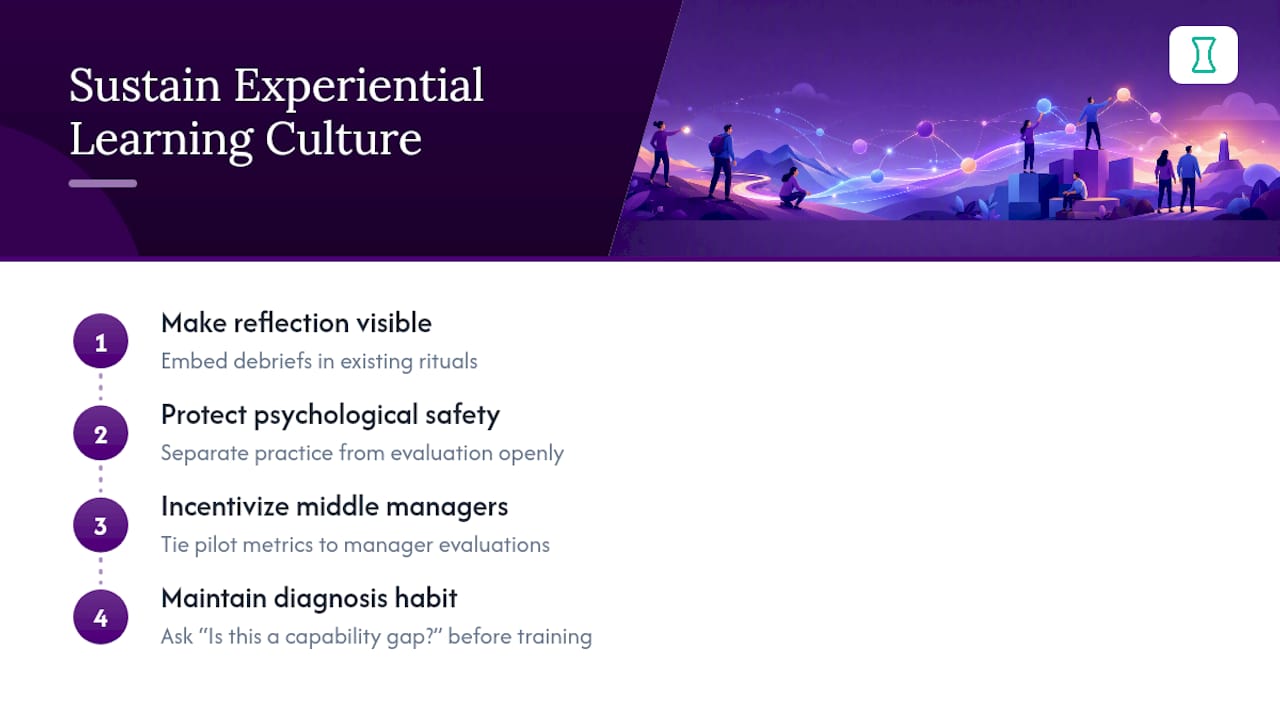
Start by making reflection a visible management habit, not a one-time workshop add-on. If debriefs only happen during the pilot and disappear afterward, the message to managers is clear: this was a project, not how we work now. Build the debrief into existing rituals, weekly one-on-ones, post-incident reviews, deal retrospectives, instead of creating a new meeting nobody attends.
Second, protect psychological safety around practice failure. If a simulation exposes that someone doesn’t yet have a skill, and that surfaces in a performance review, people will stop taking practice seriously and start performing for the audience instead of learning. Separate practice environments from evaluation environments explicitly, and say so out loud.
Third, give middle managers a reason to care beyond compliance. Tie the outcome metrics from your pilot, like time to competence or error rate, to something managers already get evaluated on. Culture change sticks when it rides on existing incentives rather than competing with them.
Finally, keep the diagnosis habit alive past the first project. Culture shift is really the habit of asking “is this actually a capability gap?” before every new training request that lands on L&D’s desk, and having the standing to say no when the evidence points elsewhere.
What Does an Experiential Learning Program Actually Cost?
Costs vary enormously by fidelity and scale, so it’s worth thinking in three rough tiers rather than a single number.
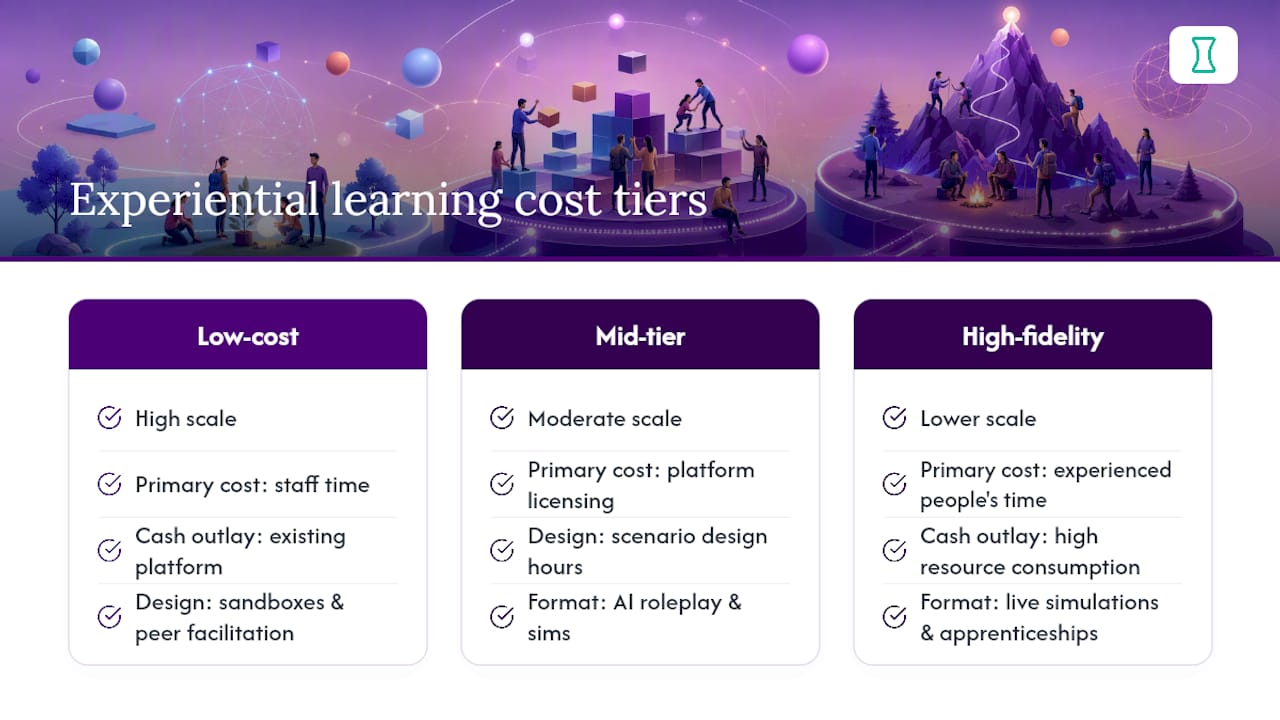
Low-cost, high-scale approaches, in-app guidance, sandboxes, structured peer coaching, mostly require staff time: someone to build the sandbox content and someone to facilitate peer sessions. The direct cash outlay is often limited to whatever platform already supports your software rollout.
Mid-tier investments cover AI-powered roleplay and simulation tools, plus the design time to build scenarios with genuine resistance built in rather than agreeable placeholder characters. Budget here goes toward platform licensing and, critically, the design hours to make scenarios reflect real failure modes instead of generic examples.
High-fidelity, high-touch programs, live human simulations for executive development, formal apprenticeships, mentorship pairings, carry the largest resource cost because they consume your most experienced people’s time. That cost is real but often underestimated when programs get scoped.
Whatever tier you’re evaluating, the resource question that matters most isn’t “how much does the tool cost.” It’s “how much diagnosis and evidence-gathering time did we budget before we started building.” Skipping that step is the single most common way experiential learning programs end up expensive and ineffective at once, building a polished simulation for a problem that was never really a capability gap.
The ROI Case for Diagnosis-First Design
Diagnosis-first design isn’t a cautious extra step. It’s the difference between an enablement play that moves a real business number and one that produces a nice simulation nobody needed. The organizations that skip diagnosis tend to discover, months later, that their new capability practice didn’t move the metric they cared about, because the actual problem was a broken handoff process the whole time.
My caution to any L&D leader reading this: never build a simulation for a process that’s fundamentally broken. Fix the workflow first, then teach people to operate inside it. Practice can’t fix a bad system; it just makes people better at working around one, which is worse than doing nothing.
— Brian
How Cognistry Supports Diagnosis-First Enablement Plays
Cognistry is a capability engineering platform built around the sequence this article just walked through: diagnose the gap, confirm learning is the right response, ground the design in your organization’s own evidence, then build. Instead of starting with a course outline, Cognistry: Forge structures capability signals, decision practice environments, and quality assurance gates from your actual frontline evidence, whether that’s quality findings, support ticket patterns, or subject-matter expert input, and measures the result against operational metrics like time to competence.
If you’re facing a request to “build a course” and suspect the real problem sits somewhere else, start with the diagnostic questions L&D should ask before any build. When you’re ready to see how a diagnosis-first platform structures the response, request a walkthrough of Cognistry: Forge and bring your evidence, not your slide deck.
Sources
- Putting experience at the center of talent management (Center for Creative Leadership)
- Experiential Learning: What It Is, How It Works, and How to Apply It at Scale (Digital Adoption)
- What Is Experiential Learning? (Northeastern University Knowledge Hub)
FAQ
Can you give me an example of experiential learning?
A new supervisor practicing a difficult performance conversation against a trained roleplay partner who pushes back realistically, then debriefing with their manager afterward, is a clear example of experiential learning in the workplace.
What are some common problems employees face at work that experiential learning addresses?
Employees commonly struggle with judgment-heavy tasks like handling escalations, adopting new software, and leading difficult conversations, all situations where reading a manual doesn’t build the skill that practice does.
What are the core principles of experiential learning?
The widely used framework, drawn from Kolb’s cycle, moves through concrete experience, reflective observation, abstract conceptualization, and active experimentation, with reflection identified as the step that converts raw experience into transferable learning.
What are the main types of experiential learning formats used at work?
The most common formats are stretch assignments and apprenticeships, simulations and role play, in-app guidance and sandboxes, and peer coaching or communities of practice, each suited to a different kind of capability gap.
How is experiential learning different from a traditional training course?
Traditional courses deliver information for a learner to recall later, while experiential learning has people act on real or simulated tasks and reflect immediately, which is why Cognistry’s diagnosis-first approach checks whether a course or a practice environment is actually the right fix before either gets built.