A modern enterprise learning experience is a diagnosis-first capability architecture, not a catalog of courses. It starts by determining what the work actually requires and whether learning is even the right response, then builds practice environments grounded in the organization’s own evidence. Cognistry is built around exactly this sequence: diagnose first, design second.
TL;DR:
- A capability architecture focuses on diagnosing actual operational needs before building targeted practice environments, rather than simply creating courses.
- Effective diagnosis pulls from strategy documents, frontline friction points, quality data, and role outcomes to ensure training addresses real, not assumed, gaps.
- Modular, role-based sequencing and realistic decision-practice environments enhance transfer of judgment skills more than traditional content modules.
- Measuring success requires behavioral telemetry and operational metrics like time-to-productivity and error rates, not just completion rates.
- A culture that supports management visibility, psychological safety, and ongoing feedback is essential for sustaining capability initiatives at scale.
Table of Contents
- What Is an Enterprise Learning Experience?
- How Do You Know If Learning Is the Right Response?
- Building Judgment: Practice, Modularity, and Role-Based Sequencing
- How Do You Measure Whether a Learning Experience Worked?
- A Quick Checklist Before You Build Anything
- How Do You Sustain a Capability System at Scale?
- Capability Building vs. Skills Training: What’s the Real Difference?
- Why Evidence-Informed Design Beats Designer Preference
- Formal, Informal, Social, and Self-Directed: Which Type Fits?
- What Drives Engagement in a Learning Experience?
- Where Do Technology and Digital Tools Actually Help?
- Designing for Different Learners and Accessibility Needs
- How Does Organizational Culture Shape Learning Outcomes?
- How Should Feedback Loops Improve Learning Design Over Time?
- A Learning Experience Engineer’s View on Diagnosis
- How Cognistry Supports Diagnosis-First Capability Building
- Sources
- FAQ
What Is an Enterprise Learning Experience?
Most L&D teams still measure success by what got built: modules shipped, hours logged, completion rates. A capability architecture measures something different. It asks whether people can make better decisions on the job, and it treats course creation as the last step, not the first.
The distinction matters because a course catalog optimizes for content consumption. A capability architecture optimizes for role outcomes. It maps every learning asset to a specific job function, ties it to an application checkpoint on the actual workflow, and retires anything that doesn’t move a measurable behavior. Instead of “here are forty modules, pick what applies,” the architecture says “here is the exact sequence a new claims adjuster needs before touching a live file.”
This isn’t a stylistic preference. Industry analysts now frame effective enterprise learning strategy as capability architecture that prioritizes diagnostics over course requests and maps needs directly to role-based outcomes. When a business unit asks for training, the mature response is a diagnostic conversation, not a build order. That shift in posture, from order-taker to capability partner, is the single biggest structural change happening in enterprise L&D right now.
How Do You Know If Learning Is the Right Response?
Not every performance gap is a training gap. Sometimes the process is broken, the tool is missing a feature, or nobody has clarified who owns a decision. Building a course against any of those problems wastes budget and erodes trust in L&D as a function.
A useful diagnostic pulls from four sources before anyone opens an authoring tool: the strategy’s stated goals, frontline friction points from the people doing the work, quality or error data, and the specific role outcomes the business is chasing. Each source answers a different question.
- What does the business need? Pull strategy documents and transformation roadmaps to identify the operational outcome required, not the topic someone wants covered.
- Where is the friction? Interview frontline supervisors and pull quality metrics to find where work actually breaks down.
- Is this a capability gap or something else? Compare the friction against process design, tooling, and governance. If people know what to do but can’t do it, that’s not a learning problem.
- Can the behavior be practiced safely? If judgment under pressure matters, and the real environment is too risky or expensive to fail in, that’s the strongest signal a decision-practice environment will pay off.
Cognistry runs this diagnosis before any build begins. Once the evidence points to a genuine capability gap, Forge structures the learning architecture around it, and Sim builds the decision-practice environment where people rehearse the judgment calls the job actually demands.
Pro Tip: Bring quality data and frontline interviews to the first scoping meeting, not after. Stakeholders who arrive with a solution already in mind rarely revisit it once they’ve seen a course outline.
Building Judgment: Practice, Modularity, and Role-Based Sequencing
Recall doesn’t transfer to the job. Judgment does, and judgment only develops through practice under conditions that resemble the real decision. That’s the core argument behind evidence-informed learning design, which favors proven mechanisms like practice, interleaving, and testing over content formats chosen because they’re easy to produce or look polished in a demo.
Three design patterns make the difference between a course that gets completed and a capability that gets used:
- Decision-practice environments that force a choice under realistic constraints, then show the downstream consequence of that choice.
- Branching scenarios built from real quality-escalation cases rather than hypothetical examples, so the stakes feel authentic.
- Modular foundations separated from role-specific practice layers, so a workflow or platform change only requires updating the affected module, not rebuilding the whole path.
That modular separation matters more than it sounds. When foundational content and role-specific practice stay entangled, a single tool update can force a full reauthoring cycle. Keeping them apart reduces rework every time the underlying platform or process shifts.
Role-based sequencing then enforces transfer: each stage ends with an application checkpoint tied to actual work, not a quiz. Cognistry’s approach to learning pathway design follows this exact logic, and the case for why experiential practice outperforms passive content is grounded in the same evidence.
Pro Tip: If a scenario could be answered correctly without ever having done the job, it’s testing recall, not judgment. Rebuild it around a real edge case instead.
How Do You Measure Whether a Learning Experience Worked?
Completion rates tell you almost nothing about whether capability improved. They confirm attendance, not competence, and enterprises that stop there are measuring the wrong layer entirely.
The KPIs that actually connect learning to business impact sit downstream of the program: platform adoption rate, time-to-productivity for new hires, error rate on the specific task the training targeted, and throughput on the workflow the capability gap was slowing down. Each one is observable in the operational system, not self-reported by the learner.
What “measurement” should actually mean: behavioral telemetry from the practice environment, periodic manager observation on the live job, and a sampling method that checks whether practice performance predicts real performance, not just whether a module got marked complete.
This is also where claims discipline matters most. Be skeptical of any vendor or internal report that cites a specific percentage improvement without a verifiable customer study behind it. A number without a named study attached is marketing, not evidence. The design-based research model treats practitioners, researchers, and developers as co-designers precisely because that collaboration is what makes outcome claims defensible rather than aspirational.
A Quick Checklist Before You Build Anything
Before scoping a new enablement play, run the ask through five questions in the same meeting where the request lands.
- Is the outcome operational? If nobody can name the specific decision or task the program should change, it isn’t ready to scope.
- Is evidence available? Strategy goals, frontline friction data, and quality metrics need to exist and be accessible, not assumed.
- Can the audience practice in a safe environment? If the real job is too costly or risky to fail in, that’s the case for a simulation.
- What scale is required? A twelve-person team and a four-thousand-person frontline function need very different formats.
- Is leadership sponsorship present? Without a visible sponsor, even a well-designed capability program stalls at rollout.
The answers dictate format. Operational judgment under pressure points to a decision-practice simulation. A workflow-adjacent skill gap points to embedded workflow learning at the point of work. A narrow, high-frequency task points to micro-practice. And if the diagnosis turns up a process or tooling problem instead, the right answer is a fix outside L&D entirely, not a course nobody asked for.
On governance, aim for early adoption among informal influencers before a wide rollout. A critical mass threshold around a quarter of the target population is often what tips a new behavior from novelty to norm.
How Do You Sustain a Capability System at Scale?
A capability architecture doesn’t run itself once it’s built. It needs owners, and it needs a rhythm that keeps pace with how fast the business changes, which for most enterprises now outstrips the old annual content refresh cycle.
Three roles typically anchor the governance model. Business owners define what operational outcome the program serves and hold the measurement gates accountable. A Learning Experience Engineer, a role built around evidence-grounded design rather than content production, translates diagnostic findings into architecture and keeps the modular structure intact as workflows change. Managers and senior leaders carry the heaviest, least formal weight: role-modeling the target behavior publicly does more to normalize a new capability than any amount of formal content.
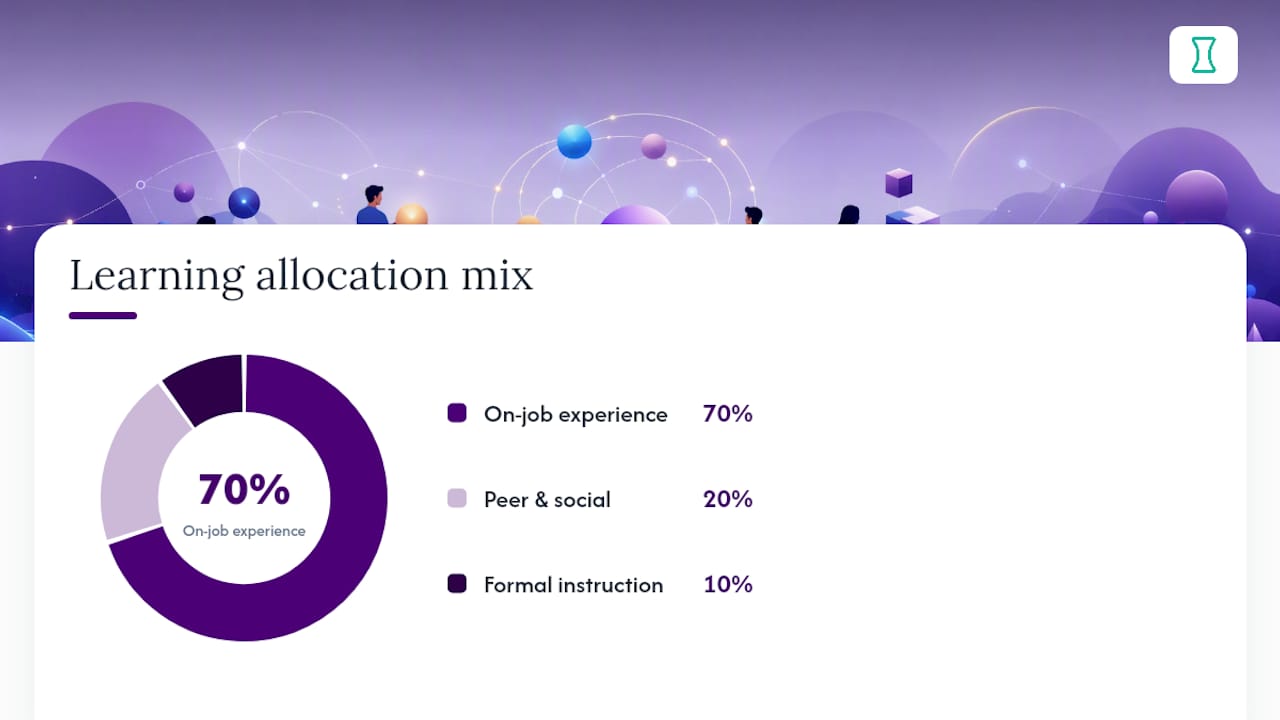
The old 70-20-10 split, roughly seventy percent on-the-job experience, twenty percent peer and social learning, ten percent formal instruction, still holds as a rough allocation guide. It’s a reminder that the practice environment and the peer conversation carry more weight than the module itself.
Update cadence should track platform and process changes, not the calendar. When a workflow tool changes, the modules touching that workflow update. Everything else stays untouched, which is the entire point of building role-based pathways as separable, modular units in the first place.
Capability Building vs. Skills Training: What’s the Real Difference?
Skills training teaches a person to execute a defined task correctly. Capability building develops the judgment to decide what to do when the situation doesn’t match the script, which is most of the time in real operational work.
The distinction shows up clearly in how each is scoped. Skills training starts from a task list: here’s how to process a return, here’s how to configure the system field. Capability building starts from a diagnosis of the operational outcome the business needs and works backward to what judgment has to develop to get there. One produces a checklist. The other produces someone who can handle the exception the checklist didn’t anticipate.
This is why L&D functions that only respond to “we need training on X” requests stay stuck at the skills layer. Functions that instead position themselves as capability architects get invited into project planning before launch, which lets them diagnose the capability gap while there’s still time to design for it rather than patch it after adoption fails.
The practical test is simple: if the training were removed, would the person still make a reasonable decision in an unfamiliar situation? Skills training rarely survives that test, because it was built around a known procedure. Capability building is built to survive exactly that test, because the practice environment was designed around ambiguity and consequence from the start, not around a fixed correct answer.
Neither replaces the other entirely. Most roles need a skills floor and a capability ceiling. The failure mode is building only the floor and calling it a program.
Why Evidence-Informed Design Beats Designer Preference
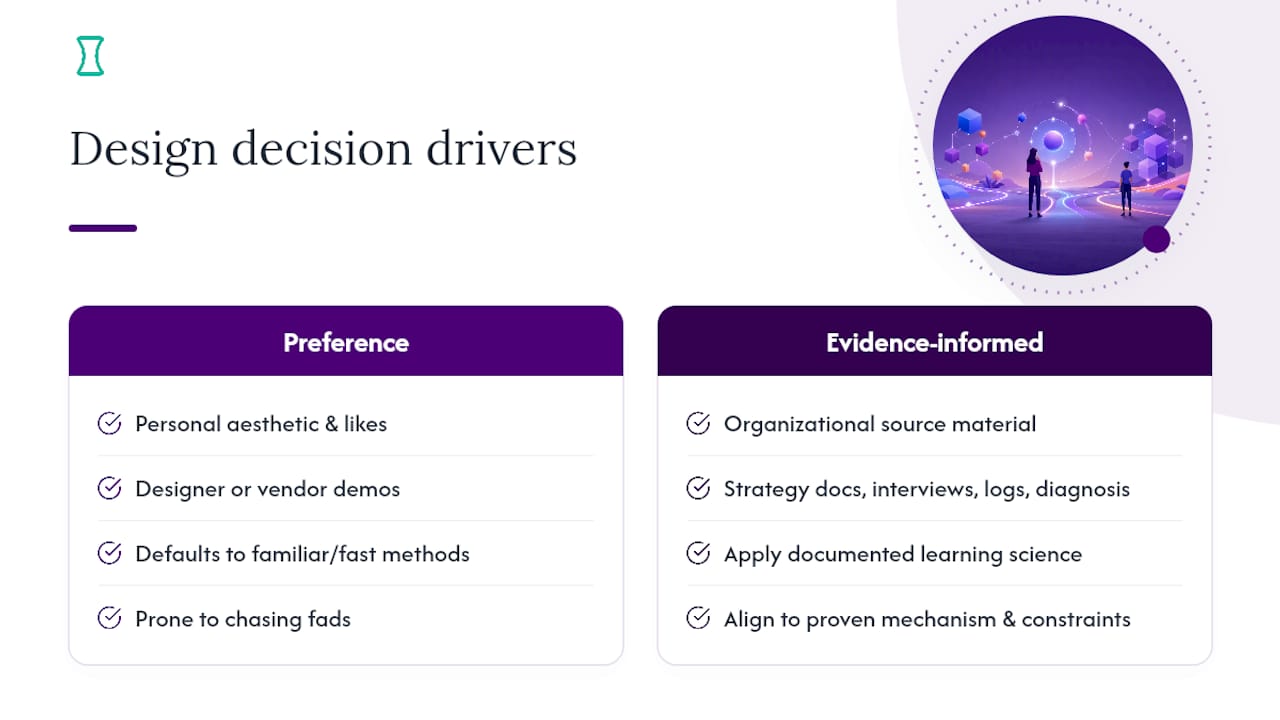
Learning design has a fad problem. New formats, new platforms, and new authoring tools cycle through enterprise L&D constantly, and a lot of program design still gets decided by what the designer personally likes rather than what the organization’s own evidence supports.
Evidence-informed design flips that order. It grounds every design decision in organizational source material: strategy documents, frontline interviews, quality escalation logs, and the specific friction points a diagnosis surfaces, rather than in a designer’s aesthetic preference or a vendor’s demo reel. The distinction between evidence-informed and evidence-based matters here too. Few enterprise learning problems have a randomized controlled trial behind them, but that doesn’t mean the design has to be a guess. It means pulling from documented learning science techniques, like spaced practice and interleaving, and applying them against the specific evidence the organization has collected.
This approach explicitly warns against chasing content fads and against defaulting to methods just because they’re familiar or fast to produce. Kogan Page’s treatment of evidence-informed learning design argues the safest guardrail against wasted spend is aligning every design choice to a proven mechanism and a documented organizational constraint, not a personal hunch about what will “engage” learners.
The design-based research model takes this further by building the evidence pipeline into the product itself. A golden triangle of practitioners, researchers, and developers working together produces tools that are validated against real use, not just shipped and hoped for. Cognistry’s evidence-based process for capability design follows the same principle: the diagnostic evidence dictates the architecture, not the other way around.
Formal, Informal, Social, and Self-Directed: Which Type Fits?
Enterprise learning happens in four distinct modes, and most organizations over-invest in exactly one of them.
Formal learning is the structured, scheduled program: a course, a certification path, a facilitated workshop. It’s necessary for foundational knowledge that everyone needs at the same baseline, but it’s also the mode most enterprises default to even when it’s the wrong fit for the outcome.
Informal learning happens at the point of work, often unplanned. Someone hits a problem, searches for an answer, or asks a colleague, and that moment of resolution is itself a learning event. Embedded workflow learning is the deliberate design of these moments, placing guidance exactly where the friction occurs instead of hoping the formal course covered it months earlier.
Social learning runs through peer interaction, mentoring, and observation of how experienced colleagues actually handle ambiguity. This is where a lot of judgment genuinely develops, because peers model the exception-handling that formal content can’t fully script.
Self-directed learning puts the employee in control of pace and sequence, often pulling from a resource library or practice environment on their own initiative. It works best when the underlying architecture is modular enough that people can find the specific piece relevant to their immediate problem, rather than sitting through an entire path to reach it.
The mistake isn’t choosing one mode. It’s assuming formal learning alone covers the job. A capability architecture blends all four deliberately, using the diagnostic evidence to decide which mode fits which part of the gap, rather than defaulting to whichever mode is easiest for L&D to produce.
What Drives Engagement in a Learning Experience?
Motivation problems in enterprise learning are usually diagnosis failures wearing a disguise. When a program feels irrelevant, it’s often because it was built against a topic request instead of an operational outcome the learner actually cares about.
People engage with practice that resembles a real decision they’ll face, especially when the stakes and consequences feel authentic rather than hypothetical. A decision-practice environment built from an actual quality-escalation case pulls attention in a way a generic scenario never will, because the learner recognizes the situation. That recognition is the engagement mechanism, not gamification badges or a slicker interface.
Autonomy matters too, but less than most engagement frameworks suggest. Employees don’t need to choose their own topic. They need to see, quickly, why the specific practice in front of them connects to something that will happen on the job next week. Application checkpoints that tie directly to the workflow do more for motivation than any amount of interface polish, because they remove the ambiguity about why the practice exists at all.
Manager visibility reinforces this further. When a manager references the capability program in a real work conversation, engagement rises, because the program stops being an isolated event and becomes part of how the team actually operates. That’s a governance and culture lever, not a content design lever, and it’s frequently the missing piece when a well-designed program still underperforms on participation.
Where Do Technology and Digital Tools Actually Help?
Technology’s job in a learning experience is to make the diagnosis, the practice, and the measurement possible at scale, not to make content look impressive.
AI-guided authoring tools speed up the translation from diagnostic evidence into structured content, but they don’t replace the diagnosis itself. A tool that generates a course from a topic prompt still skips the step that determines whether a course was the right answer in the first place. The platforms worth evaluating are the ones that support the capability signal mapping step, connecting organizational evidence to design decisions, rather than the ones that only accelerate content production.
Decision-practice environments and behavioral telemetry are where digital tools add the most genuine value, because they make two things possible that formal content alone can’t: safe rehearsal of high-stakes judgment, and observable data on how someone actually performed in that rehearsal. That telemetry becomes the evidence base for measuring whether the program worked, closing the loop between design and outcome.
Learning should also get built alongside the platform rollout it supports, not after adoption has already stalled. Enterprise strategy increasingly treats capability development and technology deployment as a single coordinated effort rather than sequential projects, because waiting until after go-live to address the capability gap usually means the gap has already cost adoption momentum. Cognistry’s platform, spanning Forge for architecture and Sim for practice, is built around that same coordination.
Designing for Different Learners and Accessibility Needs
A single-format learning path fails a meaningful portion of any workforce, and it usually fails them silently, showing up as low engagement or poor transfer rather than an explicit complaint.
Diverse learning needs aren’t primarily about visual versus auditory preference, a framework with weak evidentiary support. They’re about pace, prior experience, language, and physical or cognitive access to the material. A frontline employee with five years of tenure and a brand-new hire need different entry points into the same capability gap, even when the target outcome is identical.
Modular design, again, is the practical answer here. When foundational content is separated from role-specific practice, a learner can enter at the module that matches their existing proficiency instead of sitting through material they’ve already mastered. That alone does more for engagement than most stated accessibility accommodations, because it removes friction before it starts.
Formal accessibility standards, screen-reader compatibility, captioning, adjustable pacing, and alternative input methods, remain non-negotiable baseline requirements for any enterprise platform, and they should be checked at the platform level rather than reauthored per module. Beyond compliance, the deeper design principle is flexibility in how someone demonstrates the target behavior. A decision-practice scenario can accommodate different response formats without changing what judgment it’s actually testing, and that flexibility matters more for real accessibility than surface-level content variation.
How Does Organizational Culture Shape Learning Outcomes?
The same program, deployed identically, produces different results in different organizations, and culture is usually the variable that explains the gap.
An organization where managers actively reference capability programs in team meetings sees higher completion and transfer than one where the program exists only in an LMS notification. Leader visibility signals that the capability actually matters to how work gets evaluated, and employees calibrate their effort against that signal more than against the content itself.
Psychological safety plays a specific role in decision-practice environments. If employees fear that a poor choice in a simulation will be held against them in a performance review, they’ll play it safe rather than rehearse the genuinely hard judgment calls the simulation was designed to surface. The environment has to be explicitly separated from evaluation for the practice to produce honest behavior.
Organizations with a strong blame culture around errors also tend to suppress the frontline friction data that diagnosis depends on. If reporting a mistake carries career risk, the quality metrics feeding the diagnostic process will be incomplete or sanitized, and the resulting capability architecture gets built on a distorted picture of where the real gaps are. Fixing that reporting culture is sometimes the actual prerequisite to designing an effective learning experience at all, ahead of any content decision.
How Should Feedback Loops Improve Learning Design Over Time?
A capability architecture is never finished. It’s a system that should get more accurate about the organization’s actual gaps every cycle, and that only happens if feedback flows back into the design, not just to the learner.
Behavioral telemetry from practice environments is the first feedback loop: it shows which scenarios people struggle with consistently, which is often a better signal for where to revise content than a satisfaction survey. Manager observation on the live job is the second, confirming or contradicting whether strong simulation performance actually predicts strong real-world performance.
The third loop runs back to the original diagnosis. If quality metrics or frontline friction points shift after a program launches, that’s a signal to revisit the architecture, not wait for an annual review cycle. Practical diagnostics that capture the required business outcome, the observable success behaviors, current friction points, and where practice can be safely simulated give L&D a repeatable frame for re-checking all four whenever the operating environment changes.
This is also where the design-based research posture pays off over time. Treating design as a collaborative, evidence-checked process from the start, rather than a one-time build, makes each revision cycle faster because the evidence pipeline already exists. Organizations that skip this and treat launch as the finish line end up rebuilding from scratch every time the underlying work changes, which is precisely the rework modular design and continuous feedback are meant to prevent.
A Learning Experience Engineer’s View on Diagnosis
A stakeholder walks in asking for a course. The real conversation starts by asking what changes on the floor if the course works, and more often than expected, the honest answer reveals the gap isn’t knowledge at all. It’s a broken handoff between two systems, or a decision nobody has actually been authorized to make.
That’s the reframe worth insisting on every time: turn “build us a course” into a scoped enablement play tied to a named operational outcome. It’s an uncomfortable conversation in the room, because it delays the thing the stakeholder came in wanting. But it’s the only version of the conversation that produces something measurable six months later.
The Learning Experience Engineer’s real contribution isn’t authoring content faster. It’s holding the line on evidence before design starts, and staying accountable to the measurement gate after launch, so nobody mistakes a completion rate for a capability gain.
— Brian
How Cognistry Supports Diagnosis-First Capability Building
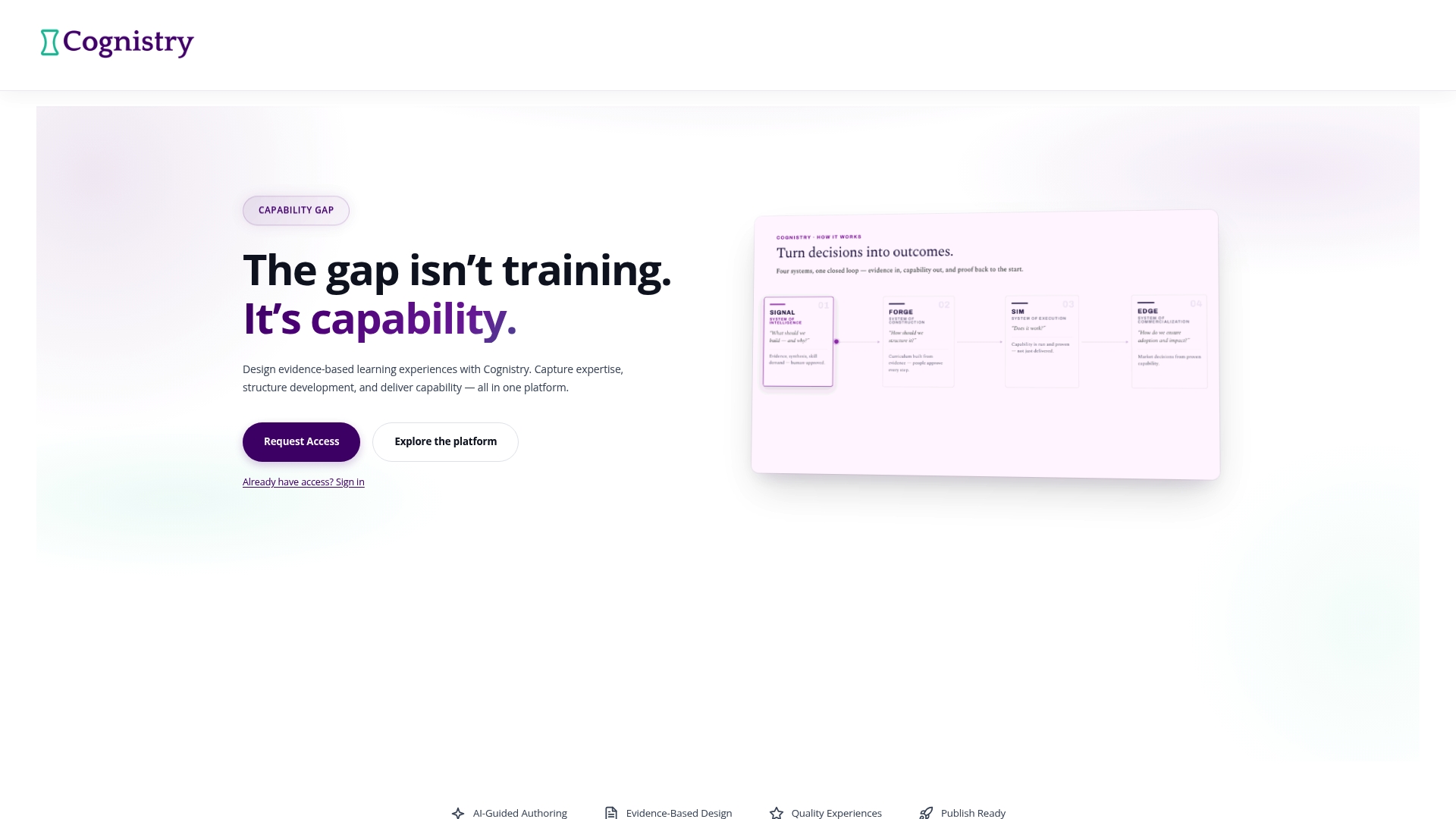
Cognistry is the platform built for the diagnosis before the design decision, not after it. Where most tools start with an authoring canvas, Cognistry starts by mapping the capability signal: what the strategy requires, where frontline friction actually sits, and what the organization’s own quality data says about the gap. Forge turns that evidence into a learning architecture built around role outcomes. Sim then builds the decision-practice environment where people rehearse the judgment the job actually demands, with behavioral telemetry feeding straight back into the measurement gate.
If your team is fielding “build us a course” requests faster than you can diagnose whether a course is even the right answer, that’s the exact gap Cognistry closes. Explore scalable expertise development for L&D leaders to see how the diagnosis-first workflow scopes an enablement play before a single module gets built, or request a demo to walk through a live capability signal map against your own evidence.
Sources
- Capability vs. Skills Training
- How capability building can power transformation
- Evidence-Informed Learning Design
- Design-based research bridge between academia and edtech (doctoral thesis)
FAQ
What Is the Difference Between a Learning Experience and a Course?
A course delivers content on a schedule. A learning experience is a capability architecture that diagnoses the operational need first, then builds practice and application checkpoints tied directly to role outcomes.
How Do You Know if a Performance Gap Needs Training?
Compare the gap against process, tooling, and governance first. If people understand what to do but still can’t execute, the gap usually isn’t a training problem at all.
What Role Does Practice Play in Building Capability?
Practice under realistic constraints is what develops judgment, since proven techniques like interleaving and testing transfer to the job far better than passive content recall.
How Does Cognistry Fit Into This Process?
Cognistry diagnoses the capability gap using organizational evidence, then uses Forge to structure the learning architecture and Sim to build the decision-practice environment, measuring outcomes back to business impact.
What Percentage of Employees Need to Engage for a Capability Program to Stick?
Engaging around a quarter of the target population is often cited as the tipping point where a new behavior becomes the cultural norm rather than an exception.