Workflow Learning for L&D Leaders: A Diagnosis-First Guide
Workflow learning is an enablement play that delivers just-in-time guidance inside the work context, so people get what they need at the moment they need it without stopping to take a course. Before you build a single asset, make one decision: is this gap caused by missing knowledge, or by friction in the environment? That answer determines everything.
Quick fit check — pilot workflow learning now if you can answer yes to all three:
- The task happens frequently enough that people encounter it at least weekly.
- Errors or delays in that task have a visible operational cost (rework, support tickets, customer complaints).
- People have a baseline understanding of the work; they need guidance, not foundational instruction.
Pro Tip: Anchor your first assets to the moment of need, not to a course catalog. An asset buried inside an LMS module is not workflow learning. It is a course with a shorter runtime.
Table of Contents
- Why this approach moves the performance needle
- How to diagnose whether workflow learning is the right enablement play
- How to design and deliver a minimal pilot
- Which tools actually enable workflow learning?
- How to measure whether workflow learning is working
- Common mistakes that sink workflow learning initiatives
- How Cognistry applies a diagnosis-first approach to workflow learning
- Key Takeaways
- The shift most L&D teams are not ready for
- Cognistry supports the full diagnosis-to-pilot cycle
- Useful sources
Why this approach moves the performance needle
The business case for learning in the flow of work rests on three measurable outcomes: faster time-to-competence, fewer errors, and lower training cost per task. Learning Guild research documents pilots where time-to-proficiency dropped significantly when performance support was embedded directly in the work context rather than delivered as a pre-work course.
The adoption driver is structural. Josh Bersin’s foundational analysis identified that employees have very limited time available for formal learning each week, which makes any approach that requires them to stop work and attend training a losing proposition for high-frequency tasks. Embedding guidance in the platforms people already use helps remove that friction.
Core metrics to define before your pilot:
- Time-to-competence: — how long from first exposure to independent task completion at the target quality standard.
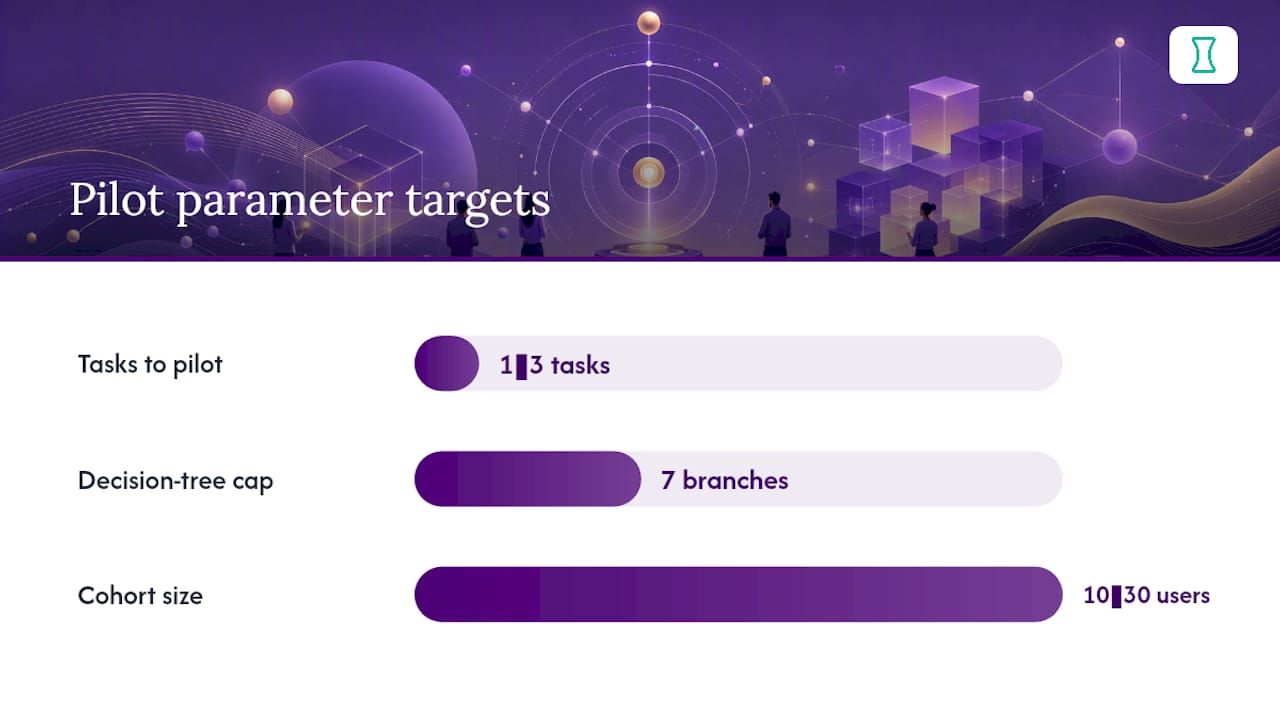
A realistic pilot timeline runs 30–90 days. In the first 30 days, establish your baseline on all five metrics and deploy assets to a small cohort (10–30 people). Days 31–60 focus on usage telemetry and qualitative feedback from frontline managers. By day 90, you have enough data to compare error rates and task completion times against the baseline and make a scale decision.
Statistic to anchor your business case: Learning Guild reports that AI-driven coaches and embedded performance support in workflow learning pilots have produced measurable reductions in onboarding time and error rates across multiple organizations.
How to diagnose whether workflow learning is the right enablement play
ATD’s guidance is direct: start with evidence from the business before you decide on a response. Quality findings, support tickets, frontline friction reports, and time-to-complete data are your diagnostic inputs. The question is whether the gap is caused by a missing skill or by friction in the environment.
Diagnostic questions to classify the root cause:
- Do people know what to do but struggle with how to do it in this specific context? (Environment friction. Workflow learning fits.)
- Are errors concentrated in a specific step or decision point, not spread across the whole task? (Friction. Workflow learning fits.)
- Is the task performed frequently, with low-to-moderate consequences for a single error? (Workflow learning fits.)
- Does the person lack foundational knowledge of the domain entirely? (Capability gap. Formal training first.)
- Is the task performed rarely (quarterly or less) with high consequences for error? (Formal training or certification, not workflow learning.)
- Is there a regulatory or legal certification requirement tied to this task? (Formal training required regardless of frequency.)
The 5 Moments of Need framework maps these triggers precisely: people need support when they are doing something for the first time, when they need to remember how, when something changes, when something goes wrong, and when they need to apply judgment to a new situation. Workflow learning is most powerful for moments two through five. Moment one almost always requires instruction.
Pro Tip: Use your support ticket data as a proxy for moments of need. If the same three questions appear in your helpdesk queue every week, those are your first three workflow learning assets. You already have the evidence. Build to it.
How to design and deliver a minimal pilot
Design starts with the workflow, not the content. Map the task end-to-end, identify where people slow down or make errors, and define what “just enough” guidance looks like at each friction point. The Cambridge research confirms that person-centric design, grounded in the actual context of the task, outperforms content-centric design in both adoption and retention.
Minimal pilot plan:
- Select 1–3 tasks that meet the diagnostic criteria: high frequency, visible error cost, baseline capability present.
- Define moments of need for each task. Where does the person pause, search, or make a mistake?
- Assign a content owner for each asset. This person is responsible for accuracy and updates, not L&D alone.
- Set authoring targets. Each asset should be completable in under two minutes. Decision trees cap at seven branches. Job aids fit on one screen without scrolling.
- Embed the trigger. The asset must appear where the person is working, not in a separate system they have to navigate to.
- Define success metrics before launch. Agree on baseline values for error rate and task completion time.
- Run the pilot for 30–60 days with a cohort of 10–30 users. Collect telemetry and manager observations weekly.
- Iterate based on usage data. Low adoption on a specific asset usually signals a trigger problem, not a content problem.
- Present findings to stakeholders at day 60. Show the delta on your agreed metrics, not completion rates.
- Scale to additional tasks only after the pilot shows measurable improvement on at least two metrics.
Authoring checklist for each asset:
- Length: under two minutes to consume or complete.
- Single task or decision point per asset. No bundling.
- Clear next action at the end (what does the person do immediately after?).
- Named content owner and review date visible in the governance record.
- Tested by at least one frontline user before deployment.
For integration planning, Real Studios’ service integration examples illustrate how learning assets can be embedded in core operational systems rather than hosted in standalone platforms.
Which tools actually enable workflow learning?
Tool selection follows diagnosis, not the other way around. The right question is not “which platform should we buy?” but “where do our people experience friction, and what tool can surface guidance at that exact point?”
Tool types and their primary use cases:
- Electronic performance support systems (EPSS): deliver contextual job aids and decision trees inside enterprise applications. Best for complex, multi-step processes.
- Digital adoption platforms (DAPs): overlay guidance on existing software interfaces. Strong for software onboarding and process changes.
- Knowledge bases with strong search: serve self-directed lookup. Effective when people know they need help and can articulate what they are looking for.
- In-app guidance and tooltips: lightweight, low-friction support for software tasks. Fast to author, easy to update.
- Conversational assistants: useful for judgment-heavy tasks where the person needs to describe a situation and get a tailored response.
- Lightweight simulation engines: for decision practice in high-stakes, high-frequency tasks where passive guidance is insufficient.
Vendor evaluation criteria:
- Trigger fidelity: can the tool surface the right asset at the right moment without manual navigation?
- Authoring velocity: how long does it take to create, update, and publish a single asset?
- Governance and QA: does the platform support content ownership, review cycles, and expiration flags?
- Telemetry: can you see which assets are used, when, and by whom, without building a custom report?
- Integration: does it connect to the systems where work actually happens (CRM, ERP, ticketing)?
The red flag to avoid: TD.org’s analysis is explicit that placing microlearning in a catalog or making courses available on mobile is not workflow learning. If the person has to leave their work context to find the guidance, the design has failed. For teams evaluating LMS alternatives that better support embedded performance support, the key criterion is whether the platform can push content to the moment of need rather than waiting for the learner to pull it.
Pro Tip: Before committing to a tool, run a proof-of-concept against your three highest-priority moments of need. Can the tool surface the right asset in under ten seconds from the point of friction? If not, the trigger architecture is wrong regardless of the feature list.
How to measure whether workflow learning is working
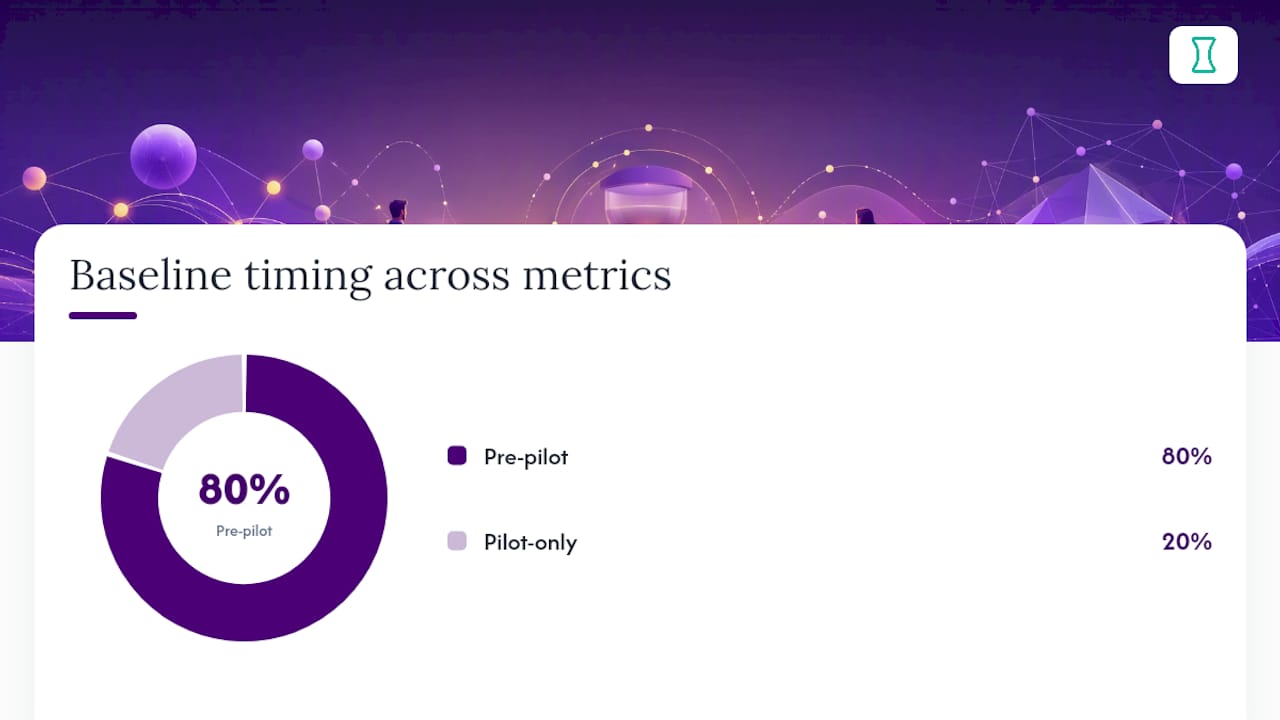
Measurement starts before deployment. If you do not have a baseline, you cannot prove a delta. Agree on your metrics with business stakeholders before the pilot launches, not after.
| Metric | Data source | Baseline timing | Pilot target |
|---|---|---|---|
| Time-to-competence | Manager observation, task records | Pre-pilot (2 weeks) | Directional reduction by day 60 |
| Error rate | Quality findings, support tickets | Pre-pilot (4 weeks) | Directional reduction by day 60 |
| Task completion time | System logs, time-tracking | Pre-pilot (2 weeks) | Directional reduction by day 60 |
| Asset adoption rate | Platform telemetry | N/A (pilot only) | A majority of eligible users by day 30 |
| Frontline confidence | Pulse survey | Pre-pilot | Directional increase by day 60 |
Quantitative telemetry alone is not enough. Triangulate with qualitative evidence: manager observations of task performance, frontline feedback on asset usefulness, and subject-matter expert review of whether the guidance is still current. SAP’s analysis links embedded, accessible on-demand learning to measurable engagement and productivity improvements, but notes that curation and currency are prerequisites for those gains.
Move away from completion-based metrics entirely. A 100% completion rate on an asset that did not reduce errors is a vanity number. The question is whether the task got better. For teams building a more rigorous measurement architecture, content analytics tools can support iterative evidence collection and reporting across pilot cohorts.
Common mistakes that sink workflow learning initiatives
Most workflow learning pilots fail for one of three reasons: they build before they diagnose, they confuse digital access with embedded support, or they publish assets and never update them.
Mistakes and their corrective actions:
- “We’ll digitize everything.” Prioritize by task frequency and error cost. Build the three highest-impact assets first.
- “We put it in the LMS.” An LMS is not a workflow learning platform. Assets must live where the work happens.
- “No one owns the content.” Assign a named business-side content owner for every asset before publishing. L&D governs the process; the business owns the accuracy.
- “We measured completions.” Switch to operational metrics: error rate, task completion time, support ticket volume.
- “We launched to everyone at once.” Pilot with a small cohort first. Scale only after you have evidence.
- “The assets are six months old and no one updated them.” Set a maximum review cycle of 90 days for high-frequency task assets. Outdated guidance destroys trust faster than no guidance.
Red flags that should pause your pilot:
- No executive sponsor who can remove IT or process barriers.
- No baseline data on the target task’s error rate or completion time.
- Assets are already out of date before the pilot ends.
- Frontline users report that the guidance does not match how the work actually happens.
“Practitioners must treat workflow learning assets as living products: continuous evidence gathering, frontline feedback, and frequent updates are essential to maintain trust and impact.” — Learning Guild
Quick fixes for the first 30 days:
- Audit your three pilot assets against the current process. Fix anything that does not match.
- Set a calendar reminder for the content owner’s 90-day review.
- Add a one-question feedback prompt to each asset: “Did this help you complete the task?”
- Share usage data with frontline managers weekly so they can reinforce the assets in context.
How Cognistry applies a diagnosis-first approach to workflow learning
Most organizations skip directly to building. Cognistry starts earlier. The sequence is: capture evidence, diagnose the capability gap, decide on the right enablement play, design the response, and measure outcomes back to the business. Workflow learning assets are the downstream result of that process, not the starting point.
The Cognistry workflow in practice:
- Evidence capture: strategy documents, quality findings, frontline friction reports, and subject-matter expertise are mapped to identify where capability gaps are causing operational drag. This is what closing a capability gap actually requires before any asset is built.
- Capability diagnosis: the evidence determines whether the gap is a knowledge problem, an environment problem, or a decision-making problem. Each has a different response.
- Design of the response: for environment and friction gaps, Cognistry structures just-in-time assets and decision-centered practice environments. For foundational gaps, formal learning comes first.
- Measurement: telemetry and quality assurance gates track whether the response moved the operational metrics that were defined before the build.
Organizations that follow this sequence typically see cleaner outcomes: fewer repeat support tickets on the target task, faster decision cycles in the relevant process, and clearer ownership of content currency across the business.
When to involve a capability-engineering partner:
- You have a performance gap with visible business cost but no clear diagnosis of the cause.
- Your L&D team has the authoring capacity but lacks the diagnostic framework to decide what to build.
- You need to prove the value of a workflow learning pilot to an executive sponsor before scaling.
Pro Tip: Ask your capability-engineering partner for a discovery artifact before any build begins. That artifact should show the evidence that justifies the design, not just a list of planned assets. If the partner cannot show you the diagnosis, the build is guesswork.
Key Takeaways
Workflow learning works when it is grounded in diagnosis first: identify the friction, confirm the task fits, build the minimum asset, and measure the operational outcome before scaling.
| Point | Details |
|---|---|
| Diagnose before you build | Confirm whether the gap is environmental friction or a foundational capability gap before designing any asset. |
| Pick the right pilot tasks | Select tasks that are high-frequency, have a visible error cost, and where people already have baseline capability. |
| Measure operational outcomes | Track error rate, task completion time, and time-to-competence, not course completions. |
| Govern content currency | Assign a named business-side content owner and set a 90-day maximum review cycle for every asset. |
| Cognistry’s role | Cognistry runs the diagnosis-to-pilot cycle: evidence capture, capability diagnosis, asset design, and outcome measurement, so organizations build what the work actually requires. |
The shift most L&D teams are not ready for
The hardest part of adopting workflow learning is not the technology. It is the mindset. Most L&D teams are organized around course production. Their credibility is measured in modules launched, hours delivered, and completion rates reported. Workflow learning asks them to give up all three as primary metrics and replace them with operational outcomes they do not fully control.
That is a real organizational risk, and pretending otherwise does not help anyone. The teams that make this shift successfully do one thing differently: they get a business sponsor to co-own the measurement before the pilot launches. Not a learning sponsor. A business sponsor who cares whether the error rate on a specific task goes down. When that person is in the room, the conversation about what success looks like changes entirely.
The other thing that surprises most practitioners is how fast adoption happens when the asset is genuinely embedded. Not linked from an email. Not housed in a portal. Embedded. When people find guidance at the exact moment they need it, without navigating away from their work, usage rates are dramatically higher than anything a course catalog has ever produced. That is not a technology story. It is a design story. The technology just makes the placement possible.
Cognistry supports the full diagnosis-to-pilot cycle
Before your team builds another asset, consider whether you have diagnosed the gap. Cognistry’s capability engineering platform runs the full sequence: evidence capture from your own organizational sources, capability diagnosis to determine the right enablement play, and structured authoring through Cognistry Forge to build decision-centered practice environments and just-in-time assets that are grounded in what the work actually requires.
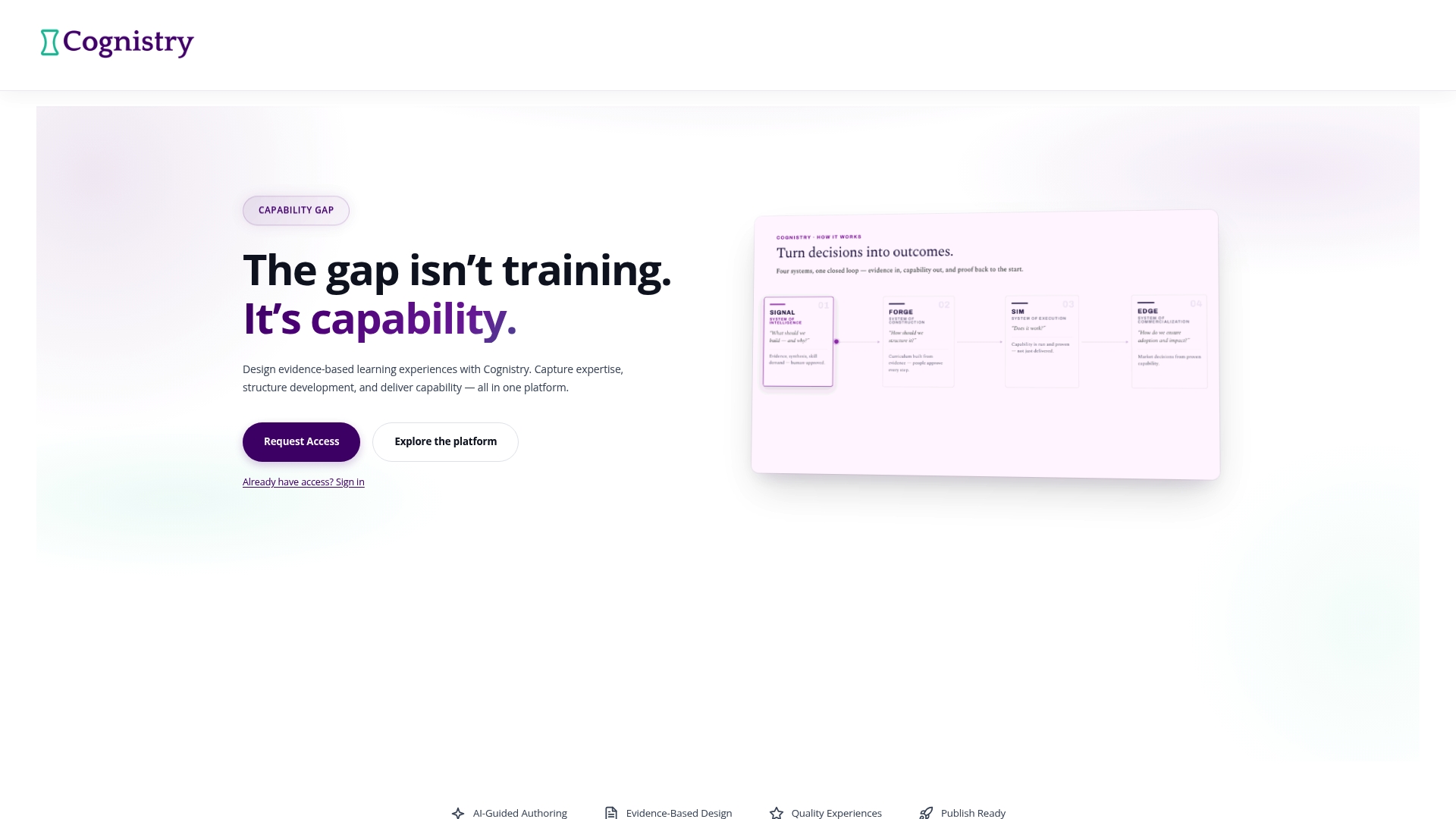
A discovery engagement with Cognistry produces three artifacts: an evidence map showing where capability gaps are causing operational drag, a pilot scope defining the 1–3 tasks with the strongest case for workflow learning, and a measurement plan agreed with your business sponsor before any asset is built. That is the diagnostic foundation most organizations skip.
If you are ready to run a diagnosis-first pilot, request a demo and see how Cognistry structures the evidence before the build.
Useful sources
The following sources informed this article and are worth reading in full for teams building a business case or designing their first pilot.
- True Impact: Measurable Performance Gains with Workflow Learning - Learning Guild
- Workflow Learning Has a Mistaken Identity - TD.org
- Learning in the flow of work: Designing person-centric learning experiences with just-in-time microlearning - Cambridge
- A new paradigm for corporate training: Learning in the flow of work - Josh Bersin
- Learning in the flow of work: A more engaging learner experience | SAP
- Workflow Learning: The Four Fundamental Principles - 5 Moments of Need Blog
- Learning in the Flow of Work: When Is It Right for Your Organization? - ATD / TD Blog