
Organizations do not have a learning problem. They have a capability problem. And the metric that exposes it is time to competence.
1. The Hidden Failure of Learning Metrics
Most organizations measure learning success through activity:
- Courses completed
- Modules finished
- Certifications earned
These metrics are easy to track. But they do not measure performance.
They answer:
“Did people go through training?”
They do not answer:
“Can people perform when it matters?”
This is the gap.
The system records completion.
The business needs capability.
This misalignment is exactly why organizations struggle to translate learning into performance.
2. The Metric That Actually Matters
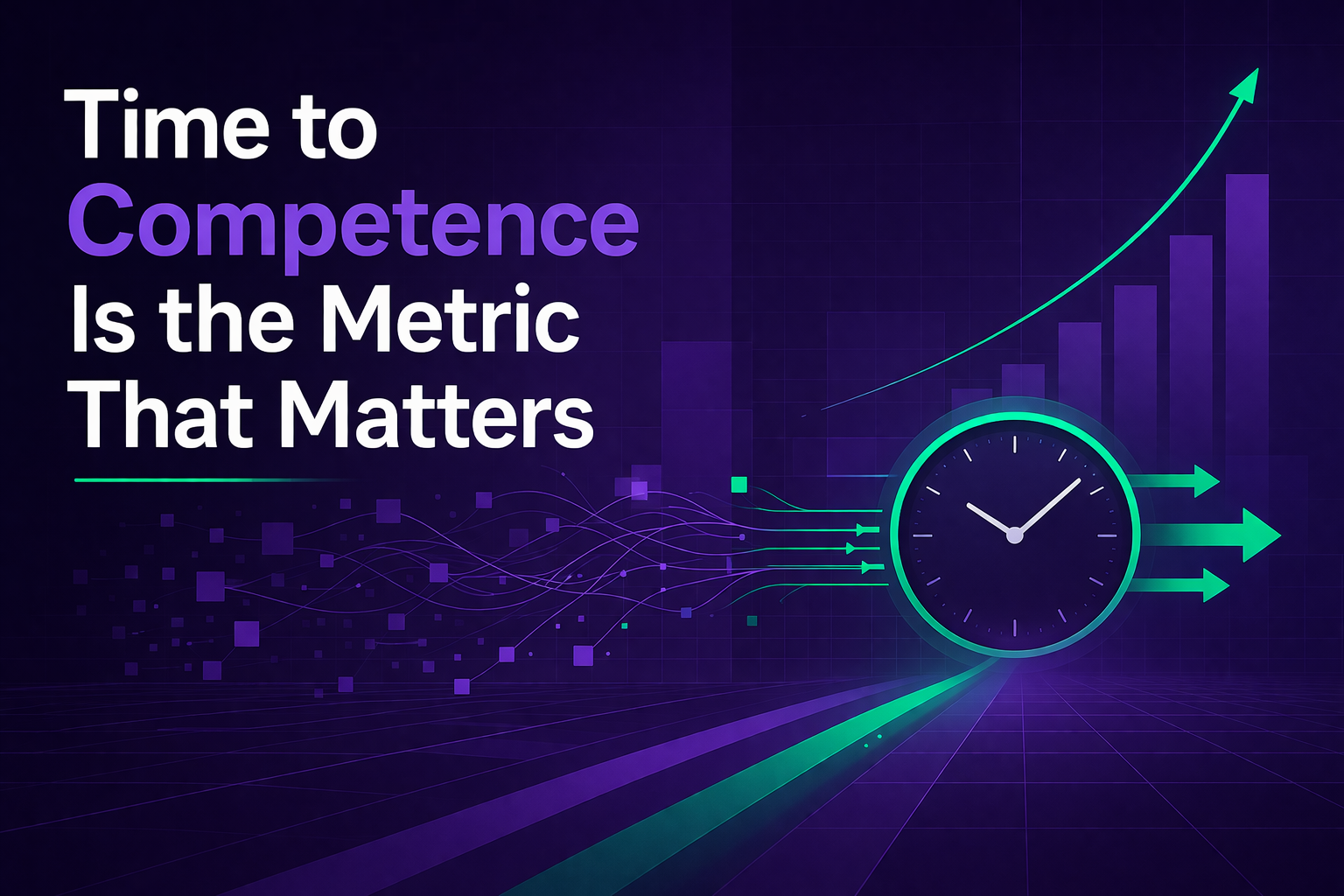
The metric that matters is time to competence.
Definition:
The time it takes for someone to perform effectively under real conditions, without supervision.
This is a capability metric—not a learning metric.
It captures:
- Speed to independent performance
- Quality of decision-making
- Ability to operate under constraint
Capability, by definition, is the ability to perform—not just to know.
3. Where Data Drag Becomes Visible
This is where Data Drag shows up.
Organizations have:
- More content
- More tools
- More data
- More AI outputs
But employees still take months to perform independently.
Why?
Because information is not capability.
Data Drag is the friction between:
- what the organization knows
- and what people can actually do
It becomes visible in one place:
Time to competence is too long.
- New hires ramp slowly
- Experienced employees hesitate under pressure
- Decisions are inconsistent
- Performance varies widely
Training is complete.
Capability is not.
4. AI Raises the Standard
AI is not just a productivity tool. It is a performance multiplier.
That changes expectations:
- Faster ramp times
- Higher decision quality
- Greater consistency at scale
Organizations can no longer accept:
- 90-day ramp cycles
- trial-and-error decision making
- uneven execution across teams
AI Leadership requires a shift:
From measuring activity → to measuring outcomes
From tracking learning → to building capability
5. Why Traditional Systems Fail
Traditional learning systems are built to deliver content.
They:
- push information
- track completion
- optimize engagement
They do not:
- structure decision-making
- simulate real conditions
- prove performance under constraint
As a result, organizations cannot answer a simple question:
“Did this actually work?”
They measure completion because they cannot measure capability.
6. Cognistry: Reducing Time to Competence
Cognistry is designed to solve this problem directly.
It is not a content system.
It is a capability system.
The platform aligns to a simple progression:
Signal → Forge → Sim → Edge
- Signal defines what capability is needed
- Forge structures how it is built
- Sim proves whether it works
- Edge connects capability to real performance
This is a complete system for developing and validating capability—not just delivering training.
At the core is a simple principle:
Capability is formed through decision interactions.
- Interaction → Experience → Simulation → Capability
Repeated exposure to realistic decisions builds judgment.
Judgment reduces hesitation.
Reduced hesitation shortens time to competence.
7. The Shift Organizations Must Make
Organizations need to change how they measure success.
From:
- Completion rates
- Content consumption
- Engagement metrics
To:
- Time to competence
- Decision accuracy
- Performance under constraint
Because that is where value is created.
8. What Changes When You Measure the Right Thing
When organizations adopt time to competence as the primary metric:
- Training becomes capability design
- Content becomes decision environments
- Learning systems become performance systems
Most importantly:
Capability becomes measurable, provable, and improvable.
Closing
Completion is easy to measure.
Capability is harder.
But only one drives performance.
Time to competence is the metric that matters.