
Use Case · Strategy & Transformation
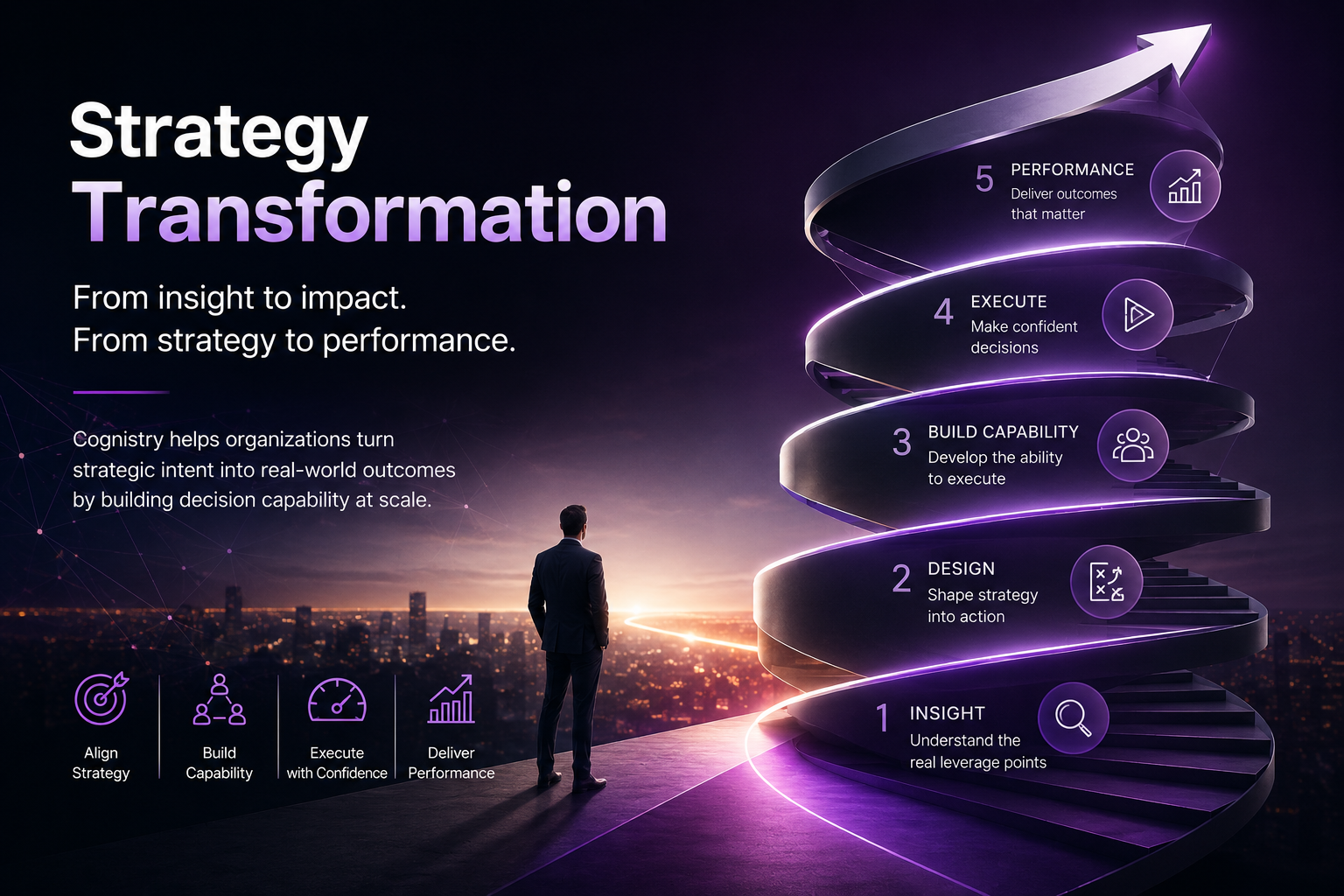
Turn strategy into the capabilities people actually adopt.
Cognistry reads your strategy and operating-model changes, infers the behaviors they require, and builds the practice that makes adoption real — measured in changed behavior, not course completion.
Here's the new operating model, the board deck, and the first two quarters of change plans.
Reading them together. I'll pull out what people have to do differently — not just what changes on paper.
Strategy evidence
Operating model shift — intake
- Strategy documents 14 ingested
- Leader interviews 6 transcribed
- Behavior shifts 19 extracted
- Hidden assumptions 3 flagged
Where is this going to stall?
Mapping required behaviors against how the work runs today. Three groups carry most of the risk.
Adoption gap
Behaviors → roles → risk
- Behavior shifts 19 mapped
- Roles affected 7 identified
- High-risk groups 3 flagged
- Ready today 4 of 19
Give people somewhere to try this before it's live.
Building decision scenarios from the real moments the new model creates.
Practice design
Rehearsal set — quarter one
- Decision scenarios 8 drafted
- Sourced from Live change moments
- Difficulty Graded by role
- Time to first run 2 weeks
Show the steering committee what actually moved.
Assembling adoption evidence — decisions made, where judgment held, where it still slips.
Adoption evidence
Quarter one — change readiness
- Behavior change signal done
- Role-level readiness done
- Residual risk register running
- Steering brief queued
A transformation lead and Cognistry read the strategy for the behaviors it requires, map where adoption will stall, build rehearsal scenarios for the new operating model, and assemble evidence of real behavior change.
Regional teams now share global accounts. Nobody here has run it this way.
The hard part isn't the org chart — it's who decides when two regions promise the same customer different things.
Change moment
Regional → global accounts
- New decision rights 5 undefined
- Conflict points 3 predicted
- Roles in scope 240 people
- Live date 9 weeks out
Put a regional director in the moment and see what they do.
Scenario running: two regions, one customer, conflicting delivery promises.
Practice run
Contested commitment — attempt 1
- Escalated too late 62% of runs
- Named an owner 31%
- Second attempt 74% escalate on time
- Coaching flag Escalation timing
Are we ready to switch this on?
Readiness by role, with the two groups that still need another cycle.
Readiness
Go-live readiness — global accounts
- Regional directors done
- Account leads done
- Delivery managers running
- Support escalation queued
A transformation lead and Cognistry work a live change moment — regional teams moving to shared global accounts — naming the new decision rights, rehearsing a contested commitment, and sealing role-by-role go-live readiness.
accelerate change
The challenge
- The strategy is clear on paper but not in how people actually work
- Change initiatives stall because people aren’t equipped to act differently
- Capability and skill plans aren’t tied to the strategy they’re meant to deliver
- Adoption gets measured by completion, not by changed behavior
How Cognistry works
Capture how experts interpret and act on AI outputs, then turn that into structured decision practice.
- Capture how teams use AI in real workflows
- Structure AI-assisted decisions into realistic scenarios
- Simulate when to trust, question, or override AI
What changes
AI becomes part of real decision-making—not just output generation.
- Teams make better decisions using AI
- Higher ROI from AI investments
- Reduced risk from poor AI usage
- AI adoption that actually changes performance
Real scenarios
Teams practice how to use AI in real decision moments.
- Interpreting AI-generated recommendations
- Deciding when to trust vs override AI outputs
- Using AI in time-sensitive decisions
- Applying AI insights to real business situations
Where decision capability breaks
Most organizations don’t have a knowledge problem. They have a decision execution problem.
- Expertise exists—but isn’t applied consistently
- Training exists—but doesn’t transfer to real work
- Tools exist—but don’t improve judgment
This is Data Drag: the gap between what teams know and how they actually perform.
How Cognistry builds decision capability
Capture → Structure → Practice → Prove
See how Cognistry can structure capability across your organization
Explore the platform, review the product realms, or talk with the team about your roadmap.
Start with Signal, continue through Forge and Sim, and connect development to operational performance.