How to Design Learning Pathways That Build Real Capability
A learning pathway is a deliberately sequenced set of learning experiences that moves a learner from their current capability to a defined, testable outcome. Before you build anything, run this three-step check:
- Diagnose the capability need. Identify what the work actually requires, not just what a manager requested.
- Map a minimal pathway. Sequence only the experiences that close the gap between current and required capability.
- Set one milestone and one assessment. Define how you will know the learner is ready to progress before you add more content.
This article follows a diagnosis-first approach throughout. The question is never “what course should we build?” It is “is learning the right enablement play at all?” Once you have that answer, the design work that follows becomes faster, cheaper, and far more likely to produce a measurable result.
Key Takeaways
Effective learning pathways design starts with a diagnosis, not a course build: confirm the capability gap is real, sequence experiences from Connect through Practice with Feedback, set milestone gates, and measure transfer back to business signals.
| Point | Details |
|---|---|
| Diagnose before you build | Confirm learning is the right enablement play by collecting performance metrics, frontline friction data, and strategy alignment evidence. |
| Use the three-stage model | Structure every milestone around Connect, Acquire, and Practice with Feedback to build capability progressively and support diverse learners. |
| Set milestone gates | Break pathways into 5–10 hour stages with a defined pass standard at each gate; add bypass tests for experienced learners. |
| Pilot before full rollout | Run a 2–4 week pilot with 8–15 learners and collect formative pass rates plus at least one transfer indicator before scaling. |
| Measure beyond completion | Track learning metrics, transfer indicators, and business KPIs at 30, 60, and 90 days post-launch to connect the pathway to real outcomes. |
| Cognistry’s approach | Cognistry structures the full design arc from capability diagnosis through decision practice and business measurement, starting before the first learning object is built. |
Table of Contents
- What is learning pathways design and why does it matter?
- Core stages: Connect, Acquire, and Practice with Feedback
- Common pathway types and how design changes by use case
- Step-by-step design process: Plan, Build, and Implement
- Sequencing, pacing, and a sample week-by-week pathway template
- Diagnosis first: deciding when learning is the right enablement play
- How to measure pathway success beyond completion rates
- Quick-reference design checklist and pitfalls to avoid
- What most pathway designers get wrong from the start
- How Cognistry supports capability-first pathway design
- Sources
- FAQ
What is learning pathways design and why does it matter?
The core benefits are practical, not theoretical.
- Faster time to proficiency. Role-based pathways that sequence content logically reduce the time a learner spends confused or repeating material they already know. Learning pathway research consistently points to progressive sequencing as the primary driver of this effect.
- Alignment to outcomes. When every activity maps to a defined behavioral outcome, managers can see what “done” looks like and L&D can defend the design with evidence.
- Inclusion and accessibility. Pathways that include low-stakes entry activities surface prior knowledge and give non-traditional learners a foothold before the harder content arrives.
- Clearer milestones for managers. A pathway with explicit stage gates gives managers a shared language for readiness, not just a completion percentage.
Use cases where pathways pay off most:
- Onboarding. New hires need a structured progression from orientation to independent performance. A pathway prevents the common failure mode where onboarding dumps information without building judgment.
- Compliance and certification. Mandatory content with a defined pass standard and a hard deadline is a natural fit for a gated pathway with formative practice before the summative assessment.
- Role-based upskilling. When a team needs to move from one level of capability to the next, a pathway with milestone assessments makes progress visible and measurable.
- Reskilling. Career transitions require scaffolded exposure to new domains. A pathway prevents learners from being dropped into advanced content before they have the foundations.
- K–12 integrated progression. Integrated Learning Pathways in K–12 contexts use cumulative, competency-based progressions across grade bands. The same logic applies to enterprise role ladders.
The diagnosis-first principle matters here because not every gap is a learning gap. If the problem is a broken process, missing tools, or unclear expectations, a pathway will not fix it. Confirming that learning is the right enablement play before building saves the organization from investing in content that cannot move the needle.
Core stages: Connect, Acquire, and Practice with Feedback
Every effective pathway runs through three stages. These are not phases of a project; they are the repeating unit of design within each milestone of the pathway.
| Stage | What it accomplishes | Example activities |
|---|---|---|
| Connect | Activates prior knowledge, surfaces experience, and motivates the learner to engage with new content | Reflection prompts, pre-assessments, case vignettes, discussion questions, scenario previews |
| Acquire | Delivers new knowledge or skill through structured exposure | Short video explainers, readings, worked examples, expert walkthroughs, annotated job aids |
| Practice with Feedback | Builds fluency and prepares learners for transfer through low-stakes repetition with corrective feedback | Branching scenarios, decision simulations, role-play exercises, quizzes with explanations, peer review tasks |
The Trefny Center’s learning pathways framework describes this three-stage model as the foundation for inclusive, scaffolded design. Connect activities are especially valuable for non-traditional learners because they explicitly surface prior experience, making the pathway accessible before the acquisition content begins.
Mapping a course learning outcome (CLO) to the three stages:
Say the CLO is: “Given a customer complaint scenario, the learner will select the correct escalation path and document the decision rationale.”
- Connect: A short case vignette showing a mishandled complaint. Learners discuss what went wrong before seeing the correct process.
- Acquire: A 12-minute explainer on the escalation policy, a job aid with the decision tree, and two worked examples with annotated reasoning.
- Practice with Feedback: Three branching scenarios where the learner chooses an escalation path. Each wrong choice triggers a consequence and an explanation. A final scenario with no hints serves as the formative checkpoint.
- Assessment: A graded simulation with a new complaint scenario. The rubric scores both the decision and the written rationale.
Formative practice before the summative assessment is not optional padding. It is the mechanism that produces transfer. Skipping it produces completion data, not capability.
Pro Tip: Design the Practice with Feedback stage first. If you cannot describe what a learner will do to demonstrate the outcome, you do not yet have a clear enough CLO to build anything else.
Common pathway types and how design changes by use case
Pathway shape is not one-size-fits-all. The type of outcome, the risk profile, and the learner population all change what a well-designed pathway looks like.
-
Role-based onboarding pathways. Typically several weeks in duration. Sequencing is mandatory and linear for the first half, then branching by role specialization. Assessment style: milestone checkpoints with manager sign-off at key gates. Stakeholder requirement: HR and the hiring manager must agree on the “ready to perform independently” standard before the pathway is built.
-
Skill micro-pathways. Short, often lasting a few hours. Designed for a single, discrete skill. Optional and self-directed in most cases. Assessment: a single performance task or scenario. These work well as supplements to longer pathways or as just-in-time resources.
-
Compliance and certification pathways. Non-negotiable sequencing. Every module is mandatory. Summative assessment with a defined pass score and a retake policy. Stakeholder requirement: legal or compliance team must approve the pass standard and the content. Adaptive sequencing is rarely worth the cost here because the content is fixed by regulation.
-
Career progression pathways. Long, often spanning multiple months. Structured as a series of milestones, each with its own Connect/Acquire/Practice cycle. Assessment style: portfolio evidence, observed performance, and manager assessment. These pathways require the most governance because they cross multiple stakeholder groups.
-
K–12 integrated pathways. Competency-based and cumulative across grade bands. The Digital Promise / ERIC framework describes these as complementary to disciplinary learning, consistent across classrooms, and designed with “I can” statements that make progression visible to students and teachers alike. Enterprise L&D can borrow this logic directly for role ladders.
Practical implications for designers:
- Short pathways (under 5 hours) can be fully mandatory. Long pathways need optional extension activities to maintain engagement without forcing everyone through content they do not need.
- Compliance pathways require a documented retake policy before launch, not after the first failure.
- Adaptive sequencing, where the platform adjusts the learner’s route based on prior performance, is worth the cost only when the learner population is large enough and varied enough to justify the configuration work. For a cohort of 20, a well-sequenced linear pathway with bypass tests is usually faster to build and easier to maintain.
Step-by-step design process: Plan, Build, and Implement
The Hyring learning pathway guide and the Digital Promise co-design framework both converge on a three-phase process. Here is how to run it.
Phase 1: Plan
- Define the destination. Write the behavioral outcome in observable terms. “Understands the policy” is not an outcome. “Applies the policy correctly in three out of three novel scenarios” is.
- Gather organizational evidence. Collect frontline friction points, quality findings, strategy documents, and subject-matter expert input. This is the evidence base that justifies the pathway design.
- Define learner personas. Who is the learner on day one? What do they already know? What environment are they working in? Personas prevent you from designing for an imaginary average learner.
- Map prerequisites and milestones. List what a learner must already be able to do before entering the pathway. Then break the destination outcome into 3–5 milestones, each with its own observable standard.
Phase 2: Build
- Curate content by format. Mix modalities: short video for concepts, job aids for reference, scenarios for practice, and peer discussion for sense-making. Research on learning journey design supports blending spaced learning, on-the-job practice, and structured feedback rather than relying on a single format.
- Create practice with feedback. For each milestone, build at least two low-stakes practice tasks before the assessment gate.
- Set assessment and bypass rules. Define the pass standard for each milestone gate. Add a bypass test for learners who can demonstrate the outcome without completing the full pathway.
- Accessibility and inclusion checklist:
- All video content has accurate captions.
- All images have descriptive alt text.
- Scenarios include diverse characters and contexts.
- Connect activities surface prior experience explicitly, not just prior course completion.
- Learners have at least one choice point per milestone (format, sequence, or extension activity).
Phase 3: Implement
- Run a structured pilot. Select 8–15 learners who represent the real population. Measure completion rate, time on task, formative pass rates, and at least one on-the-job transfer indicator. Run the pilot for 2–4 weeks before full rollout.
- Stakeholder roles:
- Subject-matter experts: validate content accuracy and scenario realism.
- Managers: confirm the milestone standards reflect actual job performance.
- Learners: provide usability and relevance feedback during the pilot.
- L&D lead: owns sequencing decisions and assessment design.
- Rollout timeline: Stagger cohorts if the pathway is long. Do not launch to the full population until pilot data confirms the formative pass rates and transfer indicators are moving in the right direction.
- Continuous improvement: Review pathway data at 30, 60, and 90 days post-launch. Update content that generates high error rates or low engagement. Treat the pathway map as a living document.
Pilot plan template (minimum viable):
- Duration: 2–4 weeks
- Cohort size: 8–15 learners
- Metrics to collect: completion rate per milestone, formative assessment pass rate, time on task per module, one manager observation or on-the-job task check
- Decision gate: if formative pass rate is below 70% at any milestone, revise before full rollout
Sequencing, pacing, and a sample week-by-week pathway template
Good sequencing is not about covering everything. It is about covering the right things in the right order, with enough space between exposures for the learning to consolidate.
Sequencing rules:
- Break long pathways into stages of 5–10 hours each, with a clear assessment gate between stages. This is a practical rule from Hyring’s pathway design guidance that keeps momentum and makes measurement actionable.
- Mix modalities within each stage. A stage that is entirely video-based will lose learners by week two.
- Use spaced repetition: revisit key concepts at least once after the initial acquisition, ideally in a new context or scenario.
- Add bypass tests at the start of each stage so experienced learners can skip content they already know.
- Keep individual learning objects under 15 minutes. Longer objects should be chunked into shorter segments with a reflection or practice task between them.
Sample 6-week role-based onboarding pathway:
| Week | Milestone | Activities | Assessment |
|---|---|---|---|
| 1 | Orientation and context | Connect: team intro, role overview video, “what I already know” reflection. Acquire: company strategy doc, role job aid. Practice: 2 scenario previews | Formative quiz (no grade) |
| 2 | Core process knowledge | Connect: common error case study. Acquire: process walkthrough video, annotated workflow. Practice: 3 decision scenarios with feedback | Milestone 1 gate: 70% pass on scenario set |
| 3 | Tool proficiency | Connect: “where do you get stuck?” self-assessment. Acquire: tool demo, reference guide. Practice: guided task in sandbox environment | Observed task completion with manager |
| 4 | Applied judgment | Connect: peer discussion on edge cases. Acquire: expert interview recording, decision framework. Practice: 4 branching scenarios, increasing complexity | Milestone 2 gate: scenario assessment |
| 5 | On-the-job application | Supervised real-work tasks with debrief. Peer observation and feedback. | Manager checklist: 3 observed tasks |
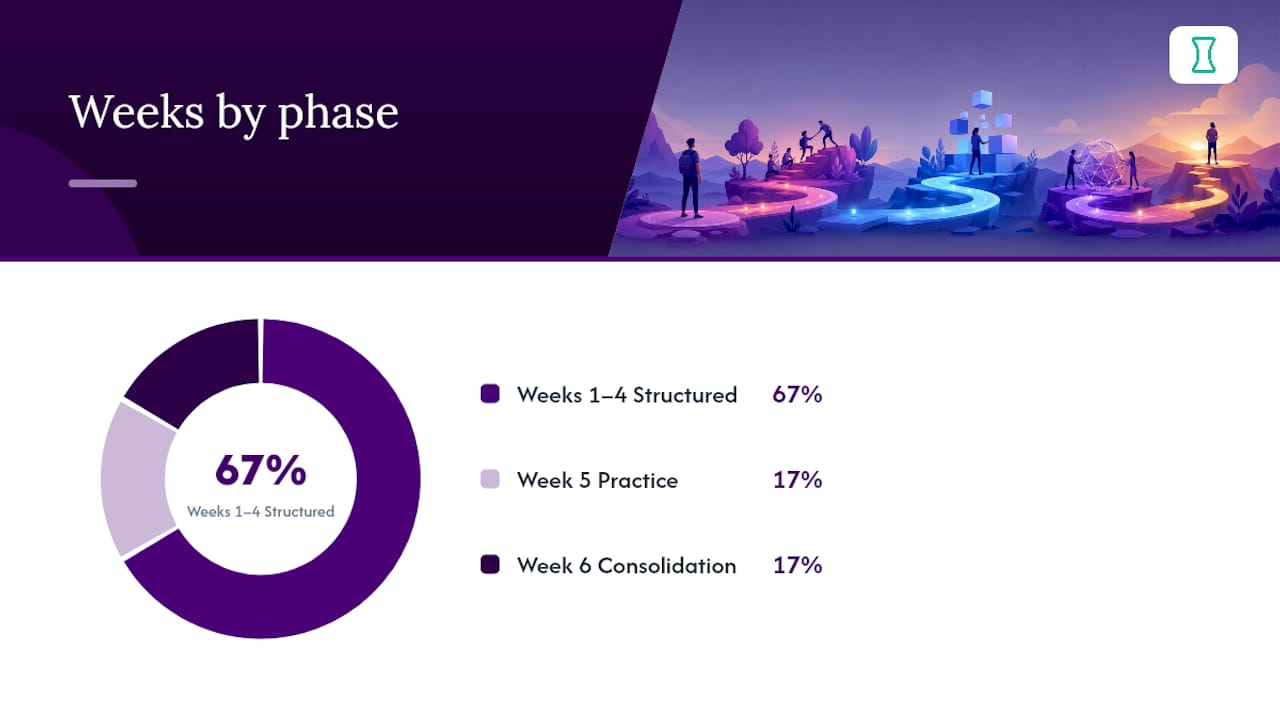
| 6 | Consolidation and transfer | Reflection on progress. Extension activity (optional advanced scenario). | Summative assessment: novel scenario + written rationale |
Weeks 1–4 are primarily structured learning. Week 5 shifts to supervised practice in the real environment. Week 6 consolidates and confirms transfer. This pattern, drawn from The Training Associates’ learning journey blueprint, reflects the principle that behavior change requires on-the-job practice, not just course completion.
Pro Tip: Place your lowest-stakes formative practice at the end of Week 1, not Week 2. Learners who get feedback early are more likely to stay engaged through the harder content that follows.
Diagnosis first: deciding when learning is the right enablement play
Most pathway design failures start before the first slide is built. A team identifies a performance gap, assumes it is a knowledge gap, and commissions a course. The course launches. The gap persists. The real cause was a broken process, unclear expectations, or a tool that did not work.
Cognistry’s capability engineering approach starts with a different question: what does the work actually require, and is learning the right response? This is the diagnosis-first frame, and it changes what gets built.
Diagnosis checklist: evidence to collect before designing anything
- Frontline friction points. Where do people slow down, make errors, or escalate unnecessarily? These are signals of a capability gap or an environment gap.
- Strategy alignment. Does the capability gap connect to a business priority? If not, the pathway will not get the stakeholder support it needs to succeed.
- Performance metrics. What does the data show? Cycle time, error rate, quality scores, and conversion rates are all potential signals of a capability problem.
- Environment factors. Is the gap caused by missing tools, unclear processes, or poor feedback loops? If so, learning is not the right enablement play.
Decision flow: build learning or not?
If the evidence shows that people lack the knowledge or judgment to perform the task, and the environment supports performance when they have it, then a learning pathway is the right response. If the evidence shows that people know what to do but cannot do it because of environment factors, fix the environment first. A pathway built on top of a broken process will not produce the outcome you measured for.
The capability gap framework makes this distinction concrete: person gaps respond to learning; environment gaps respond to process, tool, or feedback changes. Conflating the two is the most common and most expensive mistake in L&D.

Pro Tip: Before you write a single learning objective, collect three pieces of organizational evidence: one performance metric showing the gap, one frontline account of where the friction occurs, and one subject-matter expert description of what “good” looks like. If you cannot collect all three, you are not ready to design.
How to measure pathway success beyond completion rates
Completion is a proxy metric. It tells you the learner finished the pathway. It does not tell you whether they can do the job better. Effective measurement requires three layers.
Layer 1: Leading learning metrics
- Progress through milestones (are learners advancing at the expected pace?)
- Practice attempt rates (are learners engaging with the formative tasks, or skipping them?)
- Formative pass rates per milestone (where are learners struggling before the summative gate?)
- Time on task per module (outliers in either direction signal a content problem)
Layer 2: Transfer metrics
- On-the-job task completion rates (observed or manager-reported)
- Decision accuracy in real scenarios (tracked through QA outputs or supervisor checklists)
- Error rate reduction in the target process
- Time to independent performance for new hires
Layer 3: Business KPIs
- Cycle time for the process the pathway targets
- Quality scores or defect rates
- Conversion rates (for sales or customer-facing roles)
- Escalation rates (for service or compliance roles)
The Training Associates’ learning journey research argues that measurement beyond satisfaction scores is what separates a learning pathway from a training event. The pathway is the vehicle; the business outcome is the destination.
Data sources to build into your measurement plan:
- LMS or LXP telemetry for learning metrics
- Manager observation checklists for transfer metrics
- Frontline QA outputs for quality and error data
- Performance dashboards for business KPIs
AI-assisted analytics can accelerate pattern detection, flagging drop-off points and low-engagement modules before a full cohort completes the pathway. But human validation and stakeholder alignment remain mandatory before you act on those signals. An algorithm that flags Week 3 as a drop-off point cannot tell you whether the content is wrong or the learners are simply busy.
Measurement cadence:
- During pilot: weekly check on formative pass rates and time on task.
- 30 days post-launch: review completion and transfer metrics with managers.
- 60–90 days post-launch: pull business KPI data and compare to pre-pathway baseline.
The future of learning platforms is moving toward integrated dashboards that connect learning telemetry to operational performance data. Until that infrastructure is in place, a shared spreadsheet with agreed metrics and a monthly review meeting will do the job.
Quick-reference design checklist and pitfalls to avoid
Design checklist
- Collect organizational evidence (performance metrics, frontline friction, strategy alignment).
- Confirm learning is the right enablement play.
- Write the behavioral outcome in observable terms.
- Map prerequisites and define 3–5 milestones.
- Design Connect, Acquire, and Practice activities for each milestone.
- Set assessment gates with defined pass standards.
- Add bypass tests for experienced learners.
- Complete the accessibility checklist (captions, alt text, diverse scenarios, choice points).
- Run a 2–4 week pilot with 8–15 learners.
- Collect formative pass rates and at least one transfer indicator before full rollout.
- Review pathway data at 30, 60, and 90 days post-launch.
Common pitfalls and fixes
- No assessment gates. Without gates, learners advance regardless of readiness. Fix: add a milestone assessment with a defined pass standard and a retake path.
- Chunks that are too long. A 45-minute module with no interaction loses most learners by minute 20. Fix: break anything over 15 minutes into segments with a practice task between them.
- Everything is mandatory. Making every activity mandatory signals distrust and kills engagement. Fix: identify the non-negotiable core and make everything else optional or extension.
- Ignoring accessibility. A pathway without captions or alt text excludes a portion of your learner population before they start. Fix: run the accessibility checklist in Phase 2, not after launch.
- No bypass option. Forcing experienced learners through content they already know wastes their time and generates resentment. Fix: add a pre-assessment or bypass test at the start of each stage.
Stakeholder roles: who owns what
Governance failures are a leading cause of pathway abandonment. Clarify ownership before the build phase begins.
- L&D designer: owns sequencing, assessment design, and the overall pathway architecture.
- Subject-matter expert: validates content accuracy and scenario realism. Does not own sequencing decisions.
- Manager: confirms milestone standards reflect real job performance. Signs off on the transfer assessment criteria.
- Learner representative: provides usability feedback during the pilot. Should be involved in persona development.
Common tool misalignments and governance failures often trace back to unclear ownership at the build stage. When the subject-matter expert starts making sequencing decisions and the designer defers, the pathway loses its structural logic and becomes a content dump with a progress bar.
What most pathway designers get wrong from the start
The conventional wisdom in L&D is that a good pathway starts with a needs assessment. That framing is not wrong, but it is incomplete in a way that costs organizations real money.
A needs assessment typically asks: “What do learners need to know?” A diagnosis-first approach asks something harder: “What does the work require, and is a gap in knowledge or judgment actually the cause of the performance problem?” Those are different questions, and they produce different answers.
The distinction matters because most organizations have a bias toward building. A manager reports a problem, L&D commissions a course, and the course gets built before anyone has confirmed that knowledge is the bottleneck. The pathway launches, completion rates look fine, and the performance problem persists. Then L&D gets blamed for building something that did not work, when the real failure was in the diagnosis.
The smallest pathway that proves transfer is worth more than the most comprehensive pathway that proves completion. A six-week onboarding program with a Week 5 on-the-job task and a manager observation tells you something real. A six-week program with a final quiz tells you the learner can recall information under low-stakes conditions. Those are not the same thing, and treating them as equivalent is how L&D loses credibility with the business.
The learning experience engineer’s role is shifting precisely because organizations are starting to demand the former. The designers who will matter in the next five years are the ones who can connect a pathway milestone to a business signal, not just a learning objective.
How Cognistry supports capability-first pathway design
Most pathway design tools start at the build phase. Cognistry starts earlier.
Cognistry’s Forge is built for the full design arc: capture expert knowledge, structure evidence-based pathways, build decision practice environments, and measure transfer back to business signals. The diagnosis-first frame is not a consulting add-on; it is built into the platform’s architecture.
Three reasons this matters for designers working through the process described in this article:
- Diagnosis before build. Cognistry’s Signal capability mapping helps teams collect and structure organizational evidence before a single learning object is created, so the pathway is grounded in real performance data.
- Decision-centered practice. Where most authoring tools produce knowledge checks, Cognistry builds decision practice environments that develop operational judgment, the kind of capability that transfers to the job.
- Measurement tied to business outcomes. Cognistry connects learning telemetry to operational performance data, so the 30/60/90-day review described in this article has real numbers behind it, not just completion percentages.
If you are ready to move from pathway planning to pathway building with a platform that measures what actually matters, explore Cognistry’s overview or request a demo of Forge to see how the diagnosis-first approach works in practice.
Sources
FAQ
What does a learning pathway look like?
A learning pathway is a sequenced map of learning experiences, each building on the last, organized around milestones with defined pass standards. A typical pathway includes Connect activities to activate prior knowledge, Acquire content to deliver new skills or information, Practice with Feedback tasks to build fluency, and assessment gates that confirm readiness before the learner advances.
What are learning pathways?
Learning pathways are structured sequences of learning experiences designed to move a learner from their current capability to a defined, testable outcome. They differ from single training events by combining spaced learning, on-the-job practice, and measurement across multiple stages.
What are the five principles of instructional design?
Definitions vary across frameworks, but a widely applied set includes: align every activity to a measurable outcome, sequence content from foundational to complex, provide practice before assessment, give corrective feedback at each stage, and measure transfer to the real work environment, not just knowledge recall.
What are the five stages of the learning process?
A common model describes five stages: awareness (recognizing the need to learn), acquisition (taking in new knowledge or skill), application (attempting the skill in a low-stakes context), consolidation (reinforcing through spaced practice), and transfer (performing reliably in the real work environment). Pathway design maps directly onto this progression, with Connect activities supporting awareness, Acquire content supporting acquisition, and Practice with Feedback spanning application through consolidation.
How does Cognistry support learning pathway design?
Cognistry starts with capability diagnosis before any pathway is built, using organizational evidence to confirm that learning is the right enablement play. Its Forge platform then structures pathways with decision practice environments and connects learning telemetry to business performance data, so designers can measure transfer, not just completion.