
Scenario-Based Training: L&D Design and Implementation Guide
Scenario-based training (SBT) is a decision-focused learning method that places learners inside realistic situations to practice judgment before those situations occur on the job. Where a lecture transfers information and a drill repeats a procedure, SBT forces a choice — and then shows the learner exactly what that choice costs or earns. Organizations like those working with Cognistry and frameworks validated by the Association for Talent Development use it specifically when the performance gap is a judgment gap, not a knowledge gap. Every well-designed scenario shares three core elements:
- Context: a realistic, recognizable situation drawn from actual workplace conditions
- Choices: two to four plausible options that mirror the decisions real performers face
- Consequences: outcomes that flow naturally from each choice, making the stakes visible
Choose scenario-based training when the skill you need to build is a decision skill. If the task is procedural and the correct sequence never varies, a job aid or a checklist is faster and cheaper. When the answer depends on reading a situation, weighing competing priorities, or managing a person, a scenario is the only method that actually prepares someone to perform.
Table of Contents
- What makes scenario-based training different from traditional instruction?
- Why the evidence for scenario-based learning is hard to ignore
- Which scenario type fits your training objective?
- How to design scenarios using the 5 C’s framework
- How to script, branch, facilitate, and debrief scenarios
- How do you measure the impact of scenario-based training?
- What barriers slow down scenario programs, and how do you clear them?
- Which tools should you use to build and deliver scenarios?
- Real-world scenario-based training examples across industries
- The research and principles that explain why this works
- Key Takeaways
- The pattern most L&D teams miss when scaling scenario programs
- Cognistry builds the decision practice infrastructure your scenarios need
- Useful sources for deeper reading
What makes scenario-based training different from traditional instruction?
Traditional instruction transfers content. SBT transfers capability. That distinction shapes everything from how you write the learning objective to how you measure success.

A lecture or slide deck asks learners to receive and remember. A scenario asks them to act — and then live with the result. Cognitive science explains why that matters: contextual encoding, active retrieval, and emotional engagement each strengthen memory consolidation and transfer in ways passive exposure cannot. When a learner makes a choice inside a scenario and sees a consequence, the brain encodes the experience differently than it encodes a fact read from a slide.
Core characteristics of a high-quality scenario
- Realistic context: the setting, characters, and pressures match what learners actually encounter at work
- Plausible choices: every option could reasonably be chosen by a real professional — no obviously wrong answers
- Meaningful consequences: outcomes are proportional and naturalistic, not punitive “game over” messages
- Immediate feedback: the learner sees what their choice produced before moving forward
- Calibrated fidelity: the level of realism matches the learning goal, not the budget ceiling
A concrete example
Picture a customer service rep at a financial services firm. The scenario opens: a long-standing client calls, frustrated that a fee was charged without notice. The rep has four options — apologize and refund immediately, escalate to a supervisor, explain the fee policy and hold firm, or ask clarifying questions before responding.

Each path leads somewhere different. The immediate refund resolves the call but sets a precedent that costs the firm downstream. Escalating without asking questions frustrates the client further. Asking clarifying questions first — the high-performance choice — reveals the fee was applied in error, allowing the rep to resolve it with confidence and document the root cause. The scenario doesn’t tell the rep which choice is right. It lets them discover it, which is exactly how retention works.
Why the evidence for scenario-based learning is hard to ignore
Organizations using scenario-based learning report improved knowledge retention and application compared with traditional passive methods, according to data cited by the Association for Talent Development. That figure matters because it measures application, not just recall — the outcome L&D teams are actually accountable for.
57% better retention and application. That is the documented advantage of scenario-based learning over passive instruction, per ATD-cited research.
Beyond retention, the measurable outcomes designers should target include:
- Decision accuracy: the percentage of learners choosing the high-performance option under realistic conditions
- Time-to-decision: how quickly learners reach a sound judgment, which tracks confidence as much as competence
- Behavioral checklist scores: observed on-the-job behaviors rated against a rubric before and after training
- Completion rates: practitioner data shows 30–50% higher completion rates when organizations move from slide-based to scenario-based formats, with assessment scores improving 20–35%
For stakeholders, those numbers translate directly: fewer escalations, faster ramp-up for new hires, lower error rates in high-stakes decisions, and better customer outcomes. The business case writes itself when you connect a behavioral KPI to a cost line.
Which scenario type fits your training objective?
Scenarios are highly flexible across disciplines — from aviation and healthcare to corporate compliance — but fidelity must match the learning goal, not the production budget. Here are the main modalities and when each earns its place:
- Mini scenarios (text-based): short, single-decision vignettes embedded in eLearning modules. Low cost, fast to build, ideal for compliance and judgment-check moments. Best when the decision is discrete and the context is easy to convey in text.
- Branching eLearning: multi-path digital scenarios where choices drive outcomes and learners see consequences before looping back or advancing. Strong for complex judgment calls — sales conversations, ethical dilemmas, clinical triage. Articulate Storyline and Articulate 360 are the most widely used authoring tools for this format in the U.S. market.
- Live-action / field SBT: facilitated scenarios run in real or simulated environments. High fidelity, high facilitation demand. Used in policing, military, and technical trades where physical environment and stress response are part of the learning goal.
- Tabletop exercises: structured discussion-based scenarios, often used for crisis management, incident response, and leadership decision-making. Low cost, high engagement, but limited behavioral data capture.
- VR/immersive simulation: the highest fidelity option, placing learners inside a fully rendered environment. Justified for tasks where physical presence, spatial awareness, or stress inoculation are the actual performance requirements — surgical training, hazardous equipment operation, emergency response.
- Blended approaches: most enterprise programs combine a digital branching scenario for foundational judgment practice with a live debrief or facilitated tabletop for team-level sense-making. The digital layer scales; the live layer deepens.
The tradeoff is straightforward: fidelity costs money and facilitation time. Repeatability and data capture favor digital formats. When the learning goal is a judgment call that can be described in text, branching eLearning gives you the best return. When the body needs to be in the scenario, invest in higher fidelity.
How to design scenarios using the 5 C’s framework
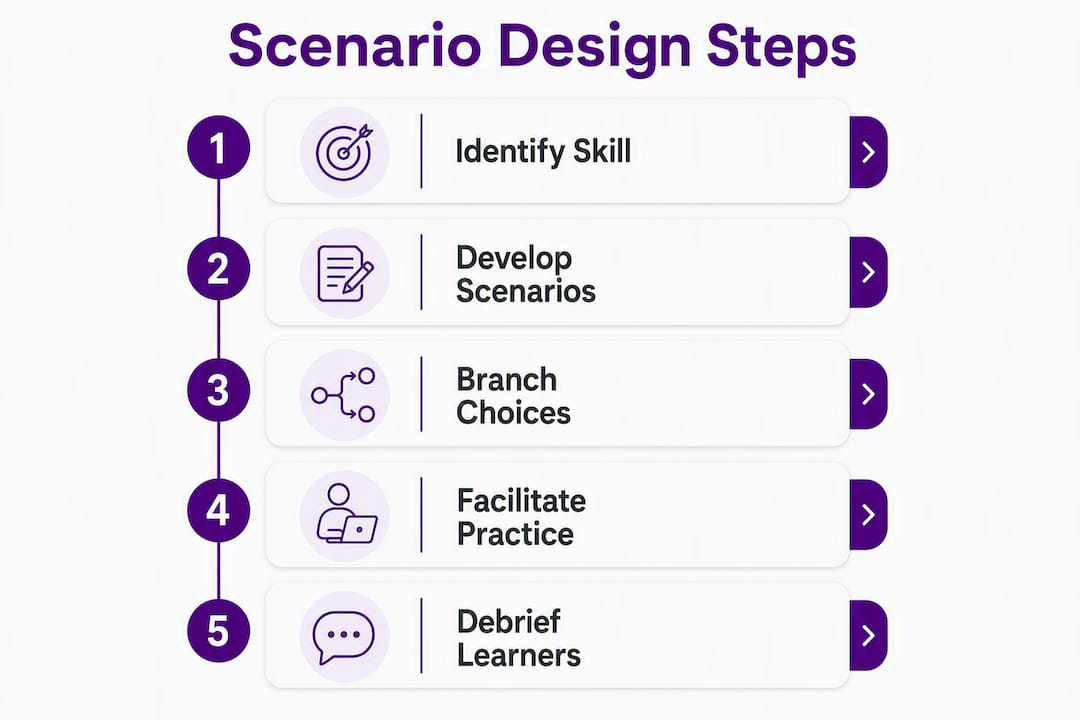
The 5 C’s framework — Context, Challenge, Choice, Consequence, Conclusion — gives designers a reproducible structure that prevents the most common authoring mistakes. Walk backward from performance first: identify the decisions that separate high performers from average ones, then build the scenario around those moments.
The 5 C’s, unpacked
- Context: Set the scene with enough detail that learners recognize the situation as real. Name the role, the relationship, the pressure, and the stakes. Avoid generic setups (“a customer calls”) in favor of specific ones (“a returning client calls three days before a contract renewal, upset about a billing discrepancy”).
- Challenge: Introduce the tension or decision trigger. This is the flashpoint — the moment where the wrong move creates downstream problems. Keep it grounded in actual workplace patterns, not dramatic edge cases.
- Choice: Offer two to four options, all of which a real professional might plausibly choose. Plausible distractors mirror common professional mistakes — they force genuine judgment rather than obvious elimination.
- Consequence: Show what each choice produces. Consequences should be naturalistic: a delayed response leads to an escalation email, not a “wrong answer” banner. Feedback that flows from choices rather than from a scoring system supports reflection and transfer.
- Conclusion: Summarize the learning point after the consequence plays out. Keep it brief and behavioral — “When a client raises a billing concern before renewal, asking a clarifying question first reduces escalation by keeping the conversation factual.”
Design checklist and timeline
- [ ] Conduct a performance analysis: identify the top three decision moments where behavior diverges
- [ ] Interview subject matter experts (SMEs) to surface the reasoning behind high-performance choices
- [ ] Draft the scenario briefing, choices, and consequence paths
- [ ] Map branching logic before scripting — sketch on paper or a whiteboard first
- [ ] Design feedback for every branch, not just the correct path
- [ ] Pilot with five to eight representative learners; observe where they pause or misread the setup
- [ ] Iterate based on pilot data; finalize and publish
Timeline estimate: a single well-designed branching scenario with three to four choice points typically requires 40–80 hours of design time from analysis through pilot, depending on SME availability and branching complexity. A full module of four to six scenarios runs 160–300 hours. Budget SME time separately — it is usually the constraint, not the authoring.
How to script, branch, facilitate, and debrief scenarios
Good scripting starts with the briefing. Give learners just enough context to feel the pressure without over-explaining the “right” answer. A briefing that telegraphs the correct choice is not a scenario — it is a quiz with extra steps.
Scripting and branching best practices
- Write the high-performance choice last when drafting options; it prevents you from unconsciously making it the most obvious
- Keep each choice to one sentence — learners should feel the decision, not read an essay
- Avoid absurd distractors; every option should be something a real professional might genuinely consider
- Map branching complexity before you write: three choice points with four options each produces 64 possible paths — collapse low-value branches early
- Track every decision in your analytics layer; the path data is as valuable as the final score
Pro Tip: Build a decision map on a whiteboard before opening your authoring tool. Seeing the full branch structure prevents you from writing yourself into dead ends and makes it easier to identify which branches share a consequence and can be merged.
Facilitation and debrief
For live or facilitated scenarios, psychological safety is the operating condition. Learners who fear judgment play it safe, which defeats the purpose. Open every session by naming the norm: this is a practice space, choices are data, not grades.
A short debrief template that works across modalities:
- What happened? Ask learners to describe the choice they made and why — no evaluation yet.
- What did you notice? Surface the cues they used (or missed) to make the decision.
- What would you do differently? Shift from reflection to intention.
- What does this mean for Monday? Connect the scenario directly to a real upcoming situation.
Keep debriefs to 15–20 minutes for a single scenario. Longer debriefs dilute focus; shorter ones skip the transfer step that makes the learning stick.
How do you measure the impact of scenario-based training?
Measurement starts before the scenario runs. Without a baseline, you cannot show change — and without change data, you cannot defend the investment.
Use the Kirkpatrick four-level framework as a scaffold, but weight your effort toward Levels 3 and 4:
- Reaction (Level 1): Did learners find the scenario realistic and relevant? A short post-scenario survey captures this. Useful for iteration, not for ROI.
- Learning (Level 2): Did decision accuracy improve? Compare pre-scenario and post-scenario scores on the same decision tasks.
- Behavior (Level 3): Are learners making better decisions on the job? Observational rubrics, manager ratings, and call/case audits measure this.
- Results (Level 4): Did business metrics move? Error rates, escalation rates, customer satisfaction scores, and time-to-competency are the right targets.
Pilot design outline
Run a pilot with 15–30 representative learners before full rollout. Collect:
- Baseline decision accuracy on a pre-scenario task (same scenario, no instruction)
- Post-scenario decision accuracy on a parallel task
- Time-to-decision at each choice point
- Behavioral checklist scores from manager observation at 30 and 60 days post-training
| Metric | Baseline | Post-Training | Target Delta |
|---|---|---|---|
| Decision accuracy (%) | Measure pre-pilot | Measure post-pilot | +15 percentage points |
| Time-to-decision (seconds) | Measure pre-pilot | Measure post-pilot | Reduction of 20–30% |
| Behavioral checklist score | Measure pre-pilot | Measure at 30 days | +1–2 rubric levels |
| Escalation rate (business KPI) | Pull from operations data | Pull at 60 days | Reduction aligned to org target |
Pro Tip: Use the same scenario as both your pre-test and your post-test instrument — just change the surface details (different client name, different product) while keeping the decision structure identical. This controls for scenario familiarity and isolates learning gain.
Pilot testing with representative learners also reveals design problems before they scale. Observe whether learners pause because the scenario is too easy or are confused by the setup — both are signals to iterate before full deployment.
What barriers slow down scenario programs, and how do you clear them?
Most scenario programs stall not because the design is wrong but because the operational model is not built to sustain them. The barriers are predictable:
- Budget: High-fidelity production costs are real, but most organizations over-invest in production and under-invest in design. A well-written text-based branching scenario outperforms a poorly designed VR experience every time.
- SME time: Subject matter experts are the source of the decision logic, but they are rarely available on demand. Solve this with structured SME interview protocols — 90-minute sessions with a prepared decision-mapping template extract more usable content than open-ended conversations.
- Facilitator inconsistency: Live scenarios depend on facilitator skill. Train-the-trainer programs with a standardized facilitation guide and a debrief rubric reduce variance significantly.
- Measurement gaps: Most programs collect reaction data and stop. Build the behavioral measurement plan before the scenario launches, not after.
- Scaling from pilot to program: A single scenario is a proof of concept. A capability program requires modular authoring templates, a governance model, and QA gates that prevent scenario quality from degrading as volume increases.
For budget planning: a small pilot (one to three scenarios, 20–30 learners) can run on $15,000–$40,000 depending on modality and facilitation costs. An enterprise rollout covering multiple roles and decision domains typically runs $150,000–$500,000 over 12–18 months, with ongoing maintenance costs factored in. Digital scenario tools can scale access, but design and measurement quality still determine whether that scale produces performance change.
Which tools should you use to build and deliver scenarios?
Tool selection follows design intent, not the other way around. Start with the decision you need to practice, then choose the tool that captures it most efficiently.
Tool categories
- Authoring tools: Articulate Storyline and Articulate 360 are the dominant U.S. market tools for branching eLearning scenarios. They support multi-path branching, variables, and SCORM/xAPI export for LMS integration. Strong for judgment-call scenarios that can be delivered digitally.
- Simulation and capability platforms: purpose-built platforms like Cognistry’s Sim environment go beyond branching slides to create decision practice environments with behavioral telemetry, capability signal mapping, and QA governance built in. The distinction matters when you need to measure decision patterns across a team, not just individual completion.
- VR/AR platforms: Unity-based and purpose-built VR authoring tools (used by enterprise simulation vendors) are appropriate when physical presence, spatial orientation, or stress response are part of the performance requirement. High cost, high fidelity, justified for a narrow set of use cases.
- LMS and analytics connectors: xAPI (Tin Can) is the standard for capturing granular scenario data — choice paths, time-on-task, branching decisions — and feeding it to an LRS or analytics dashboard. SCORM captures completion and score; xAPI captures the decision journey.
Selection criteria
- Does the tool support multi-path branching with variable tracking?
- Can it capture and export decision-level data (not just pass/fail)?
- How much authoring skill does it require, and does your team have it?
- Does it support facilitator controls for live or blended delivery?
- Can it scale to the number of learners and scenarios your program needs?
Pro Tip: When fidelity and measurement are both priorities, separate them by layer. Use a high-fidelity simulation for the practice experience and a telemetry layer (xAPI + LRS) for the data. Trying to build both into one tool usually means compromising one of them.
Simulation-driven learning is moving from a specialized technique to a standard capability-building method — which means the tools that support it are maturing fast. Evaluate them on data capture first, production features second.
Real-world scenario-based training examples across industries
Aviation: judgment under time pressure
The FAA’s Scenario-Based Training for flight schools places student pilots in realistic cross-country flight situations where weather, fuel, and ATC decisions converge. The instructor does not tell the student what to do — the scenario does. The student must read conditions, weigh options, and commit to a course of action with real consequences if the judgment is wrong. This approach targets the specific decision moments where accidents occur: not mechanical failure, but pilot judgment under pressure.
Policing and public safety: realism, stress, and debrief
Law enforcement training has used scenario-based methods for decades precisely because the gap between classroom knowledge and street-level judgment is where outcomes diverge. Practitioners in this field emphasize that scenarios must map to workplace flashpoints — the repeated, mundane decision moments where early action prevents escalation — rather than rare catastrophic events. A debrief after a use-of-force scenario that focuses on the decision cues the officer used (or missed) produces more behavior change than a debrief focused on the outcome.
Corporate: compliance and customer service
A financial services firm redesigned its anti-money-laundering compliance training from a 45-minute slide deck to a six-scenario branching module. Each scenario placed a relationship manager in a client conversation where red flags appeared gradually. Learners had to decide when to ask follow-up questions, when to escalate, and when to document. The behavioral outcome: a measurable increase in suspicious activity reports filed within 30 days of training, tracked against a pre-training baseline. The scenario format made the stakes visible in a way the slide deck never did.
The research and principles that explain why this works
Three cognitive mechanisms explain SBT’s performance advantage over passive instruction. Contextual encoding means the brain stores information more durably when it is tied to a specific situation and a decision. Active retrieval — the act of choosing and committing — strengthens memory consolidation more than re-reading. Emotional engagement, even mild stress from a realistic scenario, focuses attention and signals to the brain that this information matters.
A common design mistake is labeling a trainer’s preferred drill as a scenario. A true scenario maps to workplace decision flashpoints, not theatrical performance. The distinction is not semantic — it determines whether the training produces behavior change or just engagement.
“Well-structured scenarios promote accountability by linking actions to outcomes; they make learners see that their choices matter in ways a slide deck cannot.” — CloudAssess, 5 C’s Framework
Cognistry’s approach operationalizes these principles through capability signal mapping, which identifies the specific decision moments where performance diverges, and behavioral telemetry, which tracks whether those decisions improve after training. The result is a decision practice environment grounded in evidence, not assumption. For L&D teams building the case internally, the ATD-cited 57% improvement in retention and application, as well as 30–50% completion rate gains, give you the numbers stakeholders respond to.
Key Takeaways
Scenario-based training produces measurable behavior change when it targets real decision flashpoints, uses the 5 C’s design structure, and measures outcomes at the behavioral level, not just completion.
| Point | Details |
|---|---|
| Target decision flashpoints | Build scenarios around the repeated judgment moments where performance diverges, not rare dramatic events. |
| Use the 5 C’s framework | Context, Challenge, Choice, Consequence, and Conclusion give every scenario a reproducible, learning-effective structure. |
| Measure behavior, not completion | Track decision accuracy, time-to-decision, and on-the-job behavioral scores before and after training. |
| Pilot before you scale | Run 15–30 learners through a pilot, collect baseline and post-training data, and iterate before enterprise rollout. |
| Cognistry for decision practice | Cognistry’s platform combines simulation authoring, capability signal mapping, and behavioral telemetry to build and measure scenario programs at scale. |
The pattern most L&D teams miss when scaling scenario programs
Most organizations treat scenario-based training as an event. A module gets built, deployed, and checked off. Six months later, the behavior data shows partial improvement, and the team debates whether to build another module or try a different format.
The problem is not the scenario. It is the model.
Scenario programs that actually shift organizational capability treat decision practice as ongoing, not episodic. The best-performing teams we see build scenario libraries — not one-off modules — and rotate learners through new decision challenges as their roles evolve. They use behavioral telemetry to identify which decision patterns are still weak after initial training, then target those gaps with a new scenario rather than repeating the same one.
There is also a persistent confusion between scenario production and scenario design. Organizations invest heavily in production quality — video, branching, animation — and underinvest in the decision architecture underneath. A scenario with a mediocre briefing and plausible distractors built from real SME interviews will outperform a beautifully produced scenario built around a fictional decision no one actually faces.
The other pattern worth naming: SME involvement is treated as a content-gathering exercise rather than a decision-mapping exercise. The question to ask an SME is not “what should learners know?” It is “what do your best performers do differently in this situation, and what cues do they use to decide?” That reframe changes everything about what gets scripted.
Courses alone do not build capability. Decisions do. The organizations that internalize that distinction build programs that compound over time rather than decay after the post-training survey closes.
Cognistry builds the decision practice infrastructure your scenarios need
Scenario-based training produces results when the design is grounded in real decision flashpoints and the measurement infrastructure can show what changed. That combination — design quality plus behavioral data — is exactly what most L&D teams lack when they try to scale beyond a single module.
Cognistry’s capability platform gives L&D teams the tools to capture expert decision logic, author branching simulations, and track behavioral outcomes through a telemetry layer that goes well beyond completion rates. The Sim environment is built specifically for decision practice: realistic scenarios, multi-path branching, and the data capture to show stakeholders what is actually changing in how people perform. Cognistry accelerates capability ramp-up by 40%, scales expertise threefold, and improves decision readiness by two times — without requiring a production team or a six-month build cycle.
If you are ready to move from one-off scenarios to a repeatable capability program, book a demo with Cognistry and see how the platform fits your team’s design and measurement needs.
Useful sources for deeper reading
- Top Hat: Scenario-Based Learning Definition — Covers the ATD 57% retention statistic and a clear definition of SBT; good starting point for stakeholder briefings.
- CloudAssess: 5 C’s Framework and Applications — The most practical breakdown of the Context, Challenge, Choice, Consequence, Conclusion structure with application examples.
- Instructional Design 360: Why It Works and How to Design It — Covers cognitive principles, plausible distractors, naturalistic feedback, and pilot testing guidance; the most technically detailed source in this list.
- Dynamis: Scenario Based Training — The Why and the How — Practitioner perspective on flashpoints vs. theatrical role-play; essential reading for anyone designing live or field-based scenarios.
- Colossyan: What Is Scenario-Based Training and How Do You Build It? — Covers branching video and digital scenario tools, with practical notes on scaling access without sacrificing design quality.
- FAA: Introduction to Scenario-Based Training for Flight Schools — The primary government source for aviation SBT; useful for understanding how high-stakes domains operationalize the method.
- Ohio State University ASC: How to Build an Effective Scenario-Based Learning Activity — A concise academic practitioner guide with authoring steps; useful for designers new to the format.
Recommended
- The End of Storyboarding (And the Beginning of Capability Design)
- Cognistry: Forge
- The Rise of the Learning Experience Engineer
- AI Course Creator vs Capability Systems