Decision Intelligence in L&D: A Playbook for Enterprise Teams
Before you commission a single course, run a discovery loop. Decision intelligence in L&D, as this guide uses the term, means diagnosing which decisions drive performance, confirming that learning is the right response, and then building decision-practice experiences that develop operational judgment at scale. The single most important next step is not design. It is diagnosis.
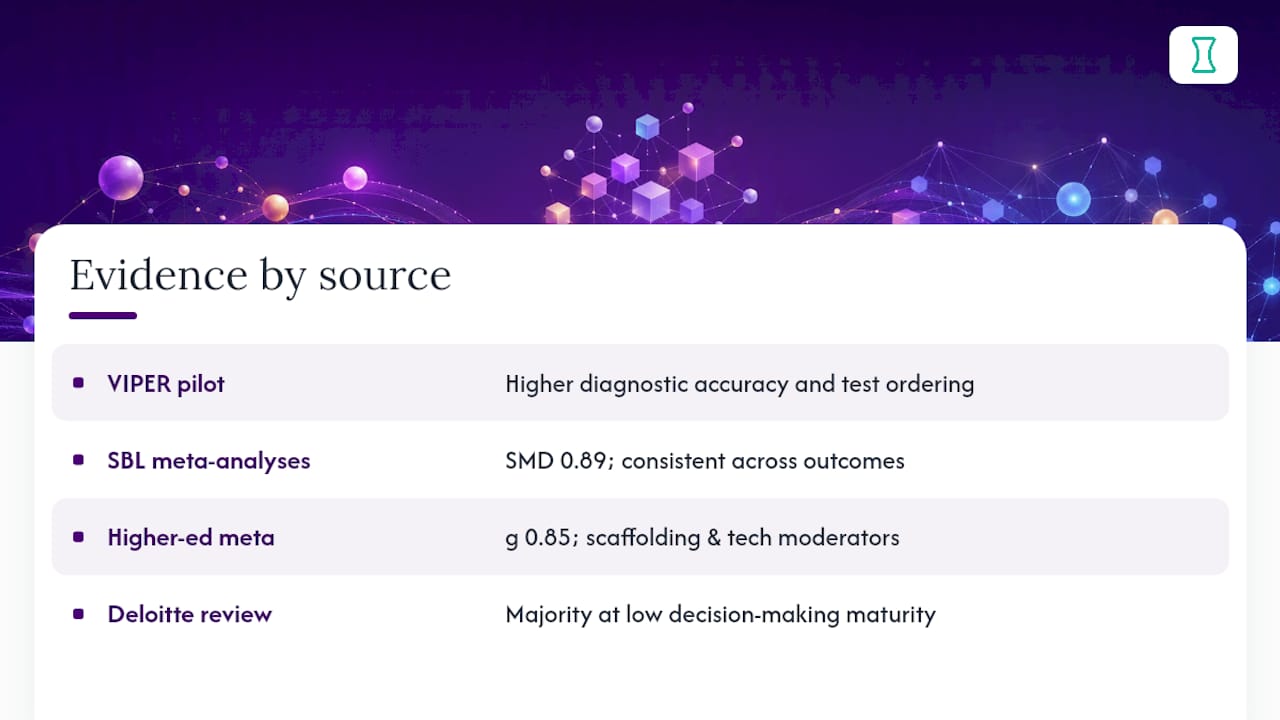
Three signals make the urgency concrete. Deloitte’s research found that 57% of organizations operate at low decision-making maturity. A prospective quasi-experimental pilot (VIPER) showed that roughly 9 hours of deliberate practice produced greater diagnostic accuracy than more than a year of routine residency exposure. And simulation-based learning meta-analyses report a standardized mean difference of 0.89 for decision-making ability, with effects strongest over 2–8 week durations.
Start here before anything else:
- Surface the decisions. List the 5–10 decisions that most directly affect business outcomes in the target role.
- Run a quick cause analysis. For each decision, ask whether the gap is a person issue or an environment issue (tools, process, data access).
- Gather initial evidence. Pull error logs, quality findings, and frontline friction reports before scheduling a single design session.
Table of Contents
- What does “decision intelligence in L&D” actually mean here?
- How do you run a discovery loop that surfaces the decisions that matter?
- How should you design decision-practice experiences that actually build judgment?
- Are your people and managers ready for AI-enabled decision environments?
- What does the evidence actually say about decision-practice learning?
- Key Takeaways
- The case for diagnosis-first capability engineering
- Cognistry gives you the system to build decision capability at scale
- Useful sources and templates for your next discovery loop
What does “decision intelligence in L&D” actually mean here?
The phrase gets used two ways. In data science, it refers to AI-driven decision modeling and optimization. That is not this guide. Here, decision intelligence in L&D means decision-focused capability engineering: diagnosing whether learning is the right response to a performance gap, then designing practice experiences that build calibrated judgment on the job.
Cognistry models this approach directly. The platform starts with diagnosis, not authoring. It maps the capability the work actually requires, separates environment gaps from person gaps, and grounds every design choice in the organization’s own evidence before a single simulation or course is built.
This guide covers four components: diagnosing capability needs, designing decision practice, measuring behavioral and business outcomes, and preparing people for AI-enabled decision environments.
How do you run a discovery loop that surfaces the decisions that matter?
A discovery loop runs 2–4 weeks and answers one question: which decisions are worth building practice for?

Week 1–2: Conduct stakeholder interviews with business owners and frontline managers. Observe work directly where possible. Harvest existing evidence: error logs, quality findings, customer complaints, audit reports.
Week 2–3: Map candidate decisions. For each, run a cause analysis using this checklist:
- Does the performer have the right tools and data at the point of decision?
- Are incentives aligned with the desired decision behavior?
- Is the process clear, or does ambiguity force improvisation?
- Is this a knowledge/judgment gap, or a system constraint?
If the answer to the first three questions is “no,” training will not fix it. Document the environment fix and move on. Deriving capability from observed performance rather than job descriptions keeps this analysis grounded in what high performers actually do.
Prioritization criteria: Score each candidate decision on frequency, consequence of error, variance in outcomes across the team, feasibility of practice design, and availability of measurable KPIs. The highest-scoring decisions become your pilot targets.
Pro Tip: Include at least one frontline performer who is already excellent at the target decision in every interview round. Their mental model is the design brief.
A typical internal pilot covers 2–3 target decisions, involves 15–30 participants, and produces a measurement baseline within the first two weeks.
How should you design decision-practice experiences that actually build judgment?
Decision practice matters more than training volume. The design patterns that produce durable judgment share three features: repeated exposure to realistic decision scenarios, immediate and specific feedback, and progressive complexity.
Core design patterns:
- Case library with progressive complexity, starting with clear-cut examples and advancing to ambiguous, high-stakes variants
- Short deliberate-practice sessions (20–40 minutes) embedded in workflow rather than scheduled as standalone events
- Role-based multi-player scenarios where teams practice the same decision from different vantage points
- Screen-based simulations for throughput and repeatability across large cohorts
Scaffolding elements: worked examples before independent practice, reflection prompts after each scenario, embedded performance criteria visible to the learner, and manager-facilitated debriefs tied to real work.
Dosage and format summary:
| Format | Typical dosage | Evidence base |
|---|---|---|
| Deliberate practice (virtual patients/cases) | ~9 hours total | VIPER quasi-experimental pilot |
| Simulation-based learning programs | 2–8 weeks | SBL meta-analyses (SMD = 0.89) |
| Screen-based simulation (repeated practice) | Multiple short sessions | NCSBN Clinical Judgment studies |
| Broad simulation across domains | Varies; large effect (g = 0.85) | Higher education meta-analysis |
Fidelity is not the primary driver of effectiveness. A broad meta-analysis of 145 simulation studies found that scaffolding and reflection phases influence outcomes more than production quality. Build low-fidelity, high-iteration prototypes first. Invest in fidelity only after the scenario logic is validated.
Are your people and managers ready for AI-enabled decision environments?
AI in training programs is only as good as the decision model it amplifies. If the underlying capability model is weak, automation makes poor decisions faster. Deloitte’s guidance is direct: organizations need explicit decision strategies, defined human-AI roles, and audit logs of human-AI disagreement before deploying AI in decision workflows.
Governance checklist:
- Decision ownership is named and documented
- Evidence standards for each decision type are defined in advance
- Human review thresholds are set (risk level, confidence score, consequence)
- Audit logs capture human-AI disagreements and override decisions
- Retraining cadence is scheduled, not reactive
Level of autonomy: require full human agency for high-consequence, low-frequency decisions. Partial automation is appropriate for high-frequency, low-consequence decisions with strong feedback loops. Building decision capability in the AI economy means teaching people when to trust the model and when to override it.
Manager conversation prompts: “What evidence would change your decision here?” “Where did the AI recommendation diverge from your judgment, and why?” “What would you need to see before delegating this decision to the system?”
What does the evidence actually say about decision-practice learning?
Three sources anchor the business case.
The VIPER quasi-experimental pilot used a pretest/posttest design to compare interns who completed a limited number of hours of deliberate practice with virtual patients against residents with more than a year of routine exposure. The deliberate-practice group showed greater diagnostic accuracy and more appropriate test ordering. Short, scaffolded practice outperformed extended experiential exposure.
SBL meta-analyses report an SMD of 0.89 for decision-making ability, with effects consistent across knowledge, critical thinking, and skills outcomes. The higher education meta-analysis across 145 studies found an overall effect of g = 0.85, with scaffolding and technology choices as key moderators.
Deloitte found that a majority of organizations operate at low decision-making maturity, meaning most enterprises have not yet made decision-making a designed, teachable capability.
Limitations to note: most simulation studies measure short-term capability gains, not long-term transfer to real work. Pilot designs should include a 90-day business KPI window to test whether gains persist. Effective decision-practice programs are integrated enablement plays with repeated cycles and manager involvement, not one-off courses.
Key Takeaways
Decision-focused capability engineering produces measurable judgment gains when you diagnose before you build, design for repeated practice, and measure behavior rather than completion.
| Point | Details |
|---|---|
| Diagnose before you build | Run a 2–4 week discovery loop to confirm a person gap, not an environment gap, before designing any enablement play. |
| Short practice beats long exposure | The VIPER pilot showed ~9 hours of deliberate practice outperformed more than a year of routine residency experience on diagnostic accuracy. |
| Scaffold and iterate, not high fidelity | A meta-analysis of 145 simulation studies found scaffolding and reflection phases drive outcomes more than production quality (g = 0.85). |
| Measure behavior and business KPIs | Track decision accuracy, time-to-competence, and downstream business metrics; completion rates tell you nothing about capability. |
| Cognistry starts with diagnosis | Cognistry maps the capability the work requires, separates environment from person gaps, and builds decision-practice environments grounded in organizational evidence. |
The case for diagnosis-first capability engineering
The conventional L&D assumption is that a performance gap means a training gap. That assumption is wrong often enough to be dangerous. Most of the time, the gap is upstream: a broken process, missing data at the point of decision, or an incentive structure that rewards the wrong behavior. Building a course on top of an environment problem does not close the gap. It adds cost and creates the illusion of action.
The more productive frame is to treat decision-making as a designed organizational capability, not a personal trait. High-maturity organizations make their decision strategies explicit, teach the judgment skills those strategies require, and measure whether the capability actually transferred to work. That is the frame Cognistry was built around: diagnosis first, evidence from the organization, design for judgment, measure behavior and business impact.
What most L&D teams underestimate is how quickly short, well-designed practice can move the needle when the diagnosis is right. The VIPER evidence is striking precisely because 9 hours beat a year of exposure. The variable is not time. It is whether the practice is calibrated to the actual decisions that matter.
Cognistry gives you the system to build decision capability at scale
Enterprise L&D teams that need to build judgment across large, distributed workforces face a specific problem: the diagnosis is hard, the design is complex, and the measurement is rarely connected to business outcomes. Cognistry is built to solve all three.
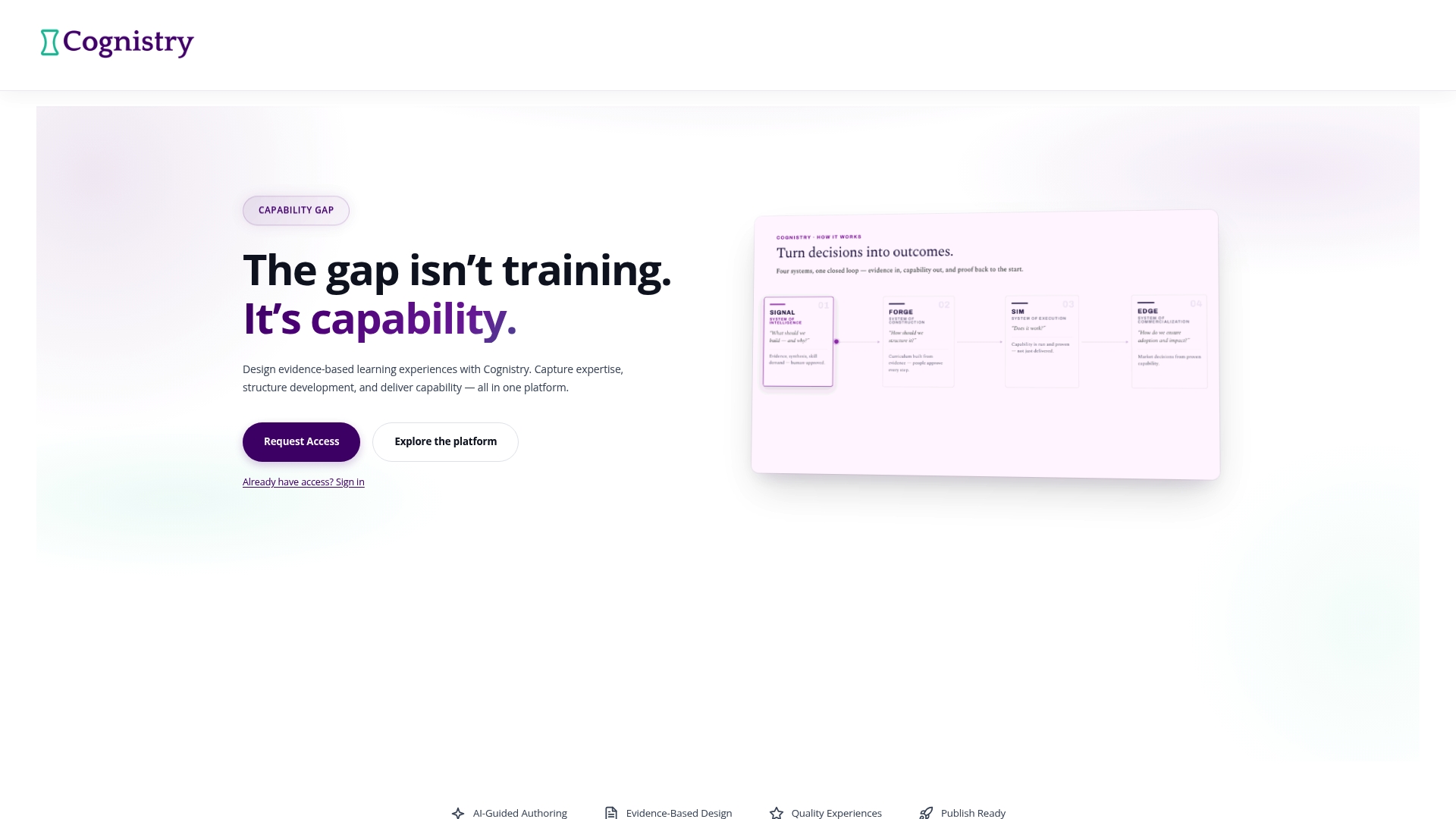
The platform starts with capability signal mapping, so you know which decisions to target before a single scenario is written. From there, Cognistry Sim structures decision-practice environments with progressive complexity, embedded scaffolding, and behavioral telemetry. Cognistry Signal connects practice performance to business KPIs, giving you the assurance data to gate rollout and report impact to stakeholders.
If your organization is running high-frequency, high-consequence decisions at scale and needs to prove that capability programs actually work, explore Cognistry Forge to see how the diagnosis-first model applies to your context.
Useful sources and templates for your next discovery loop
The studies and practitioner references below back the key claims in this guide. Each entry notes what it is most useful for.
- Decision-making with AI | Deloitte Insights
- PMC article: Virtual patient deliberate practice (VIPER)
- Review Article The Impact of Simulation-Based Learning on Nursing Decision-Making Ability: A Meta-Analysis
- Simulation-Based Learning in Higher Education: A Meta-Analysis
- Fostering Clinical Decision-Making Using Screen-Based Simulations Aligned with the NCSBN Clinical Judgment Measurement Model
- Your courses aren’t broken; your learning system is | eLearning Industry
- Evidence-Based Skills and Decision Intelligence
- Practitioner article on deliberate practice and simulation (PMC12062332)
Templates to adapt for your pilot:
Evidence and governance requirements vary by organization, sector, and decision type. Contact Cognistry for a tailored capability diagnostic and pilot design session.