Capability Model Examples for L&D Leaders
A workforce capability model is a structured description of the knowledge, judgment, tasks, and environmental supports a person or team needs to perform specific operational work at standard. One short example: a customer success specialist requires the ability to read account health signals, the skill to run a structured renewal conversation, and a CRM dashboard that surfaces risk scores before the call. Without all three, training alone will not close the gap.
Before you build anything, three questions matter:
- Does a performance gap actually exist, and is it confirmed by quality data, KPI trends, or frontline friction reports?
- Does the environment already support success (tools, manager reinforcement, clear process)?
- Is there a residual knowledge or skill gap once environmental factors are ruled out?
Only when the third answer is yes does a capability model become the right next step. Cognistry is built around exactly this sequence.Key Takeaways
A capability model is only as good as the organizational evidence behind it: diagnosis before design is the non-negotiable first step for any L&D team that wants to move results, not just completions.
| Point | Details |
|---|---|
| Diagnose before you design | Confirm a performance gap with data and rule out environmental causes before building any enablement play. |
| Use the eight-field template | Populate role, observable behavior, decision points, knowledge/skill, environmental supports, evidence sources, metrics, and scope from real organizational evidence. |
| Match response to evidence | Training is one option; coaching, job aids, process fixes, and hiring are equally valid responses depending on what the model reveals. |
| Measure at three levels | Track capability change, behavior sustainment, and business outcome — and build the measurement architecture before launch, not after. |
| Cognistry for capability assurance | Cognistry’s Forge and Signal features support the full diagnosis-to-measurement sequence, from capability signal mapping to behavioral telemetry tied to business KPIs. |
Table of Contents
- What does “capability model” actually mean for L&D?
- When should you build a capability model?
- What goes into a capability model template?
- Three copyable capability model examples
- How do you build and validate a capability model?
- How does the model tell you which response to choose?
- How do you measure capability development?
- How Cognistry supports capability modeling and assurance
- Common mistakes and a diagnostic checklist
- Why diagnosis-first teams deliver measurable value
- Cognistry starts where most platforms stop
- Sources
What does “capability model” actually mean for L&D?
Most L&D teams use ability, skill, competence, and capability interchangeably. That habit causes misdiagnosis. Confusing these terms leads to the wrong response: you train when you should hire, coach when you should fix the process, or build a course when the real problem is a broken workflow.
Here is a working taxonomy:
- Ability: An underlying cognitive or physical capacity a person either has or does not have. Abilities are largely stable and are addressed through selection, not training.
- Skill: A learned, practiced behavior that improves with deliberate repetition. Skills respond well to practice-based enablement plays.
- Competence: The demonstrated combination of knowledge and skill applied to a specific job context at an acceptable standard. Competence is observable and measurable.
- Environment: The tools, processes, manager behaviors, incentives, and information systems that allow or block performance. Environmental gaps are not training problems.
A capability model, in the L&D sense, describes the competence required for a role and the environmental conditions that must exist for that competence to produce results. This article covers workforce and enablement capability models only. Enterprise architecture capability maps (lists of business functions like CRM or Finance) are a separate discipline and are not addressed here.
Pro Tip: Before drafting a capability model, run a five-minute environmental audit: ask whether the tools, access, and manager reinforcement are already in place. If they are not, fix those first. A course will not substitute for a broken system.
When should you build a capability model?
Not every performance problem needs one. Diagnosis comes first: confirm a gap exists and whether the environment already supports success before prescribing learning.
- Confirm the gap with evidence. Pull quality reports, error logs, customer satisfaction scores, or throughput data. A gap that cannot be measured is not yet a gap worth modeling.
- Check environmental conditions. Are tools available? Are processes clear? Does the manager reinforce the right behaviors? If the answer to any of these is no, a process or system fix is the right call, not a capability model.
- Confirm a residual knowledge or skill gap. After ruling out environmental causes, ask whether people genuinely lack the knowledge or practiced judgment the work requires.
- Scope the model. If a real skill gap exists, define the role, the observable behaviors at standard, and the decision points where judgment matters most.
A practical example: a regional ops team was missing daily reconciliation targets. The initial request was for a refresher course. A short diagnostic revealed the reconciliation tool had been updated six weeks earlier with no process documentation. The fix was a two-page job aid and a manager briefing, not a course. No capability model was needed.
Pro Tip: Run a structured three-layer diagnostic (person, system, leadership) before any intake conversation. It takes under 30 minutes and stops wasteful builds before they start.
What goes into a capability model template?
Every capability framework must map to organizational evidence to be actionable: strategy documents, frontline friction reports, quality findings, and SME notes. Generic competency lists disconnected from that evidence produce generic training.
Mandatory fields for an enablement capability model:
- Role and context: The specific job title and the operational setting (team size, system environment, customer type).
- Observable behavior: What does “good” look like in practice? Described in terms a manager can observe, not a trait.
- Decision points: Where does the person need to exercise judgment rather than follow a script?
- Knowledge and skill elements: What must they know, and what must they be able to do with that knowledge under pressure?
- Environmental supports: What tools, access, processes, and manager behaviors must exist for the behavior to occur?
- Evidence sources: Which quality reports, SME interviews, or KPI thresholds informed this field?
- Success metrics: How will you know the capability has developed? Tie to a business KPI.
- Priority and minimal viable scope: Which behaviors matter most? What is the smallest model that would still be useful?
Two worked examples:
| Field | Frontline Customer Service Rep | Technical Support Engineer |
|---|---|---|
| Role and context | Inbound contact center, high-volume calls, CRM-based | Tier 2 support, SaaS product, ticket queue |
| Observable behavior | Resolves billing disputes in one contact, no escalation | Diagnoses root cause before proposing a fix |
| Decision points | When to escalate vs. resolve; when to offer retention credit | When to replicate vs. trust customer description |
| Knowledge and skill | Policy knowledge; de-escalation technique | Product architecture; diagnostic questioning |
| Environmental supports | CRM with account history; clear escalation matrix | Internal knowledge base; lab environment access |
| Evidence sources | QA audit scores; escalation rate reports; SME interviews | Ticket resolution time; re-open rate; SME review |
| Success metrics | First-contact resolution rate; QA score | Mean time to resolution; re-open rate |
Pro Tip: Populate the “evidence sources” field before any other. If you cannot name a real organizational source for a field, the model is speculative, not evidence-based.
Three copyable capability model examples
The three compact examples below use the same fields. Each includes a brief note on whether training is the primary response.
Example 1: Sales Account Handler
Training note: If battlecards are missing or deal reviews are inconsistent, fix those first. Training on qualification is warranted only when those supports exist and reps still misqualify.
Example 2: Frontline Operations Associate
Training note: Frontline teams need guidance in the flow of work, not more courses. A well-placed job aid at the exception station often outperforms a 30-minute module.
Example 3: Customer Success Specialist
Training note: If the CRM health dashboard is not configured or playbooks are outdated, those are the priority fixes. Training on renewal conversations is the right enablement play once the environment is ready.
How do you build and validate a capability model?
Build checklist:
- Run the three-layer diagnostic (person, system, leadership) and document findings.
- Collect organizational evidence: quality reports, error data, SME interviews, strategy documents.
- Conduct two to three SME interviews using behavioral event questioning (“walk me through the last time this went wrong”).
- Observe one to two live work cycles where possible.
- Draft the model using the eight-field template above.
- Review the draft with one SME and one operational manager; resolve disagreements with evidence, not opinion.
- Run a small pilot (5–10 performers) against the model’s success metrics before scaling any enablement play.
Effort estimates:
Validation gates: Before scaling, confirm that pilot performers show measurable improvement on the model’s success metrics, that the environmental supports were actually in place during the pilot, and that the operational manager agrees the behavior change is visible on the job.

How does the model tell you which response to choose?
The model’s evidence patterns point to specific responses. Training improves performance only when learners lack relevant knowledge or skill and when the workplace allows application. When the evidence points elsewhere, the right enablement play is different.
| Evidence pattern | Recommended response |
|---|---|
| Knowledge or skill gap confirmed; environment supports application | Structured learning with decision practice |
| Knowledge exists; behavior inconsistent; no reinforcement | Manager coaching and structured feedback |
| Knowledge exists; behavior blocked by tool or process | Process redesign or job aid |
| Behavior gap exists at hire; training cannot close it in time | Selection criteria review or hiring profile update |
| Knowledge and skill exist; behavior occurs in training but not on job | In-the-flow enablement (job aids, prompts, checklists) |
Pro Tip: When presenting a non-training recommendation to a stakeholder, lead with the evidence pattern, not the conclusion. “Our QA data shows the behavior exists in observed settings but drops when the manager is not present” is harder to argue with than “we think it’s a coaching problem.”
How do you measure capability development?
Performance architecture builds measurement frameworks before launch so behavioral telemetry can validate capability change rather than only measuring satisfaction or completions. Design your metrics at three levels:
- Capability change: Task accuracy, decision quality scores, or assessment performance tied directly to the model’s knowledge and skill elements.
- Behavior sustainment: On-the-job frequency of the target behavior, measured through observation, QA audits, or system telemetry over 30–90 days post-launch.
- Business outcome: The KPI the capability was designed to move: first-contact resolution, net revenue retention, error rate, throughput.
For pilot design, use a minimum of 5–10 performers, run for at least 30 days, and collect both behavioral observation data and the relevant business KPI. Set a go/no-go threshold before the pilot starts. Link your measurement architecture to existing leader dashboards so capability data sits alongside business data, not in a separate L&D report nobody reads.
Cognistry’s Signal feature maps capability signals to behavioral telemetry so measurement is built into the design, not added as an afterthought.
How Cognistry supports capability modeling and assurance
Cognistry is a capability engineering platform built for the diagnosis-first sequence this article describes. It does not start with content. It starts with evidence.
- Capability signal mapping: Cognistry captures organizational evidence (strategy, quality findings, SME knowledge) and structures it into a capability model before any design begins.
- Decision-centered practice: Rather than knowledge recall, Cognistry builds decision environments where performers practice the judgment calls the model identifies as critical.
- Measurement architecture: Behavioral telemetry and quality assurance gates are built into the platform so outcomes connect to business KPIs, not just completion rates.
- Validation workflows: Go/no-go gates prevent scaling an enablement play before pilot data confirms it works.
Two typical client workflows: an operations leader uses Cognistry’s Forge to structure SME knowledge into a validated capability model for a new product line before any course is built. A customer success team uses Signal to track whether renewal conversation behaviors persist 60 days after an enablement play launches.
Cognistry is the right platform when your organization needs to prove why a capability gap exists, what the right response is, and whether it worked — not just that training was delivered.
Common mistakes and a diagnostic checklist
Training becomes the default when it is politically visible, budgeted, and easy to point to. A short diagnostic prevents that waste. Run these eight questions before any build:
- Is the performance gap confirmed by data, or is it based on a manager’s perception?
- Have environmental factors (tools, process, access, incentives) been ruled out?
- Does the target performer already know what good looks like?
- Is manager reinforcement in place to sustain any behavior change?
- Is there a measurable success metric tied to a business KPI?
- Has at least one SME validated the capability description against real work?
- Is the scope minimal and viable, or is the model trying to cover everything?
- Is there a pilot plan before full-scale rollout?
Pro Tip: Record your diagnostic findings in writing before the intake meeting ends. Verbal agreement disappears. A one-page diagnostic summary with evidence citations gives you the data to recommend a non-training response when that is the right call, and the credibility to make it stick.
Organizational politics often push toward training because it is visible and budgeted. When diagnosis shows training is not the answer, recommending a process fix or coaching requires evidence and, frankly, some organizational courage. The diagnostic checklist above gives you both.
Why diagnosis-first teams deliver measurable value
The L&D teams that consistently demonstrate business impact are not the ones who build the most content. They are the ones who shift from content provider to performance architecture: diagnosing first, specifying behavior second, and measuring outcomes before scaling. That sequence is not a methodology preference. It is what separates teams that report completions from teams that report KPI movement. Cognistry’s entire design philosophy is built on this belief: evidence before design, measurement before launch, and business outcomes as the only acceptable proof of success. The future of L&D is not more content. It is better decisions about what to build and why.
Cognistry starts where most platforms stop
Before you build that course, Cognistry helps you confirm whether a course is even the right call. The platform captures your organizational evidence, structures it into a validated capability model, and designs decision-centered practice environments that develop operational judgment, not just knowledge recall.
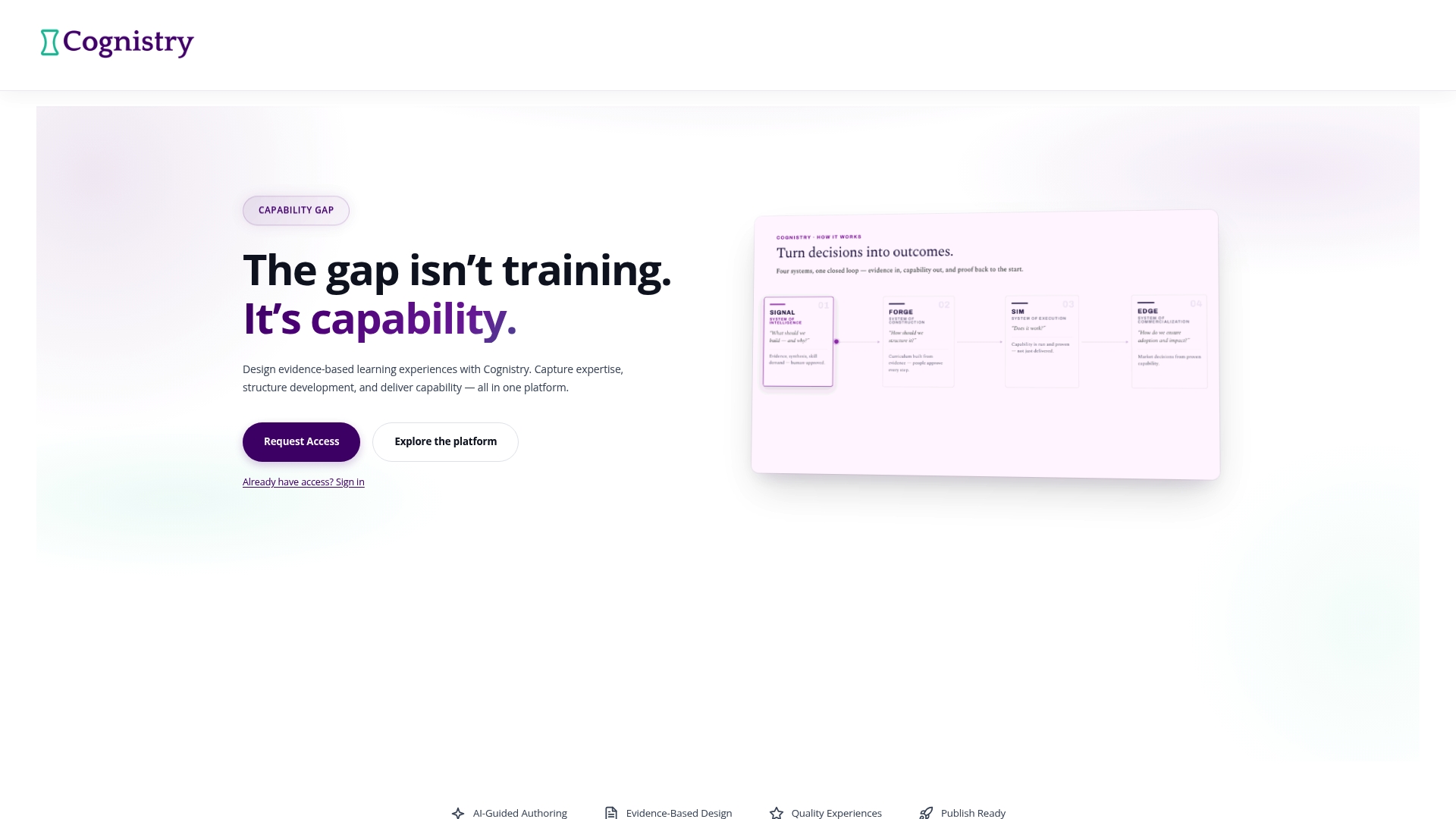
If your team is ready to move from content production to capability assurance, explore Cognistry Forge to see how the diagnosis-first workflow runs in practice. Or get a high-level view of the full platform at Cognistry.
Sources
- Diagnose first, train second
- Why organizations misread training gaps
- The L&D Function In 2026: From Content Provider To Performance Architecture - Qquench Ai
- Frontline operations: 2026 playbook for performance enablement