
Decide Build or No Build in 2–4 Weeks With Capability Mapping for L&D
Capability mapping is the process of identifying the knowledge, judgment, behaviors, tools, and environmental supports a role needs to deliver a business outcome, then testing whether people actually have them. It exists to answer one question before anything else gets built: is training even the right response the right solution, or does the gap sit in process, tooling, or leadership? Some organizations treat that diagnosis, not course creation, as the real starting point.
TL;DR:
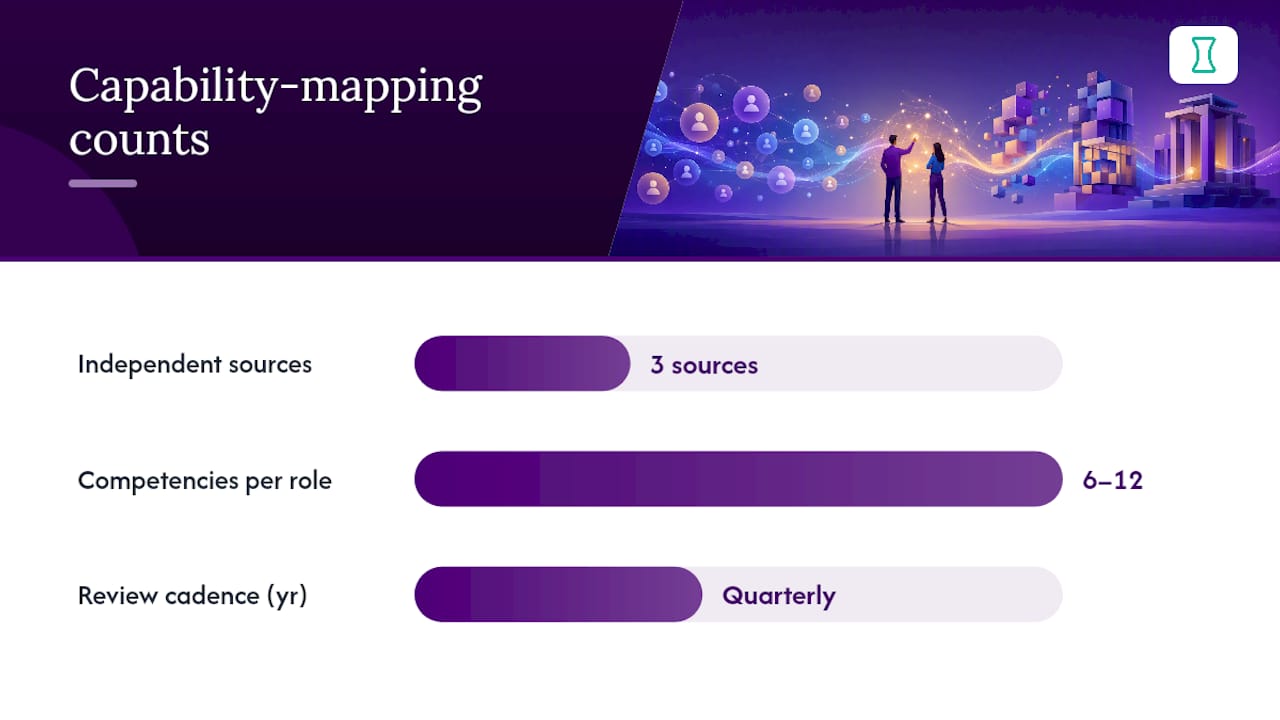
- Capability mapping should be limited to one outcome, one team, and a two-week evidence collection phase to prevent scope creep and ensure actionable results.
- Evidence triangulation from at least three independent sources is essential to accurately identify capability gaps, avoiding overreliance on manager opinions alone.
- Map each capability with clear, observable language and assign a dedicated owner to maintain the map as a living asset, not a static document.
- Use heatmaps to prioritize critical, underdeveloped capabilities and classify gaps by root cause to direct appropriate enablement strategies.
- L&D should lead diagnosis efforts, focusing on decision-making rather than building training, and ensure capability maps inform targeted, measurable actions rather than merely documenting skills.
Table of Contents
- What Capability Mapping Actually Means for L&D
- When Do You Actually Need a Capability Map?
- How to Build a Capability Map Step by Step
- Turning the Map Into a Build or No-Build Decision
- Pitfalls That Turn a Capability Map Into Shelf-Ware
- Capability Model Examples and Templates You Can Adapt
- Why L&D Should Own This, Not Just Support It
- Cognistry: Built for Diagnosis, Not Just Course Delivery
- Sources
- FAQ
What Capability Mapping Actually Means for L&D
Capability mapping is not the enterprise architecture exercise that shares its name. That version catalogs what a business does — its functions and services. This version catalogs what people need to be able to do and whether they can do it, which is a completely different problem with a completely different owner.
It sits next to, but is not the same as, a training needs assessment or a skills matrix. A skills matrix is a static inventory of who has what certification. A training needs assessment gathers evidence about performance gaps and classifies their causes. Capability mapping ties both together into a structured view that supports workforce planning, internal mobility, and risk identification.
The distinction matters because a skills taxonomy, a capability map, and a strategy-level architecture map are three separate artifacts built for three separate decisions. Confusing them is how L&D teams end up building a beautiful document nobody uses.
Capability mapping earns its place because it produces decision-grade evidence:
- It links a specific role to the specific capabilities that role’s outcome requires.
- It scores current maturity against required maturity, not just presence or absence.
- It flags single points of failure, where one person’s judgment is the only thing standing between the team and a failure.
- It gives leaders a defensible basis for choosing an enablement play, instead of defaulting to a course.
When Do You Actually Need a Capability Map?
Not every performance dip warrants a full mapping exercise. Four situations reliably do: a strategy shift that changes what “good” looks like for a role, a quality or safety issue that keeps recurring despite existing training, a single-point-of-failure skill concentrated in one or two people, and an internal mobility goal where you need to know who can move into what role and what’s missing.
Run this triage before committing resources:
- Can you name the specific business outcome at risk, in one sentence?
- Do at least two independent evidence sources (frontline feedback, quality data, performance metrics) point to the same gap?
- Has a course or job aid already been tried for this gap without moving the outcome?
- Would a wrong diagnosis here be expensive to reverse (compliance risk, customer harm, revenue loss)?
If you answered yes to three or more, you need a map, not a guess.
Pro Tip: Scope your first capability-mapping effort to one priority outcome, one team, and a two-week evidence window. Trying to map an entire function at once is the single fastest way to stall the project before it produces anything usable.
How to Build a Capability Map Step by Step
Start by naming the business outcome you’re protecting or improving, not the training you assume you need. “Reduce onboarding errors in claims processing” is a scope. “Build a claims training course” is a conclusion you haven’t earned yet. Write the outcome, the role or roles involved, and the timeframe before you touch anything else.
Collect evidence from at least three independent sources before you define a single capability. Frontline observation, quality or incident data, manager interviews, customer complaints, and subject-matter expert walkthroughs all count. The Afiniti Consultants training needs framework recommends exactly this triangulation, because a single source almost always overstates or understates the real gap.
Define capabilities in plain, observable language, not abstract competency labels. Each entry should describe what a person does, decides, or judges, tied to the outcome. Keep the list to 6 to 12 competencies per role, a ratio team capability roadmaps consistently point to as the usable ceiling before a map becomes unmanageable.
Map each capability against current roles, then score maturity against what the outcome actually requires.
| Step | Primary question | Output |
|---|---|---|
| Scope | What outcome, whose role, what timeframe? | One-sentence scope statement |
| Evidence | What do at least three sources say? | Triangulated gap list |
| Define | What must the role do, decide, or judge? | 6–12 named capabilities |
| Map | Who holds this capability, at what level? | Role-by-capability matrix |
| Classify | Skill, process, tooling, or leadership gap? | Root-cause tag per gap |
| Prioritize | Which gaps threaten the outcome most? | Now/Next/Later list |
Visualize the results as a heatmap plotting strategic importance against current maturity. Heatmaps make trade-offs explicit and surface capabilities that are both critical and underdeveloped, which is exactly where you should spend first. Sequence the rest as Now, Next, and Later rather than forcing a rigid calendar onto work that will shift as evidence comes in.
Before recommending any enablement play, classify each gap by root cause: is this a skill gap, a confidence gap, a broken process, missing tooling, or a leadership signal problem? Skipping this step is how organizations build training for a process failure. Set a small number of leading indicators tied to the outcome, establish a baseline before you act, and put a review cadence on the calendar, quarterly at minimum, so the map stays current instead of becoming shelf-ware.
Turning the Map Into a Build or No-Build Decision
A capability map is only as good as the decision it produces. Use simple rules to route each prioritized gap:
- Build learning when the root cause is genuinely a skill or judgment gap, and the environment already supports applying it.
- Change process when people know what to do but the workflow, handoffs, or policy get in the way.
- Fix tooling when the gap is really about missing information or a broken interface at the point of decision.
- Redeploy or hire when the capability required doesn’t exist anywhere in the current team, and building it would take longer than the outcome can wait.
When learning is genuinely the right enablement play, design it backward from the capability, not forward from a course template. Map each priority capability to a pathway type: procedural capabilities usually need structured practice, judgment-heavy capabilities need decision practice environments that simulate the actual trade-offs, not just knowledge checks.
Favor a minimum viable capability build over a sprawling program: one focused practice module tied to one capability, measured, then expanded. Set a baseline before launch, track leading indicators (application rate, error reduction, time to competent performance) during rollout, and follow up at 30 and 90 days to confirm the gap actually closed.
Pro Tip: If your first pass at a pathway design still looks like a slide deck with quiz questions bolted on, you’ve built a course, not a capability response. Go back to the root-cause tag and check whether learning was even the right play.
Pitfalls That Turn a Capability Map Into Shelf-Ware
Most capability maps fail for predictable, avoidable reasons. Over-decomposing roles into 30 or 40 micro-competencies is the most common one; it looks thorough and becomes unmaintainable within a quarter. Keeping the list to 6 to 12 competencies per role isn’t a stylistic preference, it’s what keeps the map governable.
Other frequent mistakes:
- Confusing the capability map with a process map, then trying to fix a workflow problem with a competency list.
- Building the entire map from one evidence source, usually manager opinion, without triangulating against frontline or quality data.
- Publishing a map with no named owner, so nobody updates it after the first review.
- Treating the map as a one-time project instead of a living asset with a maintenance cadence.
Mitigate each one by starting narrow, assigning an owner to every capability entry, connecting entries to the systems that generate evidence, and triaging new signals before they get added rather than accepting every request to expand scope.
Capability Model Examples and Templates You Can Adapt
A usable capability model needs only a few fields to function as a real decision tool rather than a static document: capability name, a short observable definition, an owner, links to the evidence that justifies its priority, and a maturity score against the required level. Governed capability maps connect these fields to owners and metadata instead of sitting as a frozen slide.
Start with a spreadsheet if your data sources are scattered and your scope is small. It’s the right tool for a single-team, single-outcome effort.
- Adapt existing capability model examples by trimming fields you can’t actually populate with evidence, rather than leaving them blank.
- Add a “confidence” column early, since not every early-stage entry deserves equal weight.
- Move from spreadsheet to a governed platform once you need evidence linked automatically to systems of record, multiple owners collaborating, or maturity scores updated on a cadence rather than manually.
Ready-made capability model examples built for L&D teams can shortcut the field design work considerably.
Why L&D Should Own This, Not Just Support It
Capability mapping only works when L&D treats itself as the diagnostic function, not the delivery arm that waits for someone else to hand it a training request. The strategic payoff isn’t a better course catalog. It’s fewer wrong builds and faster identification of the gaps that were never about learning at all.
Diagnosis first isn’t a philosophy, it’s a sequence: map the capability, classify the cause, then choose the enablement play. Skip the sequence and you’re back to guessing with better slides.
[Author credentials, relevant case studies, and client outcomes to be added.]
— Brian
Cognistry: Built for Diagnosis, Not Just Course Delivery
Cognistry starts where most L&D tools stop: before the build. Instead of jumping straight to authoring a course, Cognistry helps you determine what what capability the work actually requires, decide what whether learning is the right enablement play is, and ground that decision in your organization’s own evidence, from strategy documents to frontline friction to quality findings.
Once the diagnosis is clear, the platform helps structure the response: capability model examples and templates you can adapt to your scope, learning pathway design for the capabilities that genuinely need it, and decision practice environments that build judgment instead of just testing recall. If you’re weighing whether your team’s current approach can even support this kind of diagnosis, the comparison between an LMS and a capability platform is worth a look. When you’re ready to see how it applies to your own team, explore the Cognistry platform and request a walkthrough.
Sources
For deeper reading: the training needs assessment guide covers evidence gathering in detail. The team capability roadmap guide walks through Now/Next/Later sequencing. For planning context beyond L&D, the roadmap versus strategy explainer clarifies how delivery plans differ from strategic outcomes.
- A Practical Guide to a Training Needs Assessment - Afiniti Consultants
- Team capability roadmap: A step-by-step guide for HR & L&D
- Business capability mapping: A complete practical guide | Archilu
FAQ
What Is Capability Mapping in L&D?
Capability mapping identifies the knowledge, judgment, and behaviors a role needs to deliver a business outcome, then checks whether people currently have them, so leaders can decide whether to build learning, change process, redeploy, or hire.
How Long Does a Capability Mapping Process Take?
A focused effort scoped to one outcome and one team typically takes two to four weeks for evidence collection and capability definition, longer if you’re triangulating across multiple business units.
Who Should Own a Capability Map?
L&D should lead the diagnosis, but each capability entry needs a named business owner, usually the manager closest to the outcome, so the map stays current and connected to real evidence rather than becoming shelf-ware.
How Is Capability Mapping Different From a Skills Matrix?
A skills matrix is a static inventory of certifications or competencies per person; capability mapping ties required capabilities to a specific business outcome, scores maturity against that requirement, and feeds a build or no-build decision.
Does Cognistry Replace a Training Needs Assessment?
No. Cognistry works alongside a training needs assessment by grounding the capability map in the same organizational evidence and then structuring whatever enablement play the diagnosis points to, whether that’s a learning pathway or something else entirely.