Building Judgment and Decision-Making Capability at Work
Diagnose before you build. That is the single most important thing you can do before commissioning any enablement play around decision-making capability. Run a short diagnostic snapshot of a few days first.
- Collect objective performance signals: error rates, escalation frequency, decision latency from your operational systems.
- Conduct a decision-owner review with the relevant business sponsor to agree on scope and confirm the gap is a capability issue, not a process or tooling failure.
- Hold off on any broad curriculum build or platform proof-of-concept until that evidence is in hand.
What you should not do: commission a course library, a competency framework, or a vendor demo before you know whether judgment and decision making is actually the root problem.
Key Takeaways
Diagnose before you build: the most expensive enablement mistake is designing decision practice for a problem that is actually environmental, process-driven, or a leadership gap.
| Point | Details |
|---|---|
| Diagnose first | Run a 48–72 hour diagnostic snapshot before scoping any enablement play. |
| Measure three signals | Track decision accuracy, decision latency, and escalation frequency as your baseline metrics. |
| Default critical practice | Make the hardest scenarios non-optional for novices; overconfident learners skip what they need most. |
| Pilot narrow, then scale | Validate one decision type with telemetry and a business KPI before expanding to broader cohorts. |
| Cognistry | Provides capability signal mapping, decision-simulation authoring, and validation workflows to run the full diagnostic-to-outcome sequence. |
Table of Contents
- Why operational judgment shapes your most important business metrics
- Training myths that quietly undermine judgment development
- How to diagnose whether to train or fix something else first
- Design patterns that actually build operational judgment
- How to measure whether decision capability actually improved
- What to require from an enablement platform for decision practice
- Enterprise use cases where decision practice moves the needle
- A 90-day pilot to 1-year scale roadmap
- The conversation that gets a skeptical business partner to commit
- Cognistry gives you the diagnostic and design infrastructure to do this right
- Sources
Why operational judgment shapes your most important business metrics
Poor decisions at the frontline are expensive. A sales rep who misjudges deal qualification wastes pipeline. A support agent who escalates the wrong tickets drives up handle time and CSAT costs. A delivery manager who misreads an exception signal delays a client and triggers a penalty clause. These are not knowledge problems. They are judgment gaps — the gap between what a person knows and what they choose to do under real conditions.
Operational judgment, in enterprise enablement terms, means turning frontline signals into timely, repeatable, value-driving choices. It is the capability that sits between information and action. Organizations that treat it as a training topic rather than a measurable performance variable consistently underinvest in the right design patterns and overspend on content volume.
The metrics that matter first: decision accuracy (percentage of choices that match the defined standard), decision latency (time from signal to action), and escalation frequency (how often frontline staff defer rather than decide).
Start with one of those three. Baseline it before any enablement play launches. That number becomes your pilot’s primary success gate.
Training myths that quietly undermine judgment development
Three beliefs cause most of the wasted spend in this space.
- Myth 1: Learners know what they need. Research cited in e-Learning and the Science of Instruction found that when learners judged their recall as correct, it was actually correct only 57% of the time. Overconfident learners skip practice they need most. Novices, in particular, cannot reliably self-assess their own judgment gaps.
- Myth 2: More learner control improves outcomes. For novices, it often does the opposite. Without default pathways that make critical practice mandatory, learners route around the hard scenarios and gravitate toward content they already understand.
- Myth 3: Engagement equals capability. Completion rates and satisfaction scores measure neither decision accuracy nor behavior transfer. A learner can finish a course, rate it highly, and still make the same poor call on the floor next week.
“If a person could perform correctly if their job depended on it, the problem lies outside training.” That single question, drawn from the Mager & Pipe diagnostic lineage, eliminates a significant share of training requests before a single slide is built.
The design implication is direct: make critical practice the default path, not an optional module. Build calibration tasks into the flow so learners encounter their own gaps rather than self-reporting around them. Measure behavior transfer, not self-report.
How to diagnose whether to train or fix something else first
The seven-question diagnostic model from Training Magazine gives L&D and business partners a field-ready decision flow. Work through these in order before scoping any enablement play.
- Is there a clear performance standard, and does the performer know it?
- Is there a measurable gap between current and expected performance?
- Could the performer do it correctly if their job depended on it?
- Have they ever performed to standard before?
- Is the environment providing the tools, authority, and information needed to decide?
- Are there consequences (positive or negative) reinforcing the current behavior?
- Is the gap concentrated in specific roles, contexts, or decision types?
| Answer pattern | Primary response |
|---|---|
| No to Q1 or Q2 | Clarify standards and measurement before anything else |
| Yes to Q3 | Environment, process, or incentive fix — not training |
| No to Q4 | Skill gap confirmed — design decision practice |
| No to Q5 | System or tooling change required |
| Yes to Q6 (wrong incentive) | Leadership or culture response |
| Yes to Q7 (concentrated gap) | Targeted simulation for that role/decision type |
A three-layer diagnostic approach separating individual capability, systems, and leadership prevents the most common mistake: building training for a problem that is actually environmental. Skipping this diagnostic pass is costly. Training transfer rates average 10–15% when diagnosis is bypassed.
Design patterns that actually build operational judgment
Content volume does not build judgment. Decision practice does. These four patterns, grounded in Mayer’s instructional design synthesis, consistently move the needle.
- Decision-centered simulations: Replicate the actual signals, ambiguity, and time pressure of the target decision. Branching scenarios with telemetry capture let you see which paths learners take and where they stall. Low-fidelity quizzes rarely transfer; the scenario must recreate the real trade-off.
- Deliberate practice loops: Short cycles of action, immediate feedback, and spaced repetition tied to real work. Each loop should surface a calibration moment where the learner’s confidence is tested against their actual accuracy.
- Defaults and guided pathways: Make the hardest, most critical examples the default path for novices. Learners who can skip the difficult scenarios will. Instructional research supports making essential practice non-optional to prevent overconfidence-driven gaps.
- Feedback design: Combine behavioral telemetry with qualitative debriefs. Manager coaching tied to specific decision moments is more durable than a post-course survey.
Pro Tip: Start with the narrowest, highest-value decision type in your target role — one decision, one context, one set of signals. Build transfer patterns there before expanding breadth. Broad scenario libraries built before transfer is proven are expensive and rarely used.
How to measure whether decision capability actually improved
Pick one leading process metric and one lagging business metric for your pilot. Chasing a dashboard of vanity metrics obscures whether the enablement play worked.
| Validation outcome | What to measure | Data source |
|---|---|---|
| Decision accuracy | % of choices matching defined standard | Simulation telemetry, QA audit |
| Time to decision | Average latency from signal to action | Operational system logs |
| Escalation reduction | Change in escalation frequency vs. baseline | Ticketing or CRM data |
| Business KPI | Revenue conversion, CSAT, cycle time | Business reporting |
Pilot design essentials: run a cohort structure with a control group where feasible, capture telemetry throughout (not just at the end), and run pre/post judgment tests using the same scenario set. A pilot of several weeks is usually sufficient to see a directional signal on decision accuracy. Business KPI movement typically lags by some months. Iterate the enablement play when telemetry shows a consistent stall point in the scenario flow — that stall is your next design target.
What to require from an enablement platform for decision practice
Most platforms are built for content delivery. Decision practice requires a different capability set. Before any demo, confirm the vendor can demonstrate all of the following.
- Decision-simulation authoring with branching logic and variable signal sets
- Behavioral telemetry that captures path data, not just completion
- Evidence capture: the ability to map organizational signals (quality findings, frontline friction, SME input) to design decisions
- Built-in validation workflows that link simulation outcomes to business KPIs
- Manager-facing coaching tools tied to specific decision moments
- API integrations with your CRM, ticketing system, or operational data source
Pro Tip: In your demo, ask the vendor to walk through a capability-mapping session — not a feature tour. If they cannot show you how they move from a performance signal to a simulation design to a validated outcome, they are selling content tools, not capability engineering.
Ask specifically: “Show me a sample telemetry dashboard from a decision practice pilot. What does a pilot plan aligned to a business KPI look like in your system?”
Enterprise use cases where decision practice moves the needle
| Use case | Decision type | Design pattern | Expected KPI |
|---|---|---|---|
| Sales qualification | Deal fit vs. pipeline inflation | Branching scenario with CRM signal fidelity | Conversion rate uplift, reduction in late-stage losses |
| Support escalation triage | Resolve vs. escalate | Telemetry-tracked simulation with calibration tasks | Escalation frequency down, handle time reduced |
| Delivery exception handling | Hold vs. proceed under constraint | Time-pressured scenario with consequence branching | On-time delivery rate, penalty clause reduction |
For regulated or high-risk contexts (financial services, healthcare operations), increase scenario fidelity and add consequence weighting to the telemetry. The decision stakes are higher, so the simulation must reflect that — ambiguous signals, incomplete information, and visible downstream consequences.
A 90-day pilot to 1-year scale roadmap
| Phase | Weeks/Months | Key deliverables | Owner |
|---|---|---|---|
| Diagnostic snapshot | Weeks 1–2 | Performance baseline, seven-question diagnostic, scope agreement | L&D owner + business sponsor |
| Pilot design | Weeks 3–4 | Decision type selected, scenario architecture, telemetry plan | L&D owner + data owner |
| Build and launch | Weeks 5 | Small-batch simulation built, cohort enrolled, pre-test run | L&D owner + IT lead |
| Validate | Weeks 9 | Post-test, telemetry review, business KPI check-in | L&D owner + business sponsor |
| Scale governance | Months 4–6 | Governance model, integration with operational systems, manager enablement | All owners |
| KPI-driven rollout | Months 7–12 | Expanded cohorts, additional decision types, quarterly KPI reporting | Business sponsor |
Roles and responsibilities:
- L&D owner: diagnostic lead, design authority, measurement reporting
- Business sponsor: scope agreement, KPI ownership, stakeholder communication
- Data owner: telemetry architecture, operational data access, reporting integrity
- IT lead: system integration, API connections, data security sign-off
Success gates: move from pilot to scale only when decision accuracy improves directionally and at least one business KPI shows a measurable signal. A pilot that shows no movement after 12 weeks is a diagnostic finding, not a failure — it means the root cause was not capability.
The conversation that gets a skeptical business partner to commit
The hardest part of diagnosis-first is selling it to a stakeholder who already has a solution in mind. They have seen a performance problem, and they want a course.
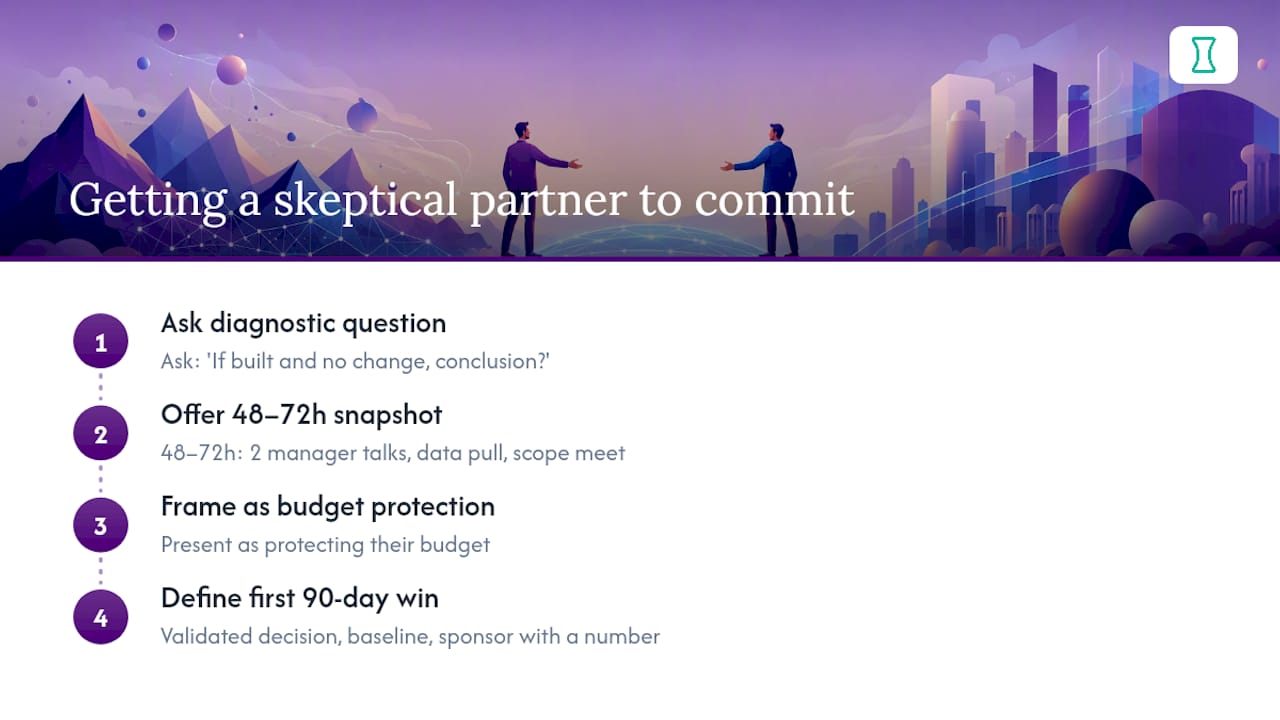
The conversation that works is short. Ask the business partner: “If we build this and nothing changes in six months, what would you conclude?” Most will say the training was bad. Then ask: “What if the problem was never about capability in the first place?” That question opens the diagnostic conversation. Offer a 48–72 hour snapshot — two manager interviews, a pull of objective performance data, and a scope-agreement meeting — as a low-cost commitment before any build begins. Frame it as protecting their budget, not questioning their judgment. Business partners respond to that framing.
The win you are aiming for in the first 90 days is not a finished program. It is a validated decision type, a telemetry baseline, and a business sponsor who can point to a number that moved.
Cognistry gives you the diagnostic and design infrastructure to do this right
Before you build a simulation or scope a pilot, you need a system that starts where the work actually starts: with evidence about what capability the role requires and whether a gap exists.
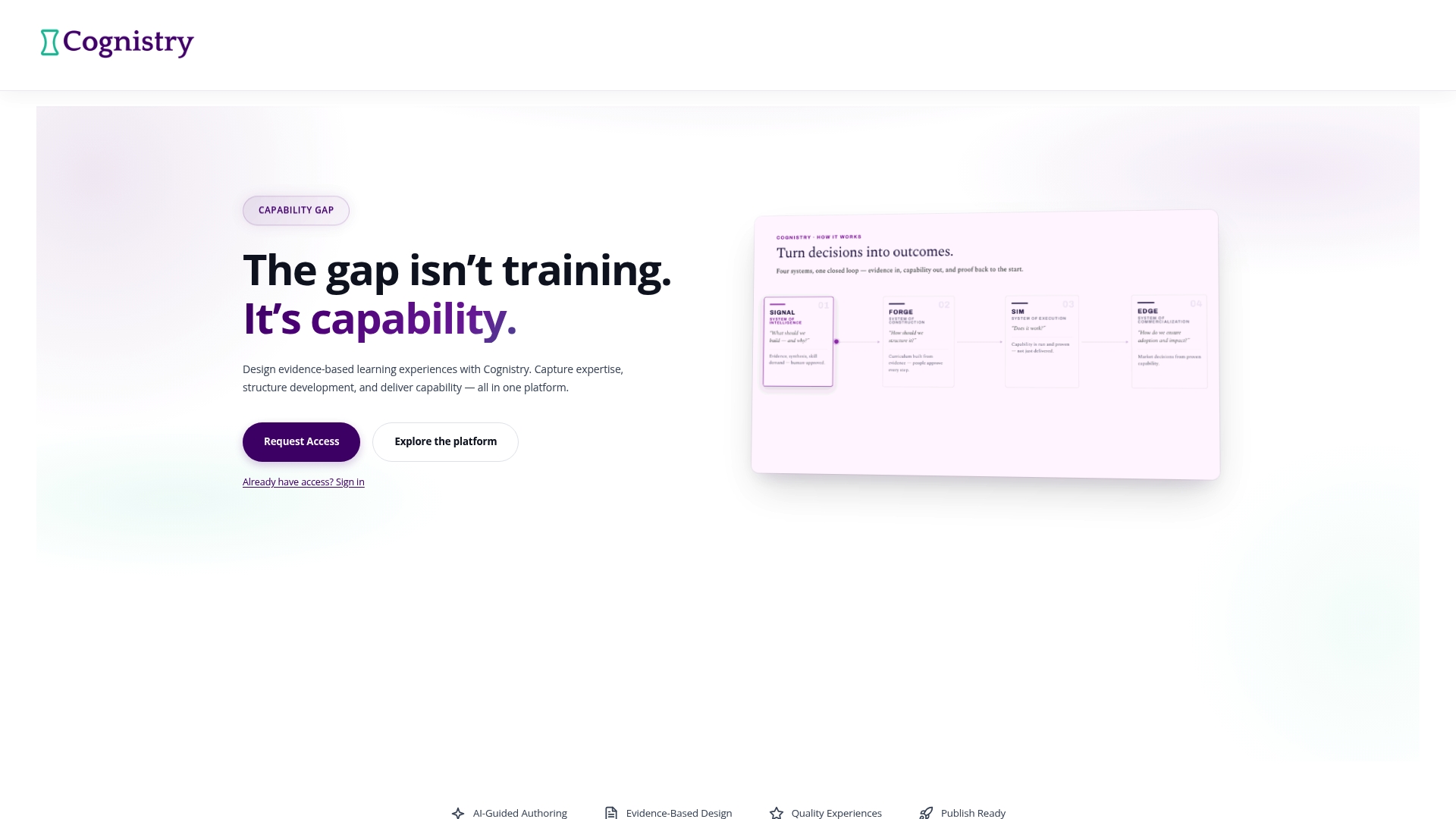
Cognistry is built for exactly that sequence. Its capability signal mapping captures organizational evidence — frontline friction, quality findings, SME input — and grounds every design decision in that source material. The Forge authoring environment builds decision-centered simulations with branching logic and behavioral telemetry. Validation workflows connect simulation outcomes directly to business KPIs, so your pilot report shows movement on the metrics your sponsor cares about. Request a demo and ask for the capability-mapping walk-through, the sample telemetry dashboard, and a pilot plan aligned to one of your current performance gaps. Start with the Cognistry overview to see how the full diagnostic-to-validation sequence works in practice.
Sources
- e-Learning and the Science of Instruction (sample excerpts referencing learner calibration and learner control)
- Diagnose First, Train Second
- How to Diagnose Performance Problems in Organisations (Before You Train) - Aptitude Management Training Solutions
- The Skills Gap Is Misdiagnosed. The Real Workforce Problem Is Judgment