A skill gap analysis compares the capability your organization needs against what your people can currently do, then routes the difference into the right fix, whether that’s training, hiring, redesigned workflows, or better tools. Before you build that course, decide whether learning is even the right response. Most skill gaps trace back to unclear processes, missing tools, or unclear expectations, not knowledge you can fix with a module.
Start with diagnosis, not curriculum. Ground your assessment of what the work requires in the organization’s own evidence: strategy documents, frontline friction, quality data, and the judgment of your subject-matter experts. Only then decide what kind of enablement play makes sense.
Your first moves:
- Scope one business unit or role family, not the whole company
- Pull in a senior stakeholder who owns the business outcome, not just the training budget
- Pick one measurable proxy (error rate, cycle time, deployment speed) to track before and after
Pro Tip: If you can’t name the business metric a skill gap is hurting, you don’t have a training problem yet. You have a diagnosis problem.Gartner’s research on talent management found that most current talent efforts limit organizational performance, and that most of the workforce will need new skills to do their jobs well. That’s the scale problem. The fix starts small, with one focused analysis done right.
Key Takeaways
Skill gap analysis works when you diagnose capability needs against business evidence before designing any learning response, and when you measure results against business metrics instead of completion rates.
| Point | Details |
|---|---|
| Diagnose before you build | Ground required capabilities in strategy and frontline evidence, not a generic competency list. |
| Separate environment from person | A process or tooling gap needs a fix, not a course; only a genuine skill gap needs enablement. |
| Use mixed assessment methods | Combine self-assessments, manager input, work product evidence, and system data to reduce bias. |
| Prioritize by impact and urgency | Rank gaps by business impact, urgency, and cost to close, not by size alone. |
| Measure business outcomes, not completions | Track time-to-competence, deployment rate, and behavior change against the original business metric. |
| Route the response deliberately | Cognistry diagnoses capability needs first, then structures courses, simulations, or decision environments only where learning is the right fix. |
Table of Contents
- What Does a Skill Gap Analysis Actually Measure?
- When Should You Run a Skills Gap Assessment?
- How to Run a Skill Gap Analysis in 4 Steps
- How Do You Prioritize Which Gaps to Close First?
- How Do You Know If You Closed the Gap?
- Which Tools and Methods Actually Work?
- How Cognistry Structures Diagnosis Before Design
- Skill Gap Analysis for HR Leaders: A Diagnosis-First Playbook
- Ready to Move From Diagnosis to Action?
- Sources
- FAQ
What Does a Skill Gap Analysis Actually Measure?
A skill gap analysis measures the distance between required capability and demonstrated capability, at whatever level you’re examining: a single employee, a team, or the entire organization. Get the vocabulary right first, because HR teams routinely blur three distinct ideas.

Skills are discrete, observable abilities: writing SQL queries, running a difficult performance conversation, operating a piece of equipment. Competencies are broader behavioral patterns that combine several skills with judgment, like “strategic thinking” or “client relationship management.” Capability is the organization’s actual capacity to produce a business outcome reliably, which depends on skills and competencies but also on process, tools, staffing levels, and incentives. A team can have the right skills and still lack capability if the workflow around them is broken. That’s why capability, not skills alone, is the right frame for a diagnosis.
Common skill categories worth separating in any inventory:
- Technical skills: coding languages, financial modeling, equipment operation
- Digital skills: CRM proficiency, data visualization, AI tool literacy
- Interpersonal skills: negotiation, coaching, cross-functional communication
- Cognitive and judgment skills: prioritization under ambiguity, risk assessment
The level of analysis matters just as much as the category. An individual-level gap (one underperforming rep) rolls up into a team-level pattern (an entire sales floor missing objection-handling skills), which rolls up into an organizational signal (the company can’t execute its stated go-to-market strategy). Widening skills mismatch trends documented by researchers at Georgetown McCourt show why treating this as a one-off, individual-level exercise misses the bigger structural problem.
When Should You Run a Skills Gap Assessment?
Run a baseline skills gap assessment regularly for stable functions, and more frequently for roles tied to fast-moving technology or markets. Several HR vendors, including Paycor’s operational guidance, recommend at least one comprehensive annual review paired with more frequent targeted scans wherever change is constant.
Certain events should trigger an assessment outside your normal cadence:
- A strategy shift that changes what “good performance” means for a role
- New technology adoption that changes how the work actually gets done
- A spike in turnover in a specific function, which often signals a capability mismatch rather than a retention problem alone
- Repeated project failures with a common root cause across teams
Match the depth to the trigger. A single new software rollout might only need a targeted scan of the affected roles. A strategy pivot usually calls for a broader audit, since capability requirements shift across multiple functions at once.
How to Run a Skill Gap Analysis in 4 Steps
Most guidance on skills gap methodology, including the widely used MindTools framework, converges on a similar sequence: define what’s required, assess what exists, compare and prioritize, then design a response. The version below adds the diagnosis-first discipline that keeps HR leaders from defaulting to a training catalog as step one.
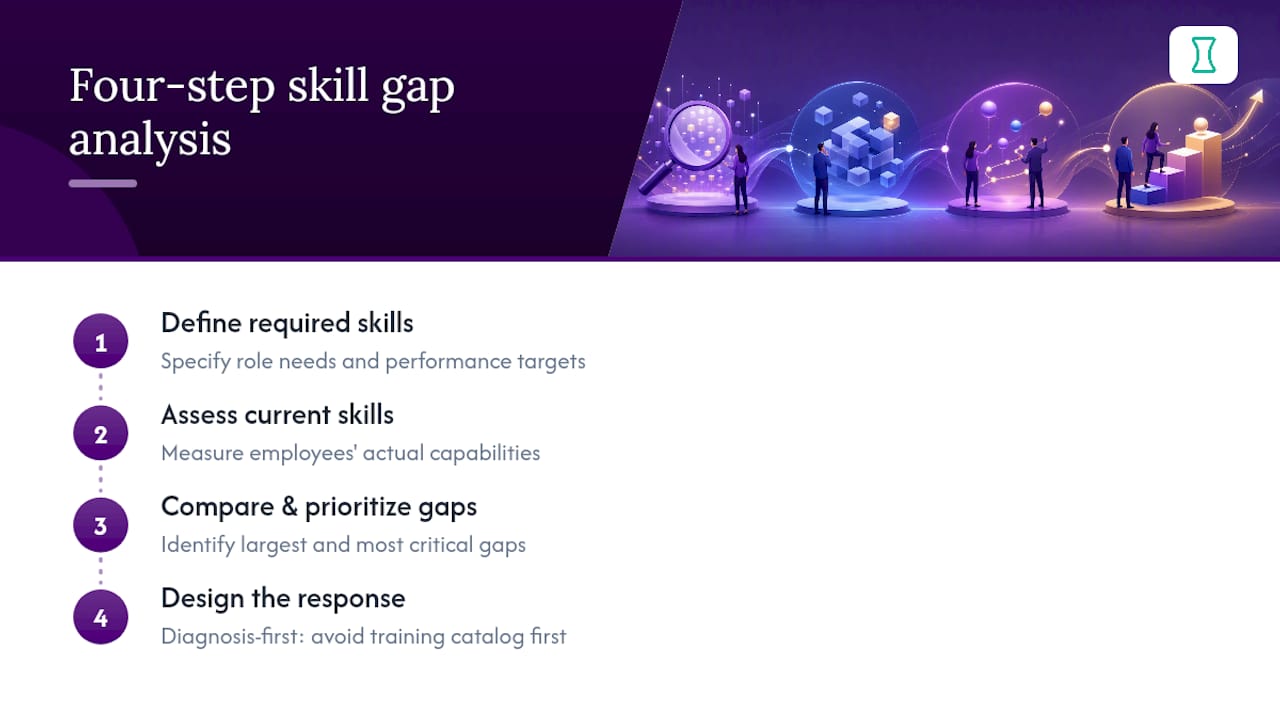
Step 1: Translate business goals into required capabilities
Start with the business outcome, not a generic competency model. Convert that into role-level skill targets that a manager could actually observe and rate.
This step fails most often when HR teams import a stock competency framework wholesale instead of deriving targets from what the strategy actually demands. A generic “communication skills” target tells a manager nothing useful. “Can identify churn risk signals in a support ticket within two minutes” does.
SHRM’s guidance on conducting a skills gap analysis stresses that this translation step works best as a joint exercise between HR and the managers who own the outcome, not an HR-only exercise handed down afterward.
Step 2: Assess current skills with mixed methods
Single-source data produces distorted results. Self-assessments inflate confidence; manager ratings carry their own biases; neither alone tells you what’s actually happening in the work.
Combine at least three sources:
- Self-assessments, useful for surfacing where employees themselves sense uncertainty
- Manager assessments, grounded in direct observation of day-to-day performance
- Work product evidence: actual deliverables, call recordings, code reviews, sales calls
- System data: CRM activity logs, support ticket resolution times, error rates from quality systems
Work product evidence is the most underused of the four, and it’s often the most honest. A manager’s rating of “strong communicator” means little next to a transcript showing the same rep skipping discovery questions on every call.
Step 3: Compare, quantify, and prioritize
Lay the required profile next to the current profile for each role or team, and quantify two things for every gap you find: size (how far off is current performance from the target) and criticality (how much does this gap threaten a specific business outcome). A small gap in a high-stakes capability, like a compliance judgment call, usually outranks a large gap in something peripheral.
MindTools’ guidance on prioritizing skills gaps makes the same point: gaps that directly threaten strategic objectives deserve priority over larger gaps in lower-impact areas, even when the larger gap looks more dramatic on a spreadsheet.
Step 4: Design the response, and don’t assume it’s a course
Once you know the size, criticality, and root cause of a gap, you have five broad options, and training is only one of them:
- Hire when the gap is too large or too specialized to close through development in a reasonable timeframe
- Upskill when the gap is a genuine knowledge or practice gap and the current role scope stays the same
- Reskill when the role itself is changing enough that the person needs a substantially different capability set
- Redeploy when someone’s existing strengths fit a different role better than the one they’re in
- Fix the process or tooling when the gap isn’t really a people problem at all: unclear handoffs, missing dashboards, or a workflow that punishes the behavior you actually want
Assign an owner, a timeline, and a measurement point to whichever option you choose. A gap-closure plan with no named owner rarely survives past the kickoff meeting.
Pro Tip: Before greenlighting any training build, ask one question out loud in the room: “If we fixed the process instead, would this gap disappear?” If the honest answer is yes, you just saved a training budget.
How Do You Prioritize Which Gaps to Close First?
Rank gaps using three factors together, not one in isolation: impact on a named business outcome, urgency (how soon does this bite), and cost to close (time, money, disruption). A high-impact, high-urgency, low-cost gap is your obvious first move. A low-impact, low-urgency, high-cost gap goes to the bottom of the list, regardless of how visible or interesting it seems.
Use simple decision rules to route each priority gap to the right fix:
- If the gap is narrow and the current team has capacity to learn it, choose targeted upskilling
- If the gap is wide, specialized, and time-sensitive, choose hiring
- If the same gap shows up across multiple people doing the same job, suspect a process or tooling issue before assuming it’s a training issue
A sample action plan for a high-priority gap might look like this: owner is the department director; milestone one is a two-week diagnostic interview with five frontline employees; milestone two is a pilot fix (process change or a short practice exercise) with ten people; measure is the target business metric at 30 and 90 days, not a training completion rate.
How Do You Know If You Closed the Gap?
Track outcomes that reflect actual performance, not activity. Time-to-competence (how long until a new hire or newly upskilled employee hits the target performance bar) is one of the clearest signals, alongside deployment rate, observable behavior change on the job, and business outcome proxies like error rates or cycle time.
Useful KPIs to track:
- Time-to-competence: days or weeks from start to target performance level
- Deployment rate: percentage of trained employees actually applying the skill in their day-to-day work
- Observable behavior change: manager or peer-rated shift in specific, defined behaviors
- Business outcome proxies: error rate, cycle time, customer satisfaction score tied to the original gap
The Future of Jobs Report from the World Economic Forum places reskilling and upskilling among employers’ top priorities as skill demands shift faster than most training calendars can keep pace with, which is exactly why a one-time assessment goes stale fast.
Triangulate across at least three evidence types: learning completion data (weak on its own), on-the-job observation checks, and quality or performance metrics from the actual work. Re-measure on the same cadence you set for the original assessment, quarterly for fast-moving roles, annually for stable ones, and automate the refresh wherever your systems allow it so the data doesn’t go stale between reviews.

Which Tools and Methods Actually Work?
Match the tool to the scope, not the other way around. A single team’s targeted scan doesn’t need enterprise software; a company-wide capability audit usually can’t run on spreadsheets alone.
Lightweight approaches work well for a first pass or a small team:
- Role templates and skill matrices built in a shared spreadsheet
- Manager surveys rating each direct report against defined skill targets
- Free assessment tools, including CareerOneStop’s skills matcher, which lists and defines common workplace skills and lets people rate their own levels against them
These are enough for a pilot or a single-department scan, and they cost nothing but time.
Advanced approaches earn their cost at scale. AI-driven skills inference and adaptive assessments can keep skills data fresher than a point-in-time survey, pulling signal from system usage and work product continuously rather than once a year. That comes with a real tradeoff: these tools need careful data governance and integration work before they add value over a well-run manual process. Traditional learning management systems, worth comparing against a capability platform before you commit budget, are built to deliver content, not to diagnose capability gaps in the first place.
The strongest setups combine both: a lightweight manual scan to move fast on a pilot, backed by a more systematic skills intelligence layer once the organization is ready to track capability continuously rather than annually.
How Cognistry Structures Diagnosis Before Design
Most enablement efforts skip straight to building a course. Cognistry starts earlier, by determining what the work actually requires and whether learning is the right response at all, grounded in in the organization’s own evidence: strategy documents, frontline friction, quality findings, and subject-matter expertise, rather than a generic competency checklist.
That diagnosis distinguishes between two very different problems. A capability gap rooted in the environment, unclear process, missing tools, poor handoffs, needs a process fix, not a course. A gap rooted in the person, a genuine skill or judgment shortfall, is where an enablement play actually makes sense.
Once the diagnosis points to a real capability gap, Cognistry structures the response: courses where knowledge transfer is genuinely the bottleneck, decision-practice simulations where judgment under real conditions is what’s missing, and decision environments built to develop operational judgment rather than knowledge recall alone.
Skill Gap Analysis for HR Leaders: A Diagnosis-First Playbook
The conventional advice on skill gap analysis treats it as a data-collection exercise: survey people, build a matrix, buy a course. That’s backwards. The research this article draws on, from Gartner’s finding that most talent management efforts actually limit performance, to the sheer pace of change the World Economic Forum documents, points somewhere else entirely: the bottleneck usually isn’t visibility into skills. It’s the habit of jumping to training before anyone asks whether training is the right fix.
Here’s what most HR teams get wrong. They measure success by course completion, not by whether the underlying business metric moved. A skill gap analysis that ends in a training catalog and a completion dashboard hasn’t closed anything. It’s tracked activity.
Prioritize the diagnosis step, even when it feels slower. Ask whether the gap lives in the person or in the environment around them. That single question, asked honestly, will save more training budget than any assessment tool on the market.
— Brian
Ready to Move From Diagnosis to Action?
Most HR teams have some version of a skills matrix already. What they’re missing is a system that connects that data to an actual diagnosis, one that tells you whether a gap needs a course, a process fix, or a hire, and then proves the fix worked against a business metric instead of a completion rate.
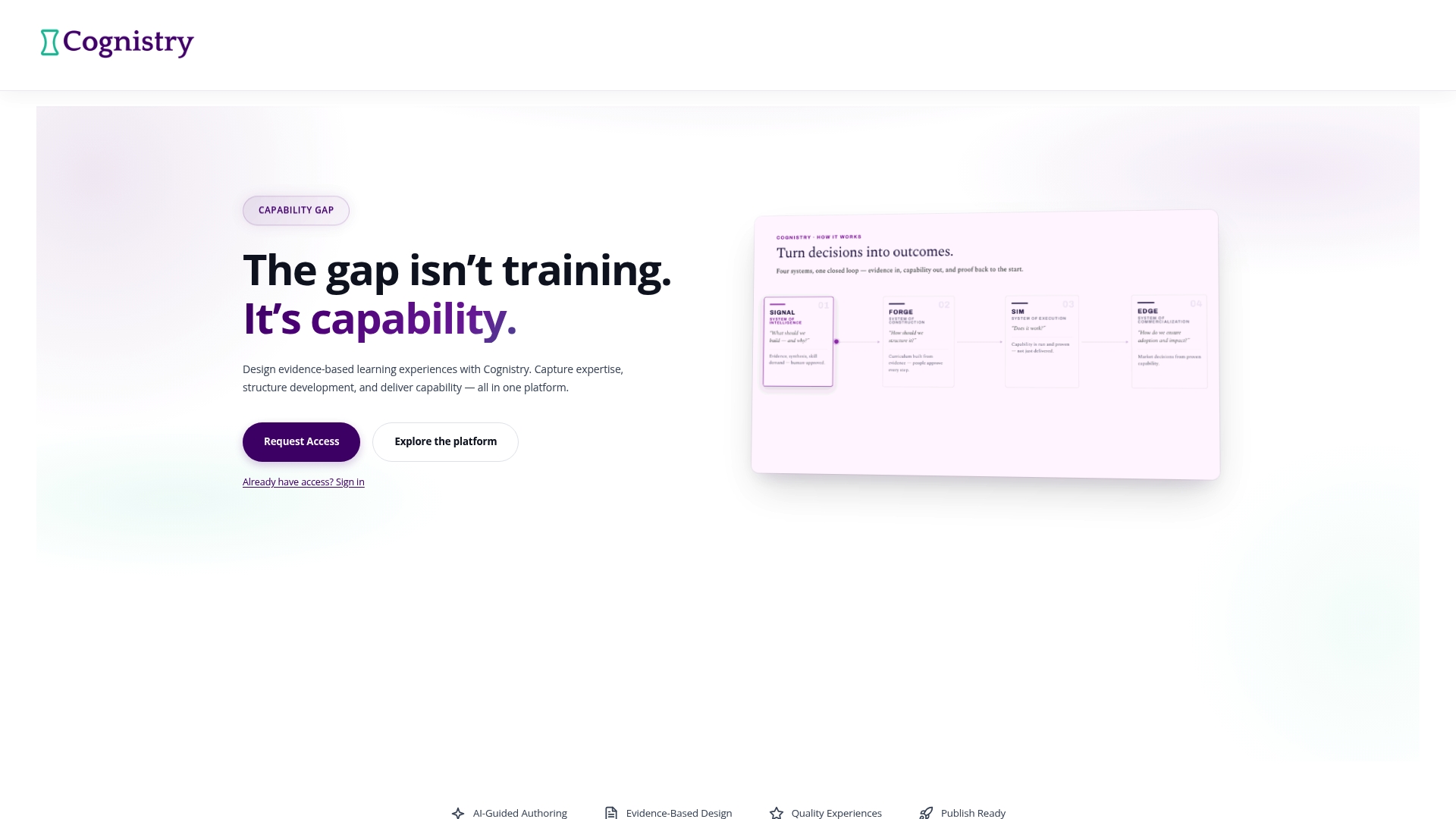
Cognistry is built for exactly that gap between assessment and action. It grounds every design decision in your organization’s own evidence, strategy, frontline friction, quality findings, and subject-matter expertise, then structures the response as courses, decision-practice simulations, or decision environments depending on what the diagnosis actually shows. That’s a different starting point than a course catalog or an AI slide generator: Cognistry Forge is the system for deciding what capability to build, grounding it in evidence, and measuring whether it worked.
If your last skills gap analysis produced a spreadsheet and a training plan nobody asked for, start with a diagnosis instead. See how Cognistry’s platform works and get a walkthrough of how the diagnosis-to-measurement flow applies to your next capability gap.
Sources
- The Future of Jobs Report 2025
- SHRM: How to conduct skills gap analysis
- CareerOneStop: Skills matcher and assessment tools
FAQ
What is a skills gap analysis example?
A retail chain notices rising return rates tied to poor product recommendations. A skill gap analysis traces this to frontline staff lacking specific product-knowledge skills, distinct from a general “customer service” gap, and the fix is a targeted knowledge refresh plus a manager coaching checklist, not a full retraining program.
What are the 4 steps of a gap analysis?
The core sequence is: define the capabilities the business goal requires, assess current skills using mixed methods, compare and prioritize the gaps by impact and urgency, and design a response, which may be training, hiring, redeployment, or a process fix.
How do I do a skills gap analysis on myself?
Compare your current skills against the requirements of your target role or your next career step, using a free tool like CareerOneStop’s skills matcher to rate yourself against defined workplace skills, then ask a manager or peer to rate you on the same list for a second data point.
How do you measure skill gaps?
Measure the gap between a defined target skill level and demonstrated current performance, using at least two independent evidence sources, such as manager observation and work product review, then track closure through business metrics like time-to-competence or error rate rather than training completion alone.