
For enterprise learning and development, AI training content means AI-guided, evidence-based enablement: structured courses, decision-practice simulations, and learning architectures designed to build operational capability. The recommended first step is not production. It’s diagnosis: mapping the actual capability gap, checking whether learning is even the right response, and grounding any content in your organization’s own evidence before a single course gets built.
TL;DR:
- AI-guided training content must be grounded in internal evidence, such as quality reports and incident logs, to build practical judgment and adaptability.
- A thorough capability diagnosis before course development ensures the actual operational outcomes and decision points at risk are correctly identified, preventing guesswork.
- The choice of training format depends on decision complexity, frequency, and consequences, ranging from knowledge checks to full decision environments.
- Vendors should demonstrate how evidence-based content is built, maintain data tenant isolation, and provide clear measurement plans, with red flags including pooled models and vague validation processes.
- Pilot programs should follow a structured five-phase process over six to eight weeks, focusing on transfer evidence and operational metrics rather than satisfaction scores.
Table of Contents
- What Counts as AI Training Content (and What Doesn’t)
- Diagnose Before You Build: A Capability-First Process
- Courses, Simulations, or Decision Environments: How to Choose the Format
- Evaluating AI Training Vendors: What to Ask in Procurement
- Running the Pilot: Roadmap and the Metrics That Matter
- Governance and Data Ethics for AI-Guided Training Content
- A Practitioner’s Note on Choosing Diagnosis-First AI Training Content
- How Cognistry Supports a Diagnosis-First Enablement Play
- Sources
- FAQ
What Counts as AI Training Content (and What Doesn’t)
Most vendors selling “AI training content” mean a chatbot that turns a PDF into a slide deck. That’s not what enterprise L&D teams need, and it’s not what this article covers.
Enterprise AI-guided training content is different in kind, not just scale. It includes structured courses built from internal evidence, practice simulations that force real decisions, and decision environments that let teams rehearse judgment calls before they make them on the job. AI’s role here is specific: adaptive learning paths that respond to how a learner performs, scenario generation that widens the range of situations a team can practice against, and agentic simulations that model realistic counterparts. None of that works if it’s built on generic best practices instead of your organization’s own quality reports, incident logs, and frontline friction points. Training built on capability alone, without that grounding, tends to produce content that’s technically correct and practically useless. Capability-focused design, as opposed to narrow competency training, aims to build judgment and adaptability tied to real role context, which is a different design target entirely.

Diagnose Before You Build: A Capability-First Process
Here’s the expensive mistake most organizations make: they get a performance complaint, assume it’s a skills problem, and greenlight a course. Skip the diagnosis and you’re guessing.
A real capability diagnosis starts by mapping four things:
- The operational outcomes actually at risk (missed quotas, quality escapes, safety incidents)
- The decision points where frontline judgment breaks down
- The evidence sources that show where friction actually lives: quality reports, incident logs, leader observations, call transcripts
- Whether the gap is a capability problem at all, or an environment problem, a process problem, or a tooling problem in disguise
Enterprise simulation methodology backs this up: serious programs start with discovery workshops and problem formulation before any modeling begins, and they qualify their data sources before committing to build anything, according to guidance on starting enterprise simulations. The decision logic is simple. If the diagnosis shows people genuinely lack the judgment or skill to act, that’s your enablement play. If the diagnosis shows the process is broken, the incentive is misaligned, or the tool doesn’t work, no course fixes that.
Cognistry’s capability signal mapping approach exists for exactly this stage, before design, not after.
Pro Tip: Before approving budget for any training request, ask the sponsor to point to the evidence: the specific report, log, or observation that shows the gap. If they can’t, you’re not ready to design anything yet.
Courses, Simulations, or Decision Environments: How to Choose the Format
Format choice isn’t a style preference. It follows directly from three variables: how complex the decision is, how often people face it, and what happens if they get it wrong.
- Low complexity, high frequency, low consequence. A structured course with knowledge checks usually suffices. Recall matters more than judgment here.
- Moderate complexity, moderate frequency, real consequence. This is simulation territory. Build a scenario with a clear decision focus, realistic consequences, and iterative rounds, because effective simulation design hinges on those three elements plus structured debriefing afterward.
- High complexity, unpredictable frequency, severe consequence. This calls for a full decision environment, the kind of system CVS Health described as a “flight simulator for management,” where leaders pressure-test decisions against plausible futures before committing real resources, using generative-agent simulations grounded in participant responses collected from thousands of individuals.
AI earns its place in this stack only when it’s anchored to internal evidence: adaptive difficulty tuned to how a specific team performs, scenario variation drawn from your own incident patterns, agentic counterparts trained on your actual customer or client behavior. Strip out the evidence grounding and AI just generates more generic content faster, which is not the problem anyone is trying to solve.
Evaluating AI Training Vendors: What to Ask in Procurement
Every vendor demo looks impressive. The questions that separate a real capability platform from a content factory are narrower than most RFPs ask.
Evaluate on five criteria: how the platform integrates your organizational evidence into design decisions, whether there’s a measurement and ROI plan built in from the start, how the vendor handles model and data governance, whether your tenant data stays isolated from other customers, and how well the platform integrates with your existing systems of record.
In the demo itself, ask directly:
- “Show me how a course or simulation gets built from our evidence, not a generic template.”
- “Is our data used to train models that serve other tenants, or is it isolated to us?”
- “What does the pilot measurement plan look like before we sign anything?”
- “Who owns the source content once it’s uploaded, and can we export it?”
Watch for red flags. Pooled-model training without tenant isolation is a real risk with document-to-course generators, and buyers should confirm isolation and content-control claims before committing, a caution echoed in enterprise AI course-generation product documentation. No measurable pilot plan and vague answers on data lineage are equally disqualifying.
Running the Pilot: Roadmap and the Metrics That Matter
A capability-first pilot moves through five phases: discovery and diagnosis, pilot design, execution, debrief and iteration, then the scale decision. Skipping straight from diagnosis to full rollout is how organizations end up scaling something nobody validated.
- Discovery and diagnosis (weeks 1 to 2): confirm the capability gap and evidence sources.
- Pilot design (weeks 2 to 4): scope a single cohort, typically one team or region, and define the format.
- Execution (weeks 4 to 8): run the enablement play with a small enough group to instrument closely.
- Debrief and iterate: this is where the debrief phase does the real work of converting practice into behavior change, and where facilitators connect outcomes to transferable action.
- Scale decision: only move beyond the pilot once transfer evidence, not satisfaction scores, justifies it.
| Signal to instrument | What it tells you |
|---|---|
| Behavioral telemetry during practice | Whether decisions improve across rounds, not just confidence |
| Manager observation post-pilot | Whether behavior actually changed on the job |
| Business KPI movement | Whether the capability gap is closing where it matters |
| Satisfaction scores | Almost nothing about transfer, use with caution |
The most common false positive is high satisfaction paired with zero behavior change. People can enjoy a simulation and still make the same mistakes back on the floor. Instrument for transfer, not applause.
Governance and Data Ethics for AI-Guided Training Content
None of this works without governance discipline underneath it. Four things are non-negotiable: data lineage that shows exactly which internal evidence shaped a given piece of content, bias checks on any AI-generated scenario or feedback, tenant isolation so your data never trains a model serving someone else, and full traceability back to the evidence that justified the design.

Validation matters just as much as governance. Mature simulation programs run retrodiction checks and pair modeling with fieldwork before scaling, staging validation from individual-level testing up to full environment embedding, a sequence detailed in enterprise simulation guidance. Human-in-the-loop review at each stage catches what automated checks miss.
Pro Tip: Ask your vendor to walk through one real example of retrodiction, a case where they tested a model’s prediction against what actually happened. If they can’t produce one, their validation process is theoretical, not operational.
A Practitioner’s Note on Choosing Diagnosis-First AI Training Content
The conventional wisdom in L&D is that speed wins: get content out fast, iterate later. I think that’s backwards for anything AI touches. Speed without diagnosis just means you build the wrong thing faster, and AI makes that mistake cheaper to repeat at scale, which is worse, not better.
What I’d tell any L&D leader evaluating this space: don’t let a vendor’s authoring speed distract you from the harder question of whether learning was ever the right response. Start with Cognistry’s diagnosis-first resources if you want a structured way into that question, and align every pilot to a named business owner who will judge success by a KPI, not a satisfaction score. Instrument for transfer from day one. Everything else is downstream of getting that first decision right.
— Brian
How Cognistry Supports a Diagnosis-First Enablement Play
Cognistry is the direct alternative to building training first and hoping it lands: it diagnoses the capability gap, designs the response only when learning is the right one, builds decision practice grounded in your own evidence, and measures the result against operational metrics instead of completion rates.
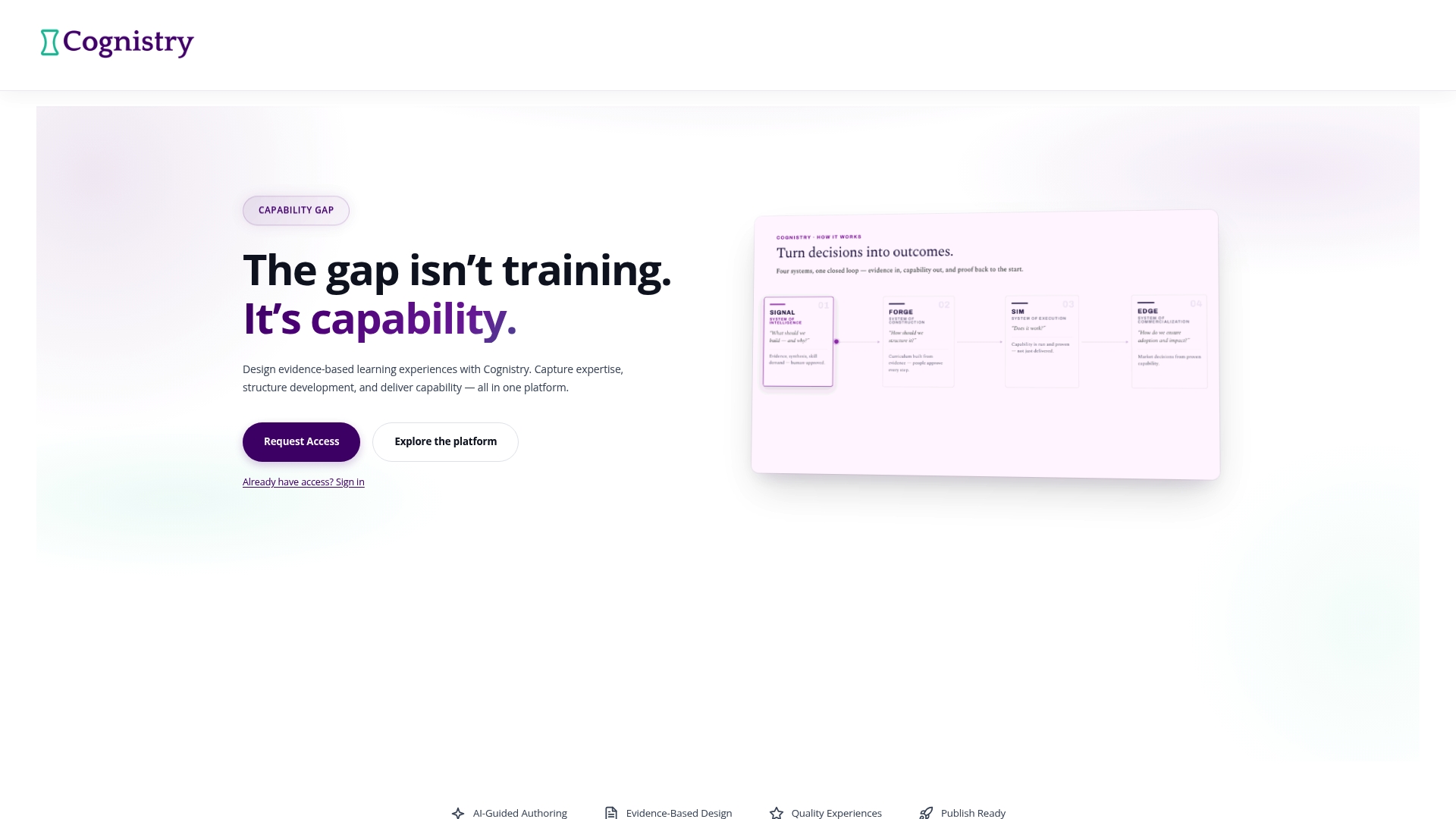
Where a generic course generator starts with your document upload, Cognistry starts with the question of whether a course is even the answer. The platform’s capability engineering methodology walks through how diagnosis, evidence mapping, and decision-practice design connect to measurable operational outcomes, and it’s a useful read before any procurement conversation starts. If you’re ready to see the workflow itself, request a demo of Cognistry Forge and bring your own capability question. That’s the fastest way to find out whether an enablement play is warranted at all, before you spend a dollar building one.
Sources
- The Flight Simulator for Management (CVS Health whitepaper)
- How to design a corporate training simulation that works (StratX Sim)
- Training for competency versus capability (Training Industry)
- AI Corporate Training · Docs to Interactive Courses | Uncoursed
FAQ
What Is AI Training Content in an Enterprise Context?
It’s AI-guided, evidence-based enablement content, courses, practice simulations, and decision environments, designed only after a capability diagnosis confirms learning is the right response.
How Is Capability Training Different From Competency Training?
Capability training builds judgment, confidence, and adaptability tied to real role context, while competency training targets narrower, discrete skills.
How Long Should a Pilot Take Before Scaling?
Most capability-first pilots run one cohort through discovery, execution, and debrief within roughly six to eight weeks before any scale decision, with transfer evidence, not satisfaction scores, deciding whether to expand.
What Should I Ask AI Training Vendors About Data?
Ask directly whether your data trains models shared with other tenants, who owns the source content, and what tenant isolation guarantees they can put in writing.
Does Cognistry Replace Instructional Designers?
No. Cognistry structures the diagnosis, evidence mapping, and decision-practice design work, giving instructional and learning experience teams a system to ground their design decisions rather than replacing their judgment.
Why Not Just Use an AI Course Generator Directly?
A document-to-course generator can produce content fast, but without a capability diagnosis first, it risks encoding generic best practices instead of the specific decisions your teams actually struggle with.