
When routine operational decisions take too long, the issue is usually the system around the decision, not individual willpower or a missing course. Unclear decision rights, a process mismatched to the decision type, and environmental blockers account for most delays. The first move is not training. It’s a rapid diagnosis within a few days that maps each decision’s type, owner, required inputs, and the exact point where it stalls.
TL;DR:
- Most decision delays stem from unclear ownership, mismatched processes, or environmental blockers, not individual effort or willpower.
- Sorting decisions into big bets, cross-cutting, and routine types helps determine appropriate speed and process; routine decisions should be delegated quickly.
- Rapid diagnostics like decision maps, meeting audits, and evidence checks reveal where bottlenecks like approval overload or data gaps occur, facilitating targeted fixes.
- Quick wins involve separating information sharing from decision-making, streamlining approval policies, and building psychological safety to encourage open discussion.
- Building enablement programs is justified only if diagnosis shows gaps in judgment or absorptive capacity, emphasizing real-case simulations and continuous measurement.
Table of Contents
- Why Are Decisions Taking Too Long? A Diagnostic Framework
- Quick Fixes to Shorten Decision Cycles This Week
- When Should You Build an Enablement Play Instead?
- How Do You Measure Whether Decisions Are Getting Faster?
- Why Diagnosis Has to Come Before Any Build
- A Direct Way to Run Diagnosis, Simulation, and Measurement
- Sources
- FAQ
Why Are Decisions Taking Too Long? A Diagnostic Framework
Before fixing anything, you need to know what kind of decision you’re actually dealing with. McKinsey’s research on decision making identifies decision segmentation as one of the strongest predictors of speed. Not every choice deserves the same process, and treating a routine call like a board-level bet is exactly what stalls a team.
Start by sorting decisions into three buckets:
- Big-bet decisions. Infrequent, high-stakes, and worth slowing down for real deliberation.
- Cross-cutting decisions. Touch multiple functions and need coordination, but shouldn’t require a committee every time.
- Delegated or routine decisions. High-frequency, lower-risk calls that should move fast, made by the person closest to the work.
Once decisions are sorted, run three rapid diagnostics to find where the friction actually lives:
- Decision map. Document the inputs, outputs, timeline, and named owner for a sample of recent decisions. Gaps here usually mean unclear ownership.
- Meeting audit. For every recurring meeting, ask what its purpose is, who’s actually needed, and what outcome it produces. Meetings that mix information sharing with decision commitment are a common culprit.
- Evidence check. Ask whether the data people need to decide is visible, trusted, and easy to reach, or whether people are chasing it down meeting to meeting.
Watch for red flags: too many approvers on a single decision, no written guardrails, an escalation path nobody can name, policy that reads like a legal brief, and teams that stay quiet in the room rather than raise a concern. A 15-minute pulse survey on the last three decisions a team made, paired with a one-page decision map template, usually surfaces the bottleneck faster than a full audit ever would.
Quick Fixes to Shorten Decision Cycles This Week
You don’t need a program to start closing the gap. Some of the fastest wins come from changing how meetings and delegation work, not from new content.
- Split information sharing from decision commitment. Put the expected decision outcome on the agenda in advance, and don’t let a briefing meeting quietly turn into a debate. McKinsey’s research on meeting design found that separating these two objectives improves both speed and quality.
- Apply a minimum viable policy. Strip out redundant approval steps and replace them with published guardrails that let people use judgment inside clear limits. MIT CISR’s research on decentralized decision-making links this practice to teams moving through idea cycles in roughly half the time.
- Delegate routine decisions with a rollback rule. Give the owner explicit success criteria and a simple exception process, so autonomy doesn’t feel like exposure.
- Run micro-simulations, not courses. A short scenario script that rehearses a common delegated decision builds more judgment than a slide deck ever will.
- Change how leaders open the room. Frame the first few minutes as information-sharing, ask genuine open questions, and rotate who plays devil’s advocate. Edmondson and Lei’s research on psychological safety found that safety is what lets diverse teams actually surface the perspective that would have sped the decision up. Gatherilla’s guidance on building psychological safety offers a few concrete micro-rituals worth stealing for your next stand-up.
Pro Tip: Before your next recurring decision meeting, rewrite the invite so it names one required outcome. If you can’t name one, cancel the meeting. That single edit surfaces more dead weight than any process audit.
When Should You Build an Enablement Play Instead?
Not every slow decision is a capability problem, and this is where most L&D teams jump too fast. Build an enablement play only when your diagnosis shows a real gap in judgment or absorptive capacity, something a policy fix or a delegation change won’t touch. Peer-reviewed research on training and organizational performance found that training rarely improves performance directly. Its effect runs through absorptive and innovative capacity, which means an enablement play only earns its budget when it’s built to strengthen those capacities, not just deliver content.
Designing one that actually moves decision speed follows a consistent sequence:
- Pull organizational evidence first: strategy documents, frontline friction reports, quality findings, and input from the people who make the call today.
- Define the specific decisions you’re targeting and build a scenario bank around real cases, not hypotheticals.
- Build short practicum simulations rather than a full course, with coaching embedded at the point of practice.
- Pilot before you scale, and design for reuse from day one.
Good enablement design leans on a few consistent principles: spaced practice over one-off sessions, scenarios pulled from the actual work, feedback that lets people fail safely, and artifacts a team can reuse rather than relearn each time. Cognistry’s take on why decision practice outperforms training walks through why rehearsal beats content delivery for this kind of judgment work.
| Design element | What it should do |
|---|---|
| Evidence gathering | Ground the scenario bank in real friction, not assumptions |
| Scenario bank | Mirror the actual decisions teams stall on today |
| Practicum simulation | Build judgment through repetition, not recall |
| Coaching layer | Give feedback close to the moment of practice |
| Pilot and reuse library | Test small, then scale what worked |
How Do You Measure Whether Decisions Are Getting Faster?
Decision latency is measurable, and skipping that measurement is how enablement budgets quietly disappear. Track a small set of metrics consistently:
- Decision cycle time. The gap between when a decision starts and when it’s actually committed to.
- Percentage of decisions made at the right level. Are routine calls still climbing to senior leaders who shouldn’t be involved?
- Time spent in decision meetings. A rising number here often signals the information/commitment split from earlier has broken down.
- Execution commitment rate. How often does a decision actually get acted on within the agreed window?
- Reuse rate. Are teams reusing prior decision artifacts, or rebuilding the same analysis every time?
Pull this data from meeting notes, workflow or ticket timestamps, simulation telemetry if you’ve built a practicum, and short surveys asking teams how effective a decision process felt. Run a baseline before any change, pilot with a control group where possible, and check whether time-to-decision and execution rates actually moved. Organizations that publish decision evidence tend to avoid re-running the same debate weeks later, which is its own form of latency reduction. Publish an evidence package for each major decision, and feed what you learn back into your minimum viable policy so speed doesn’t erode again in six months.
Why Diagnosis Has to Come Before Any Build

The most common mistake I see is teams over-indexing on content, building a course because it’s the tool everyone already knows how to build, while the real blocker sits somewhere else entirely: an approval chain nobody questioned, or a room where nobody feels safe naming the risk out loud. Skipping measurement compounds the problem, because without a baseline you can’t tell whether the enablement play worked or the team just got lucky that quarter.
If you do build, mirror the actual frontline conditions in your simulations, not a sanitized version of the decision, and instrument them to capture behavioral telemetry from the first pilot. That data is what tells you if judgment is actually changing, not just whether people liked the session.
— Brian
A Direct Way to Run Diagnosis, Simulation, and Measurement
There are platforms that give L&D and HR leaders a faster path to the fix than building a diagnosis process from scratch or defaulting to a course because it’s what’s already on the shelf. Rather than starting with content, they start where this article does: mapping the organization’s own evidence to determine whether a capability gap actually exists before anything gets built.
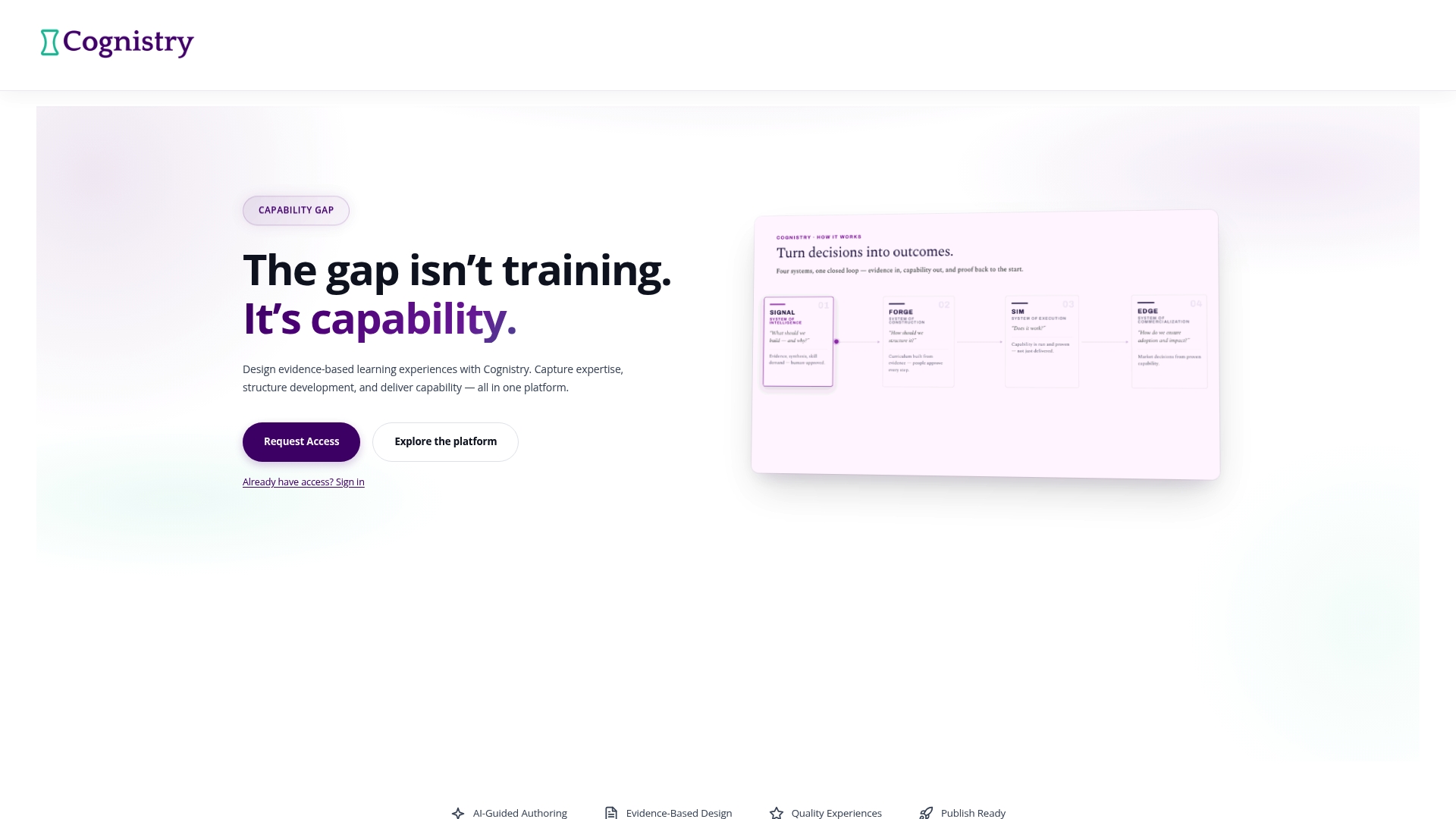
The platform breaks that work into four connected capabilities. Signal maps capability gaps against your actual decision friction. Forge builds the enablement play once diagnosis confirms it’s warranted. Sim authors the practicum simulations that rehearse judgment instead of recalling facts. Edge handles adoption and measures the result back to the business outcome you started with. Together, they run on the Cognistry Platform, the same structure this article just walked through, built so it can be run repeatedly rather than reinvented every time a decision stalls. If your team is still deciding whether the bottleneck is process or capability, book a walkthrough of the Platform and bring one real decision to diagnose live.
Sources
For deeper reading, see McKinsey’s decision speed research, MIT CISR’s decentralization briefing, and Edmondson’s psychological safety work.
- Decentralized decision-making research briefing — MIT CISR (2023)
- Psychological safety in diverse teams — HBS (Edmondson & Lei)
- From training to organizational behavior: a mediation model through absorptive and innovative capacities — PMC (2017)
FAQ
Why Do Operational Decisions Take Too Long?
Slow decisions usually trace back to unclear decision rights, a process applied to the wrong decision type, or environmental blockers like missing evidence, not a lack of skill or effort. Running a rapid diagnosis, mapping owners, inputs, and where delays happen, is the fastest way to find the actual cause.
How Do I Know If Training Will Fix Slow Decisions?
Training only helps when diagnosis shows a genuine capability gap in judgment or absorptive capacity. Peer-reviewed research found training’s effect on performance runs through those capacities, so building content before confirming the gap usually wastes budget without fixing decision speed.
What Is a Minimum Viable Policy?
A minimum viable policy strips decision-making down to published guardrails instead of layered approvals, letting people act within clear limits. MIT CISR’s research associates this approach with teams cutting decision cycle time roughly in half.
How Does Psychological Safety Speed Up Decisions?
Psychological safety lets team members voice missing information or disagreement before a decision is finalized, rather than after it fails. HBS research from Edmondson and Lei found it’s what allows diverse teams to actually use the range of perspectives in the room.
What Does Cognistry Cost?
Pricing for the Cognistry Platform and its Signal, Forge, Sim, and Edge product lines is available directly on the Cognistry site after a demo or trial conversation, since costs depend on the scope of the enablement play your diagnosis calls for.