
Deliberate practice training is the targeted, coached rehearsal of isolated sub-skills, paired with immediate feedback and measurable stretch goals, until performance under real conditions improves. It benefits clinicians refining high-stakes procedures, clinical trainers running workshops, and L&D leads building enablement programs for teams who must act correctly under pressure. The evidence, variants, and resources below show how to build it properly.
TL;DR:
- Deliberate practice requires isolating specific sub-skills, providing immediate expert feedback, and setting incremental stretch goals just beyond current ability.
- Evidence shows simulation-based deliberate practice with structured feedback has a medium to large advantage over traditional methods, especially in procedural skills like resuscitation.
- The most effective programs begin with a thorough diagnosis based on organizational evidence to identify true capability gaps before designing targeted practice episodes.
- Formats such as rapid cycle drills, team simulations, workshops, or ongoing coaching are chosen based on the skill’s complexity, risk of wrong habits, and organizational capacity for sustained effort.
- Successful implementation demands careful planning, short frequent sessions, standardized coaching, and measurement of progress against real organizational outcomes.
Table of Contents
- What makes practice “deliberate” instead of routine repetition
- What the research actually shows about deliberate practice outcomes
- Choosing the right format: RCDP, team practice, and workshops versus ongoing coaching
- How to design a deliberate practice program: diagnosis before you build anything
- Where to find credible deliberate practice training and resources
- A practical checklist for running deliberate practice sessions
- How Cognistry applies the diagnosis-first enablement play at scale
- When deliberate practice is worth the investment
- Start a diagnosis-first pilot for your team
- FAQ
- Sources
What makes practice “deliberate” instead of routine repetition
Most professional “practice” is really just repetition. A resident runs another code. A therapist sees another client. Volume accumulates, but skill plateaus because nothing forces the sub-skill that’s actually broken into focused, corrected repetition. K. Anders Ericsson’s research on expert performance gave this distinction its name: deliberate practice is practice designed around a specific weakness, performed at the edge of current ability, with expert feedback close enough in time to correct the next attempt.
That definition carries real structural requirements, not just good intentions.
- Objective baseline: you measure where performance actually stands before you decide what to practice, not where someone assumes it stands.
- Isolated sub-skills: a complex procedure gets broken into components (airway management, difficult conversation openings, de-escalation sequencing) practiced separately before being reintegrated.
- Immediate expert feedback: correction happens within the same session, often within the same attempt, not in a performance review weeks later.
- Incremental stretch goals: each session targets a goal just beyond current capability, never comfortable and never impossible.
- Repeated rehearsal with correction: the same scenario runs multiple times in one session, with adjustments between reps.
- Measurement built into the cycle: progress is tracked against the sub-skill, not against attendance or hours logged.
A clinical trainer running intubation drills illustrates the contrast well. Routine supervision lets a resident attempt the procedure on the next available patient and offers feedback afterward, if at all. Deliberate practice instead isolates the laryngoscope positioning as its own rep, runs it five times in a row on a task trainer, and corrects grip and angle after each attempt before moving to the next sub-skill. The same logic applies to a therapist working on empathic reflection: instead of waiting for the next session with a live client, a coach plays the role of a difficult client in a two-minute rep, gives immediate feedback, and runs it again.
This is also why deliberate practice differs from simulation generally. A simulation can be realistic and still be practiced the wrong way: run once, debriefed loosely, filed away. Deliberate practice demands structure around the simulation, specifically the baseline, the isolation, the feedback loop, and the stretch goal, or the rehearsal reverts to volume practice with better production values.
What the research actually shows about deliberate practice outcomes
The evidence base for deliberate practice in clinical and procedural training is stronger than for most training methods, largely because the field has produced controlled comparisons rather than satisfaction surveys.
A meta-analysis found that simulation-based medical education paired with deliberate practice produces a meaningful advantage over traditional clinical education, with effect sizes averaging around 0.71 across included studies, a range generally considered medium to large in educational research. That is the strongest single data point behind the method, and it is specific to simulation-based medical education, not training broadly.
A more recent line of evidence looks at Rapid Cycle Deliberate Practice, a variant built for procedural, algorithm-driven skills. In resuscitation training, RCDP learners showed faster time-to-task performance and shorter pause durations compared with learners trained through immersive simulation, along with higher self-rated preparedness. The mechanism is straightforward: RCDP pauses a scenario the moment an error occurs and corrects it immediately, rather than letting the team run the full sequence and debrief afterward, so incorrect choreography never gets the chance to become habit.
Psychotherapy research tells a complementary story. A 10-week deliberate practice training program delivered inside routine clinical services showed feasibility, clinician acceptability, and early signals of improved patient outcomes in pilot evaluations, with machine learning tools piloted to flag sessions that were drifting off track. Separate workshop research found that practitioner-oriented deliberate practice workshops, built around repeated rehearsal and expert feedback, produced better observer-rated skills and stronger retention at follow-up than equivalent didactic workshops.
None of this means deliberate practice is a guaranteed win. The research carries real limits:
- Effect sizes vary widely across studies depending on how rigorously the “deliberate” elements were actually implemented.
- Dose matters: a single workshop rarely produces durable skill change without follow-up rehearsal.
- Resource intensity is real: expert feedback, task trainers, and protected practice time all cost something, and the research doesn’t settle how much is enough for every skill.
The pattern across these studies is consistent even where the magnitude isn’t: structured, corrected, isolated rehearsal consistently outperforms exposure alone.
Choosing the right format: RCDP, team practice, and workshops versus ongoing coaching
Deliberate practice isn’t one format. The right structure depends on what kind of skill is breaking down and what it costs to get it wrong.
Rapid Cycle Deliberate Practice fits algorithmic, highly choreographed procedures where a wrong sequence has to be caught in the moment. Resuscitation, intubation, and other emergency protocols are the classic use case: the facilitator pauses the scenario at the first deviation, corrects it, and restarts the sequence from that point rather than letting the team finish and debrief later. That immediacy is the entire point. RCDP is particularly effective for tasks with a fixed correct sequence, because it prevents a wrong habit from ever being reinforced through repetition.

Team deliberate practice targets coordination rather than individual technique. A review of team-based and repeated simulation exposure found that the active ingredients driving improvement were repetition and expert facilitation, not any particular curriculum design. Study designs in this area are heterogeneous enough that aggregating a single effect size is difficult, but the direction of the signal consistently favors repeated, facilitated exposure over one-off team simulations.
Workshop-format deliberate practice compresses rehearsal into a concentrated block, typically a day or a few days, with high-intensity reps and immediate coaching. It works well for discrete skills that can be practiced and largely mastered in a short window, like a specific therapeutic technique or a scripted difficult conversation.
Longitudinal coached practice spreads the same rehearsal structure across weeks or months, with spaced sessions and periodic reassessment. It suits skills that decay without maintenance or that develop through gradual refinement, like ongoing clinical judgment or complex interpersonal skills.
The decision between them comes down to three questions: Does the skill have a fixed correct sequence, or does it require judgment under variable conditions? Is the risk of a wrong habit forming in a single session high enough to need immediate correction? And does the organization have the capacity to sustain coached practice over months, or only the budget for a single intensive session?

How to design a deliberate practice program: diagnosis before you build anything
Most training failures trace back to one decision made too early: building the course before confirming that a capability gap, and not something else entirely, is actually the problem, a challenge explored in Odesa. A diagnosis-first approach treats deliberate practice as an enablement play grounded in organizational evidence, not a default response to a performance complaint.
- Diagnose the capability gap from organizational evidence. Before designing any practice episode, pull from what the organization already knows: quality audit findings, incident reports, supervisor observations, client outcome data, or frontline friction logs. If the evidence points to a system or environment problem (unclear protocols, missing equipment, conflicting incentives), training is not the right response, and no amount of deliberate practice fixes it.
- Confirm learning is the right response. Once the evidence points to an actual skill or judgment gap, rather than a resource, policy, or process gap, deliberate practice becomes a reasonable next step.
- Set SMART stretch goals tied to the evidence. A stretch goal should sit just past current capability and connect directly to the outcome the organizational evidence flagged: faster time-to-correct-airway-positioning, more accurate escalation calls, better observer-rated empathic response.
- Build the practice episode. Each episode needs four parts: a realistic stimulus (case, scenario, simulated patient), a scoring rubric that defines what “correct” looks like, a coach script that standardizes feedback language, and a feedback cadence that delivers correction within the same session.
- Plan measurement before the first session runs. Establish a baseline score, track session-level metrics across reps, check outcomes against the original organizational evidence, and define the threshold at which the practice moves from pilot to scale.
- Build in spaced repetition and maintenance. A skill that isn’t revisited decays. Schedule follow-up sessions at increasing intervals and set a maintenance gate, a minimum performance level that triggers a booster session if crossed.
A clinical diagnostics guide behind this approach recommends reviewing a substantial sample, often dozens of cases, roughly 60, before drawing firm conclusions about which sub-skill actually needs practice. Skipping that step is the single most common design failure: teams jump to a plausible-sounding training topic instead of the one the evidence actually supports.
Pro Tip: Run the diagnosis on paper before booking a single practice session. If you can’t point to the organizational evidence behind the stretch goal, the goal isn’t ready yet.
This diagnosis-first sequence mirrors how decision practice builds operational judgment rather than knowledge recall: the goal of every episode is a better decision under real conditions, not a better score on a quiz about the decision.
Where to find credible deliberate practice training and resources
Not every book or workshop labeled “deliberate practice” actually builds the structure the method requires. Here’s what’s worth your time and what to check before you commit budget.
- Clinical practitioner texts like the APA’s sample chapter on using deliberate practice to improve therapeutic effectiveness pair outcome monitoring (feedback-informed treatment) with coached rehearsal targeted at specific clinical “trouble spots,” the uncomfortable, high-stakes moments in a session rather than general skills.
- Modality-specific chapters, such as the deliberate practice in CBT sample material, show how to separate skill components for isolated practice before reintegrating them, typically using graded difficulty from beginner to advanced scenarios.
- RCDP and simulation master trainer pathways exist through simulation centers and professional societies for clinicians who want to run Rapid Cycle Deliberate Practice sessions themselves, usually structured around a certification or train-the-trainer track.
- Workshop-format courses should show you a curriculum before you enroll: look for baseline assessment, a defined scoring rubric, scheduled feedback within the session, and a follow-up or retention check, not just a day of content delivery.
- Low-cost starting points include the free study summaries and sample chapters linked throughout clinical deliberate practice literature, useful for building internal pilot sessions before paying for a full program.
The clearest red flag when vetting a vendor or trainer: a program heavy on content delivery and light on feedback time. Deliberate practice requires isolating sub-skills and practicing at the edge of ability with explicit feedback; a course that schedules practice time without diagnostics or coaching is unlikely to produce the gains the research describes, no matter how polished the materials look.
A practical checklist for running deliberate practice sessions
Before launching, confirm the basics are in place, then run the cycle.
- Pre-launch diagnostics: pull organizational evidence, select 2-3 representative cases or scenarios, and confirm training is the right response before building anything.
- Session design: define the objective, the stimulus, the scoring rubric, the feedback cadence, and the number of reps per session.
- Scheduling: short, frequent sessions beat long, infrequent ones. Most clinical deliberate practice programs run weekly or biweekly sessions of 30 to 90 minutes rather than one long annual workshop.
- Troubleshooting common pitfalls: if learners are “grooving” the same error repeatedly, the feedback loop is too slow, tighten it. If coaches vary wildly in what they correct, standardize the coach script. If progress stalls, check whether the stretch goal moved too far past current ability.
- Scale decisions: only expand a pilot to additional teams once baseline-to-outcome measurement shows consistent improvement across the pilot group, not just engagement or attendance.
Pro Tip: Track one number across every session: the gap between the stretch goal and the actual score. If that gap stops shrinking after a few sessions, the coaching or the goal needs to change, not the schedule.
How Cognistry applies the diagnosis-first enablement play at scale
Running deliberate practice well inside a single workshop is one challenge. Running it consistently across departments, with evidence behind every design choice, is a different kind of problem, and it’s the one we built our platform to solve.
Our diagnosis-first approach starts before any practice episode gets built: we pull from an organization’s own evidence and expertise to determine what capability the work requires and whether a learning response is justified at all.
- Signal maps capability gaps from organizational evidence, so a stretch goal is tied to an operational finding rather than a guess.
- Forge structures the response once a gap is confirmed, building practice episodes, rubrics, and feedback sequences the design stage calls for.
- Sim builds the decision practice environments where rehearsal happens safely, letting learners run high-stakes scenarios repeatedly without real-world risk.
A pilot with our platform typically moves through four stages: a diagnostic review of existing organizational evidence, a decision on whether deliberate practice is the right enablement play, a design phase that builds the specific practice episodes, and a proof stage that checks baseline-to-outcome movement against the original evidence.
Before procuring any platform for this work, ask the vendor three questions: Does the system start with organizational evidence or with a course template? Does it measure outcomes against the business problem, or against completion? And does it build judgment through practiced decisions, or recall through content delivery?
When deliberate practice is worth the investment
Deliberate practice works, but it isn’t free, and the evidence supports a specific, narrower claim than “practice more.” Diagnosis-first design reduces wasted spend precisely because it stops teams from building expensive simulation infrastructure around a skill gap that turns out to be a process gap in disguise.
Expect incremental improvement, not transformation. The strongest effect sizes in the research come from tightly scoped, well-resourced programs targeting a specific procedural or interpersonal sub-skill, not sweeping organizational retraining. That’s a feature, not a limitation: it means the resource intensity, expert feedback, task trainers, protected time, scales with the specificity of the goal.
The practical path is a focused pilot on one high-leverage skill, measured against a real baseline, before any decision to scale. Everything else, the format, the dose, the tooling, follows from what that pilot actually shows.
— Brian
Start a diagnosis-first pilot for your team
Most training requests start with “we need a course.” We start earlier: a short diagnostic review of the evidence behind the request, strategy documents, quality findings, frontline friction, before deciding whether deliberate practice is even the right enablement play.
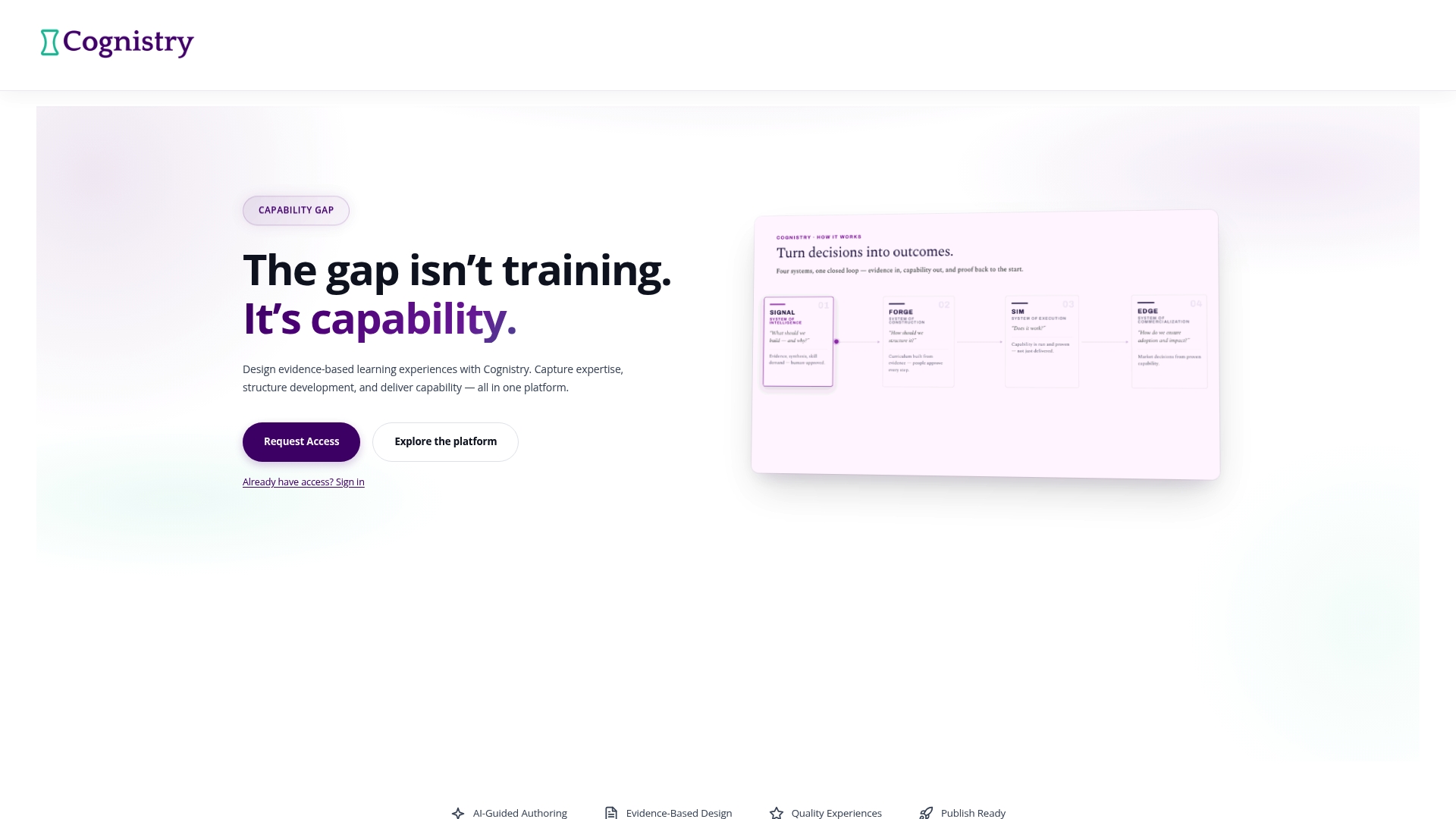
If the diagnosis points to a real capability gap, our platform carries the work forward end to end. Signal turns organizational evidence into a mapped capability gap. Forge structures that gap into coached practice episodes with scoring rubrics and feedback cadence built in. Sim runs the rehearsal itself inside a decision practice environment, so learners work through realistic scenarios without real-world risk.
L&D leads, clinical training managers, and operations leaders are typically the ones who bring a pilot to us, usually starting with one skill rather than a full program. For teams managing adoption and behavior change after a program launches, our Edge offering picks up where the pilot leaves off.
Ready to see whether deliberate practice is the right next step for your team? Visit our Cognistry Platform page to request a diagnostic review and scope a pilot.
FAQ
What are the 5 steps of deliberate practice?
Deliberate practice generally follows five steps: establish an objective baseline, isolate a specific sub-skill, set a stretch goal just beyond current ability, rehearse with immediate expert feedback, and measure progress to decide whether to repeat, adjust, or advance. The exact sequence varies by program, but these components appear consistently across clinical and procedural training literature.
What is a red flag in therapy?
In the context of deliberate practice training, the clearest red flag is a program that schedules practice time without diagnostics, scoring, or coaching behind it. Deliberate practice requires isolating sub-skills and practicing at the edge of ability with explicit feedback, so a workshop built mainly around content delivery rather than corrected rehearsal is unlikely to produce the skill gains the method is known for.
What are examples of deliberate practice?
Common examples include a clinical trainer isolating laryngoscope positioning for repeated, corrected reps on a task trainer, a therapist rehearsing empathic reflection with a coach playing a difficult client, and resuscitation teams running Rapid Cycle Deliberate Practice drills that pause and correct at the first deviation from protocol. Each example shares the same structure: a narrow skill, immediate feedback, and repeated correction rather than a single run-through.
What are the key principles of deliberate practice?
The key principles are an objective baseline, isolated sub-skills, immediate expert feedback, incremental stretch goals set just past current ability, repeated rehearsal with correction, and built-in measurement. These principles distinguish deliberate practice from routine supervision or volume-based repetition, which rarely isolate a specific weakness or correct it in real time.
How is deliberate practice different from regular training?
Regular training often delivers content or allows general repetition without a diagnosed sub-skill, immediate correction, or measured stretch goals. Deliberate practice training instead starts with a diagnosis of what capability the work actually requires, then builds focused rehearsal around that specific gap with feedback close enough in time to correct the next attempt.
Sources
- Does simulation-based medical education with deliberate practice yield better results than traditional clinical education? (meta-analysis)
- Better Results: Using Deliberate Practice to Improve Therapeutic Effectiveness (sample chapter)
- Deliberate practice training approach could improve effectiveness of psychological therapy