
Evidence-Based Training: A Leader’s Guide to Real Results
Evidence-based training (EBT) is a capability-first approach that uses an organization’s own evidence to decide whether learning is the right enablement play and, if so, designs practice and measurement to change behavior, not just knowledge. Before you build a single course, the right move is to diagnose what capability the work actually requires, then determine whether a learning response is warranted at all.
Three things define a genuinely evidence-based program:
- Diagnosis before design. Organizational evidence, including strategy documents, quality findings, incident reports, and frontline friction, drives the decision to build, not vendor recommendations or gut instinct.
- Evidence tiers matter. The U.S. Every Student Succeeds Act (ESSA) uses four tiers of evidence, from strong experimental evidence down to a logic-model rationale, giving leaders a practical lens for evaluating any program’s claims.
- Cross-industry proof exists. Aviation’s ICAO/IATA guidance shows what happens when operational data drives competency design across a multi-year cycle. Cognistry applies the same logic to enterprise workforce development.
Key Takeaways
Evidence-based training produces measurable behavior change only when it starts with a capability diagnosis grounded in organizational evidence, not a course request.
| Point | Details |
|---|---|
| Diagnose before you build | Pull quality findings, incident data, and strategy documents before deciding whether a learning enablement play is warranted. |
| Apply learning-science methods | Spaced practice, retrieval, interleaving, and decision simulations outperform passive content delivery for retention and transfer. |
| Measure behavior, not completion | Track decision-quality signals and operational KPIs, not quiz scores or module completion rates. |
| Plan sustainment from day one | Reinforcement schedules and manager enablement must be built into the program design, not added after deployment. |
| Cognistry starts with diagnosis | Cognistry maps organizational evidence to capability gaps before any course or simulation is designed, then measures outcomes back to the business. |
Table of Contents
- What evidence-based training actually means (and how it differs from what most organizations do)
- Core principles that define a high-quality evidence-based program
- Learning-science methods that reliably improve retention and transfer
- How to implement evidence-based training step by step
- How to measure training effectiveness and connect it to business outcomes
- Common failure modes when a program claims to be evidence-based
- What to ask vendors and internal teams that claim to deliver evidence-based training
- How Cognistry implements evidence-based training: diagnosis, decision practice, and measurement
- Where evidence-based training delivers the most value
- Why diagnosis-first training is the only frame that holds up
- Cognistry gives you a diagnosis before it gives you a course
- Sources
What evidence-based training actually means (and how it differs from what most organizations do)
Most organizations build training because someone asked for it. Evidence-based training starts from a different question: what does the work actually require, and what does our evidence say about the gap?
Evidence-based instruction is grounded in criteria that any L&D leader can apply: objectivity, reliability, validity, systematic methods, and peer review. Applied to the workplace, that means design decisions must trace back to verifiable organizational sources, not tradition, vendor claims, or the loudest voice in the room.
Aviation offers the clearest sector-level model. SKYbrary defines EBT as assessment and training designed to develop competence across multiple domains using operational evidence rather than isolated event repetition. IATA’s implementation guide extends that definition: EBT is competency-focused, driven by operational data, and structured across modules with evaluation and training phases over a multi-year cycle.
The contrast with traditional training is stark:
| Dimension | Evidence-based training | Traditional/opinion-based training |
|---|---|---|
| Starting point | Diagnosed capability gap, grounded in organizational evidence | Perceived need, stakeholder request, or vendor pitch |
| Evidence sources | Quality findings, operational telemetry, incident data, strategy | Subject-matter opinion, course catalog, compliance mandate |
| Design focus | Competency and decision practice | Knowledge transfer and content coverage |
| Measurement | Behavioral change linked to operational KPIs | Completion rates, satisfaction scores, quiz pass rates |
| Expected outcome | Sustained behavior change and performance improvement | Short-term knowledge gain, often without transfer |
Organizational evidence sources worth capturing before any design work begins:
- Strategy statements and operational priorities
- Quality audit findings and near-miss reports
- Customer complaint and escalation data
- Frontline friction logs and supervisor observations
- Incident and error-rate data by role or process
Core principles that define a high-quality evidence-based program
A program earns the label “evidence-based” through its design logic, not its marketing copy. Practitioner guidance consistently points to performance and competency orientation as the foundation: training should assess and develop observable behaviors that predict on-the-job performance, not behaviors that are merely easy to measure.
Six principles separate programs that work from programs that look good on paper:
- Diagnose before you build. Map the capability the work requires. Identify whether the gap is a person problem, an environment problem, or both. Only then decide if a learning enablement play is appropriate.
- Orient to competency and decision-making. Design for the decisions people must make under real conditions, not for the content a subject-matter expert wants to cover.
- Build real-world practice into the structure. Simulations, worked examples, and decision scenarios are not add-ons. They are the mechanism through which capability transfers to the job.
- Apply learning-science foundations. Spaced practice, retrieval, and interleaving are not preferences. They are the methods cognitive science has validated for retention and transfer.
- Measure back to business metrics. Every program needs a pre-defined operational KPI it is expected to move, and a method for detecting whether it moved.
- Plan for sustainment from day one. Reinforcement schedules, manager enablement, and environmental supports are part of the design, not afterthoughts.
How a single principle changes a design decision: if you apply principle two (competency and decision-focus) to a manager training program, you stop building slides about “giving feedback” and start building scenarios where the manager must decide how to respond to a specific underperformance situation, with consequences that play out based on their choice. The content is the same. The capability outcome is entirely different.
Pro Tip: Before finalizing any program design, tie it explicitly to one operational KPI your executive sponsor already tracks. That single step forces the right conversation about what “success” means before a dollar is spent on development.
Learning-science methods that reliably improve retention and transfer
The gap between what people learn in training and what they do on the job is not a motivation problem. It is a design problem. Cognitive-science research consistently shows that spaced practice, retrieval practice, interleaving, and elaboration outperform passive listening or rote memorization for both retention and transfer to new contexts.
Here is what each method means in practice and how to embed it in a workplace program:
- Spaced practice. Distribute learning across multiple sessions rather than concentrating it in a single event. In a workplace program, this means replacing a two-day workshop with five 30-minute practice sessions spread over three weeks, with a brief retrieval check at the start of each.
- Retrieval practice. Require learners to recall information from memory rather than re-read or re-watch it. Embed low-stakes quizzes, scenario prompts, or “what would you do?” challenges at the start of each session, not just at the end of a module.
- Interleaving. Mix problem types or skill areas within a practice session rather than blocking all examples of one type together. A sales program, for instance, might alternate between objection-handling scenarios and discovery-question scenarios rather than running all objection drills first.
- Worked examples. Show learners a fully solved problem before asking them to solve one independently. This is particularly effective early in skill acquisition, when cognitive load is highest.
- Desirable difficulties. Introduce manageable challenges, such as slightly ambiguous scenarios or time pressure, that force deeper processing. Easy practice feels productive but produces shallow encoding.
- Simulation and decision practice. Place learners in realistic decision environments where they must apply judgment under conditions that approximate the job. This is the highest-fidelity transfer method available without putting learners in live operational situations.
Statistic callout: A systematic review published on PubMed found that training increased short-term knowledge and adherence but did not reliably increase adoption or demonstrate clear client outcomes. Evidence strength was rated low-to-moderate across studies, underscoring that knowledge gain alone is not a sufficient measure of training success.
The implication is direct: if your program measures only quiz scores or completion rates, you are measuring the least predictive signal available. Behavioral practice metrics and decision-quality signals are what connect learning to performance.
How to implement evidence-based training step by step
Most programs fail before design begins because no one asked the right diagnostic questions. This sequence keeps the work grounded from the start.
- Conduct a capability diagnosis. Pull quality findings, error-rate data, incident reports, and strategy documents. Interview frontline supervisors and subject-matter experts. Map what the work actually requires against what people currently do.
- Apply the decision gate. Ask whether the gap is a knowledge or skill problem, an environment or process problem, or a motivation and consequence problem. A learning enablement play is appropriate only when the gap is genuinely a capability gap. Environment and process gaps require different responses.
- Define the competencies and decisions to develop. Specify the observable behaviors and decision types the program must produce. Avoid vague outcomes like “understands customer needs.” Write outcomes like “selects the correct escalation path when a customer presents two or more risk indicators.”
- Design for practice, not coverage. Structure the program around decision scenarios and retrieval practice, with content serving as reference material rather than the primary delivery vehicle. Use decision-centered simulations to build judgment in realistic contexts.
- Run a structured pilot. Select a representative cohort of 15–30 learners. Define success criteria before the pilot begins: which behavioral metric will move, by how much, over what period. Collect baseline data before launch.
- Build sustainment into the rollout plan. Schedule spaced practice sessions, manager check-ins, and reinforcement prompts as part of the program calendar. Sustainment is not optional; it is where behavior change either consolidates or evaporates.
- Instrument for behavioral telemetry. Track decision-quality signals, time-to-decision, error rates, and practice completion, not just module completion. Connect those signals to the operational KPI you defined in step one.
- Review and iterate post-pilot. Analyze behavioral data against the pre-defined success criteria. Adjust design, practice cadence, or enablement supports before scaling.
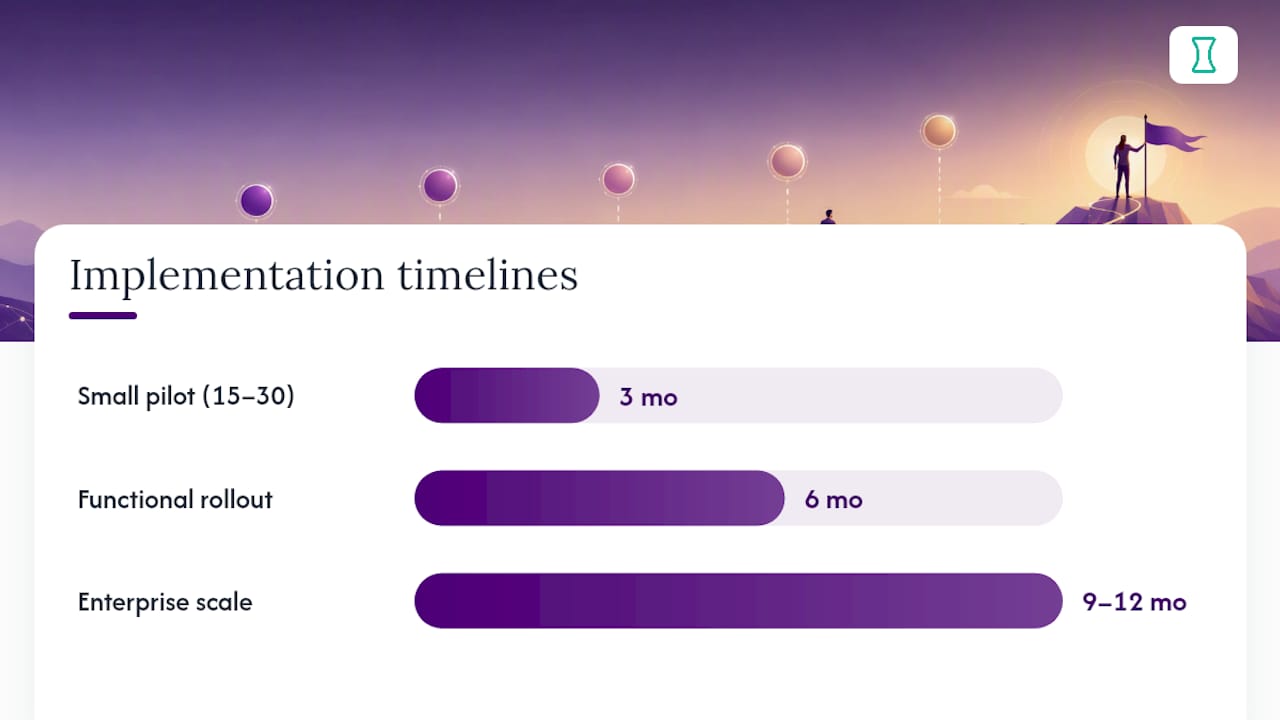
Rough timelines to plan against:
- Small pilot (15–30 learners, one functional area): 3 months from diagnosis to post-pilot review
- Functional rollout (one department or business unit): 6 months including pilot, iteration, and scaled deployment
- Enterprise scale (multiple functions or geographies): 9–12 months with governance, localization, and measurement infrastructure
Where to invest: Diagnosis and measurement infrastructure are chronically underfunded. Most organizations spend the majority of their L&D budget on content development and delivery. The programs that produce measurable outcomes tend to invert that ratio, spending proportionally more on diagnosis, simulation design, and behavioral telemetry. For teams building analytics and reporting infrastructure to support this work, operational analytics guidance can help operationalize telemetry from the start.
How to measure training effectiveness and connect it to business outcomes
Completion rates and satisfaction scores are not measures of capability. They are measures of attendance and preference. The metrics that connect learning to business outcomes look different.
Recommended metrics for an evidence-based program:
- Behavioral practice metrics. How often are learners engaging with practice scenarios? What decision paths are they choosing, and how does that distribution shift over time?
- Decision-quality signals. In simulation environments, what percentage of decisions align with the target competency? How does that percentage change across practice sessions?
- Time-to-decision. As learners build competence, decision latency typically decreases. Tracking this over a cohort reveals whether fluency is developing.
- Error rates in operational context. Compare pre-program and post-program error rates for the specific task or decision type the program targeted. This is the most direct link to business outcomes.
- Customer and quality KPIs. For programs targeting customer-facing or quality-critical roles, track the downstream KPI the program was designed to move: complaint rates, escalation frequency, audit findings, or similar.
A concrete mapping example: a frontline quality program uses decision simulations to develop escalation judgment. The learning metric is decision-simulation accuracy across three practice sessions. The business metric is the rate of undetected quality escapes per 1,000 units. If simulation accuracy improves and escape rate drops in the pilot cohort relative to a control group, you have a defensible causal link, not just a correlation.
Statistic callout: WHO data shows that investing in treatment for depression and anxiety yields a positive economic return, which supports the business case for workplace mental-health enablement plays. The same measurement logic applies: define the operational outcome the program is expected to influence, then track it.
For teams that want to go deeper on connecting training to decision-quality metrics, the link between practice signals and operational performance is where the most defensible ROI arguments are built.
Common failure modes when a program claims to be evidence-based
The phrase “evidence-based” has become a marketing claim as much as a design standard. Knowing the failure modes protects your investment.
Common pitfalls:
- Skipping diagnosis. The most frequent failure. Organizations jump to course development because a stakeholder requested training, not because a capability gap was confirmed. The result is content that addresses the wrong problem.
- Single-shot workshops. A one-day session, however well-designed, cannot produce durable behavior change. Without spaced practice and retrieval, most of what is learned is forgotten within days.
- No measurement beyond completion. If the only data collected is who finished the module and what score they got on the end quiz, the program has no way to demonstrate that behavior changed or that business outcomes moved.
- Relying on face validity. “This feels relevant” is not evidence. Vendor claims that a program is “research-backed” without specifying which research, what the study design was, or how the findings apply to your context are not evidence either.
- Ignoring enablement and environment. Training cannot fix a broken process, an unclear policy, or a management culture that punishes the behaviors the training is trying to build. Diagnosing environment gaps before building a learning response is not optional.
- No sustainment plan. A program that ends at deployment is a program that fades. Reinforcement schedules, manager coaching, and periodic retrieval practice must be built into the design from the start.
Red-flag questions to screen any program or vendor:
- What organizational evidence did you use to diagnose the capability gap?
- What is the evidence tier for the methods you are using (experimental, quasi-experimental, correlational, or logic model)?
- How will you measure behavior change, not just knowledge gain?
- What is the sustainment plan after initial deployment?
- Can you show pilot results with pre-defined success criteria?
If a program is already in place and underperforming, the recovery path starts with the same diagnostic step that should have come first. Pull the operational data, identify whether the gap is a capability problem or an environment problem, and redesign the enablement play from that finding. Why training often fails to change culture is a useful frame for understanding what organizational barriers are actually blocking transfer.
What to ask vendors and internal teams that claim to deliver evidence-based training
Procurement decisions in L&D are often made on the basis of demos and testimonials. The questions below shift that conversation to evidence.
Vendor evaluation checklist:
- Ask for the evidence sources they used to design the program. Peer-reviewed research, systematic reviews, and operational data from comparable organizations are acceptable. “Our instructional designers have 20 years of experience” is not.
- Request pilot results with pre-defined success criteria. A vendor who has never run a measurable pilot has never tested whether their program works.
- Ask what behavioral metrics the program tracks and how those connect to operational KPIs. If the answer is completion rates and quiz scores, that is a knowledge-delivery product, not a capability program.
- Confirm the sustainment plan. What happens after the initial deployment? Who owns the reinforcement schedule? What does the program look like at month six?
- Ask whether they can work from your organizational evidence. A genuinely evidence-based vendor will want your quality findings, incident data, and strategy documents. A content vendor will want your topic list.
Contract guardrails worth requiring:
- A pilot phase with measurable success criteria agreed before work begins
- Access to behavioral telemetry and decision-quality data throughout the program
- A post-pilot review with a go/no-go decision gate before full rollout
- A shared measurement taxonomy so that learning metrics and business metrics use the same definitions
Practical verification without a research background:
- Ask the vendor to name the specific studies or systematic reviews their methods are based on. Then look those studies up. If they cannot name them, the “evidence-based” claim is marketing.
- Check whether the methods they describe (spaced practice, retrieval, simulation) match what the program actually delivers. Many programs describe evidence-based methods in their sales materials and then deliver slide decks.
- Require a demonstration of the measurement dashboard before signing. If the platform cannot show you decision-quality data or behavioral telemetry, it is not built for capability measurement.
For teams evaluating whether a learning design tool is actually built for capability development rather than content authoring, why authoring tools alone won’t achieve behavior change is a useful reference before any procurement decision.
How Cognistry implements evidence-based training: diagnosis, decision practice, and measurement
Cognistry’s approach starts where most platforms stop: before the course exists.
The workflow follows a deliberate sequence. First, Cognistry captures the organizational evidence that should drive design: strategy documents, frontline friction, quality findings, and subject-matter expertise. From that evidence base, it determines whether a learning enablement play is the right response at all. If the gap is environmental or structural, the answer may not be a course. If it is a genuine capability gap, the design work begins.
From that foundation, Cognistry structures the response:
- Capability signal mapping. Identify the specific decisions and behaviors the work requires, grounded in the organization’s own evidence, not a generic competency framework.
- Decision-centered simulations. Build practice environments where learners must apply judgment under realistic conditions, with behavioral telemetry tracking decision paths and quality signals across sessions.
- Learning architecture. Structure spaced practice, retrieval, and interleaving into the program calendar so that the learning-science methods are built into the design, not bolted on afterward.
- Measurement back to the business. Connect practice metrics (decision accuracy, time-to-decision, behavioral shift across sessions) to the operational KPI the program was designed to move.
This is the difference between a capability engineering platform and a slide authoring tool. Cognistry is not built to generate content quickly. It is built to decide what capability to develop, prove why, and show that it worked.
Where evidence-based training delivers the most value
Not every organizational problem is a training problem. EBT delivers the most value when the gap is genuinely a capability gap and when the program is designed to develop judgment, not just knowledge. Three use cases illustrate the range:
- Sales decision practice. Sales underperformance is rarely a knowledge problem. Reps know the product. The gap is usually in decision-making under pressure: when to escalate, how to respond to a specific objection type, when to walk away. Decision simulations built from real sales scenarios, with spaced practice across a six-week cadence, develop the judgment that a two-day product training never reaches. For organizations looking at sales performance through a capability lens, the design logic is the same: diagnose the decision gap, build practice around it, measure the outcome.
- Frontline quality escalation. Quality failures often trace back to a single decision point: a frontline worker who did not recognize the signal that warranted escalation. An evidence-based program for this context starts with incident data to identify the specific recognition failures, builds decision scenarios around those exact patterns, and tracks whether escalation accuracy improves in the operational environment post-training.
- Manager mental-health first-response practice. Workplace mental-health training for managers is a growing priority, and the WHO’s economic data on the return from addressing depression and anxiety supports the business case. The scope of an evidence-based program here is specific: build recognition and referral skills, not clinical treatment competency. Managers should be able to recognize distress signals, respond with appropriate language, and refer to professional support. Decision simulations for this use case are built around realistic conversation scenarios, not awareness slides.
A note on tailoring: evidence-based programs must account for the diversity of the learner population. Scenario content, language, and context should reflect the actual work environment of the learners, not a generic corporate template. Diagnosis that includes frontline voices and representative operational data is the most reliable way to get this right.
Why diagnosis-first training is the only frame that holds up
Most L&D investment is wasted not because the training was bad, but because it was built before anyone confirmed that training was the right answer. That is the uncomfortable truth the evidence keeps surfacing.
The systematic review literature is clear: training reliably improves short-term knowledge. It does not reliably change behavior or produce measurable client outcomes without organizational enablement and sustainment. That finding should reframe how every L&D leader thinks about their budget. The question is not “how do we build better courses?” It is “how do we confirm the gap, design for behavior change, and measure whether it happened?”
The diagnosis-first frame is not a methodology preference. It is the only approach that produces defensible answers to the questions executives are now asking: Did this work? How do we know? What changed in the business?
Run a short diagnostic pilot before committing to a full program build. Pull the operational data. Map the capability the work requires. Decide whether a learning enablement play is warranted. That 30-day diagnostic step will save more budget than any course redesign.
Pro Tip: Bring your executive sponsor into the diagnostic review, not just the program launch. When they see the evidence map and the pre-defined success criteria before a dollar is spent on development, the conversation about ROI becomes much easier to have after deployment.
Cognistry gives you a diagnosis before it gives you a course
Most platforms start with a blank canvas and ask you to fill it. Cognistry starts with your organizational evidence and asks what the work actually requires.
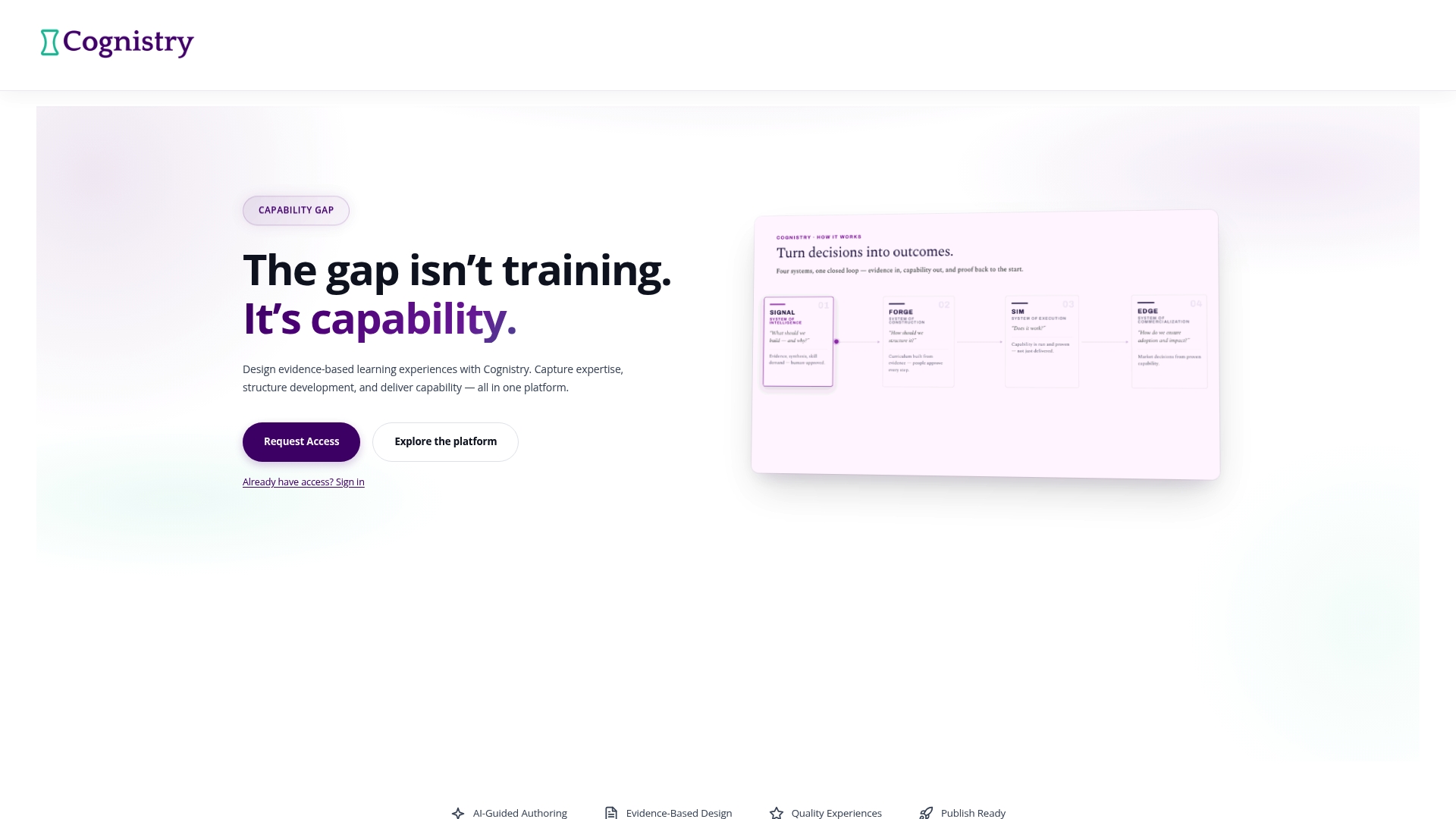
A Cognistry demo is not a product walkthrough. It is a working session that produces three things: an evidence map of the capability gap you bring to the conversation, a sample pilot scope with pre-defined success criteria, and an initial measurement framework that connects practice metrics to the operational KPI you care about. You leave with a diagnosis, not a brochure.
If you are ready to move from course-building to capability engineering, explore the Cognistry platform or see how decision simulations work in a live environment. The diagnostic conversation takes 45 minutes. The clarity it produces tends to last considerably longer.
Sources
- What Is Evidence-Based Instruction? | Reading Rockets
- Effectiveness of training methods for delivery of evidence-based psychotherapies: a systematic review
- Learning techniques and cognitive science — PubMed
- Evidence-Based Training Implementation Guide — IATA
- Investing in treatment for depression and anxiety leads to fourfold return — WHO
- Evidence-Based Staff Training: A Guide for Practitioners