

A forward deployed capability engineer (Capability FDE) is the person who makes sure the work counts once AI agents join it. The technical forward deployed engineer gets an AI system running inside your business. The Capability FDE defines what the people and the agents must each be able to do, holds both to one bar, tests both on the same scenarios, and gets the result accepted by a named person. Before you build that training course or sign off that agent, this is the role that decides what capability the work actually requires.
The idea matters because most firms describe their AI agents precisely and their people vaguely. An agent gets a scope, an evaluation set and an error budget. The person who reviews its output gets a job title and a one-hour course.
TL;DR
- A technical FDE makes an AI system work inside a customer’s environment. A Capability FDE makes the work count: people and agents held to one bar.
- The gap to close is that agents are defined precisely and people vaguely. Verified is not the same as accepted.
- Five moves: units of work with a bar and an acceptor, one human-and-agent spec, shared decision scenarios that include AI errors, evidence for managers’ allocation calls, and value against a finance-signed baseline.
- The two FDEs work as a pair. Neither is change management, training delivery or surveillance.
- Test yourself: for one AI-touched task, how was the agent tested, and how was the person who accepts its work tested?
Table of Contents
- Start with the technical FDE
- The imbalance: agents defined precisely, people vaguely
- Verified versus accepted
- The five moves of a Capability FDE
- Before the course: is training even the right response?
- How the two FDEs pair
- What a Capability FDE is not
- Where it differs from other roles
- Perspective
- How we support this work
- A test you can run this week
- FAQ
- Sources
Start with the technical FDE
The title “forward deployed engineer” comes from software. McKinsey’s explainer describes an FDE as an engineer who works inside the client’s system and leaves behind a product, which is what separates the role from a consultant. A developer, by contrast, usually has a predefined product. The FDE first has to understand the problem and agree with the client what the solution should look like.
In practice that looks like a small team embedded in a customer’s operation for a defined stretch. Salesforce describes FDE pods that focus full-time on one client for about three months to deploy an agent for one or two use cases. Deloitte describes a unit of one engineer and one designer that, in a matter of weeks, built an AI-enabled migration tool matching legacy and new digital assets one-to-one, with compatibility scores and edge cases flagged for human review.
Read that last detail again. The tool flags edge cases for a human. Someone has to look at them, decide, and be right. The technical FDE built the flagging. Nobody on that page is described as defining what the reviewer must be able to judge.
That is the gap the Capability FDE fills.
Why the term is shifting from a job to a capability
A Microsoft engineering post notes that forward-deployed engineering began as a job title but is increasingly used to describe capability, not just job function: a small multidisciplinary team pointed at a measurable business outcome. We take that one step further. If AI deployment is a team sport, the human side of the team needs an engineer too.
The imbalance: agents defined precisely, people vaguely
Look at how a typical organization specifies an AI agent for, say, handling vendor invoice exceptions:
- The task is named and bounded.
- Inputs and outputs are defined.
- A test set of real cases exists.
- Failure modes are logged and a threshold is set.
Now look at how the same organization describes the accounts payable specialist who works alongside it:
- “Reviews exceptions.”
- “Completed AI awareness training.”
One side has a spec and a test. The other has an activity and a certificate. When an error slips through, nobody can say whether the agent failed, the person failed, or the handoff between them failed, because only one of the three was ever defined.
CIO’s description of the technical FDE shows where the exposure sits. It says the role has to catch the 10 to 20 percent of AI output that is wrong and design validation, human-in-the-loop checkpoints and fallbacks. A checkpoint is only as good as the person standing at it. Designing the checkpoint without defining that person’s capability leaves half the control unbuilt.
Verified versus accepted
This distinction is the center of the role.
Verified means a test says the agent’s output meets a standard. It is a technical statement.
Accepted means a named person puts their name to the work as fit for use. It is an accountability statement.
Most AI programs stop at verified. The model passes its evaluation, the dashboard goes green, and the work moves downstream. But somebody still has to accept it: the claims supervisor, the pharmacist, the maintenance planner, the controller. That person’s acceptance is the real quality gate, and they are rarely tested on whether they can spot the case where the agent is confidently wrong.
An illustration, not a case study: picture a regional lender where an agent drafts adverse-action explanations. Legal verifies the template. The agent passes its test set. A compliance reviewer accepts each draft. But the reviewer was onboarded with a policy walkthrough, never shown a draft where the agent cites a reason that contradicts the file. The agent is verified. The acceptance is untested. When the first contradictory draft goes out, the question “who should have caught this?” has no defensible answer.
The Capability FDE closes that by making acceptance a defined, tested capability instead of an assumed one.

The five moves of a Capability FDE

1. Define units of work, each with a bar and an acceptor
Stop describing jobs. Break the work into units: one invoice exception, one prior-authorization packet, one customer escalation. For each unit, state the bar (what good looks like, in terms the business uses) and name the acceptor (the person who signs it off). Without an acceptor, a bar is a wish.
This is where observation of real work starts. Jay Burgess’s essay on the FDE loop makes the point that practitioners should ask for the last forty real cases, not a representative set picked to flatter the design. The same discipline applies here: define units from the organization’s own recent work, quality findings and frontline friction, not from the job description.
2. Write one spec for the human and the agent
A single document says which parts of the unit the agent handles, which parts the person handles, and where the handoff happens. It states what the agent must do, what the person must be able to do, and what each must do when the other is wrong.
This replaces two parallel artifacts, the agent’s technical spec and the person’s training outline, that never reference each other. If the agent drafts and the person decides, the spec says what the decision requires: which signals to check, which to distrust, when to escalate.
3. Build shared decision scenarios, including AI errors
Test the agent and the person on the same scenarios. That is the sentence to remember. If the agent is evaluated on forty real exception cases, the person who accepts its work works through those same cases, including the ones where the agent is wrong.
AI errors have to be in the set on purpose. A person who has only seen the agent succeed learns to trust it. A person who has practiced on a plausible-but-wrong output, a fabricated reference, a confident misread of a policy exception, learns what wrong looks like in this workflow. That is operational judgment, and it is not built by a slide deck or a knowledge quiz.
Where the same scenarios also feed the agent’s evaluation, you get a shared baseline: one set of hard cases, two kinds of worker, one bar.
4. Give managers evidence for their allocation calls
Managers decide every day what goes to the agent, what goes to a person, and what gets a second look. Most make those calls on instinct, or on whichever vendor demo was most recent. The Capability FDE gives them evidence in the sense that matters: the organization’s own source material, such as quality findings, error patterns from the scenarios, and frontline friction, organized so allocation decisions rest on it.
This is about team-level work design. It is not a per-person scorecard. The question is “which units of work can this team and this agent carry at the bar?” and not “how proficient is each individual?”
5. Show value against a finance-signed baseline
Value claims die in the room where finance is present. So the baseline is agreed before the work starts, and finance signs it. After deployment, the result is measured against that baseline in terms the business already reports.
The measurement language is already common in FDE practice. Microsoft says success is measured through workflow impact, production adoption and ROI, along with what is left behind: evaluation frameworks and trained experts. Alvarez & Marsal’s report describes deals structured around verifiable metrics such as cycle-time reduction and dollars recovered. The Capability FDE applies that same standard to the human side, so training completion never stands in for performance. For why returns stall without this, see our piece on measuring AI ROI.
Before the course: is training even the right response?
The Capability FDE does not start by building. The first job is a cause analysis: what does the work require, and where is performance actually breaking? Sometimes the answer is capability. Sometimes it is a broken handoff, an unclear acceptance rule, a tool that hides the signal the reviewer needs, or an incentive that rewards speed over checking. Those are gaps in the environment, not in the person, and no course fixes them.
Only when the gap is truly about what people can do does the response become an enablement play: practice environments, decision scenarios, structured learning. Doing the diagnosis first is also faster than it sounds. Our write-up on diagnosing first in six to eight weeks shows how leaders do it when AI is bought and performance has not moved, and the readiness checks before you build cover the questions to settle early.
How the two FDEs pair
The technical FDE and the Capability FDE work the same engagement from two sides.
| Question | Technical FDE | Capability FDE |
|---|---|---|
| What gets defined? | The agent’s scope, inputs, outputs and failure modes | The human’s decisions, the handoff and the acceptance bar |
| How is it tested? | Evaluation set of real cases | The same cases, including AI errors, worked by the person |
| Who signs off? | Engineering and security owners | A named acceptor for each unit of work |
| What is left behind? | A running system and a run-state process | A tested standard people and agents are both held to |
| How is value shown? | Workflow impact and adoption | Value against a finance-signed baseline |
The pairing mirrors what the better FDE models already do. Alvarez & Marsal’s report describes the most robust implementations as separating an embedded team that understands how work is done today from a team that ships code quickly. The Capability FDE sits closest to the first: someone who knows how the work really runs, and why it fails.
Handover matters just as much. Microsoft lists three practices for transferring an FDE build: co-engineering, formal knowledge-transfer sessions in parallel with the final sprints, and a customer ready to operate with a named owner, support team and documented run-state processes. The human side needs the same: a named acceptor, documented standards, and practice material that outlives the engagement. Teams often package that run-state knowledge as short walkthroughs, and it helps to see how AI training videos get made before deciding what to record. Cohere makes a related argument, that FDEs should be building capacity, not dependency.
Why a named owner inside the company matters
The Lean Enterprise Institute warns that a rented engineer asks almost nothing of you: management stays as it is, and the hard conversations with people never happen. Its argument is for building capability close to the work. A named acceptor per unit of work is how that looks at the task level: someone inside the business owns the standard after the engagement ends.
What a Capability FDE is not
Not change management. Change management works on sentiment, communication and adoption of a decision already made. The Capability FDE works on what the work requires and whether people and agents can meet it.
Not training delivery. Delivery gets content in front of people. The Capability FDE decides first whether content is the right answer, and what the work needs people to be able to decide. Courses and practice simulations may follow, but they are downstream.
Not surveillance. The point is to define the bar and test against shared scenarios, not to watch individuals. Evidence here means the organization’s own source material grounding the design: strategy, frontline friction, quality findings and expert knowledge. It is not a log of what each worker did. The same applies to governance: see how team capability supports AI governance.
Where it differs from other roles
- Solutions engineer: supports the pre-sale with demos and proofs of concept. A hiring guide from PeopleInAI puts the FDE’s focus on post-sale deployment and adoption.
- Consultant: advises and leaves a recommendation. The FDE works inside the system and leaves something that runs.
- Instructional designer: designs learning. The Capability FDE decides whether learning is warranted at all, then specifies the bar the learning has to reach.
- Technical FDE: makes the system work. The Capability FDE makes the work count.
Perspective
We think of the Capability FDE as the missing half of every AI deployment. Organizations already know how to specify an agent: scope, tests, thresholds. They do not know how to specify the person beside it, so they fall back on a course and a completion rate.
Our approach starts earlier than most. Before anyone builds training, we diagnose what capability the work requires, whether learning is the right response, and what the organization’s own evidence says: its strategy, the friction at the front line, quality findings and expert knowledge. Courses, practice simulations and decision environments come out of that, built to develop judgment, not recall.
That is why the role fits the way we work. Units of work with a bar and an acceptor. One spec for humans and agents. Shared scenarios that include the agent’s mistakes. Measurement tied back to the business, not to attendance.
If you take one thing from this article: do not let a verified agent stand in for an accepted piece of work.
Brian Lambert, PhD
How we support this work
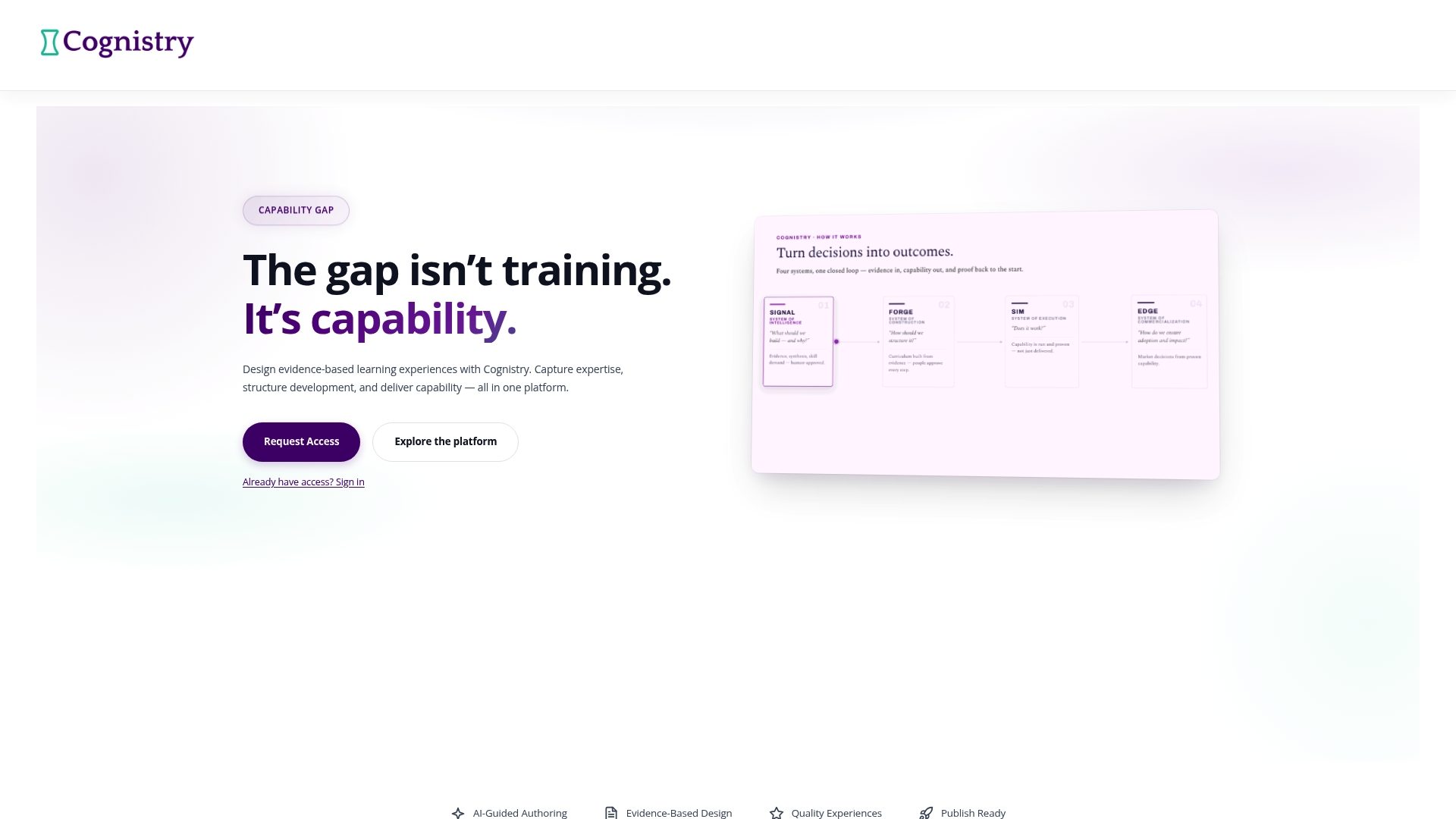
If you are deciding what capability a workflow needs before building anything, our capability engineering platform is built for that sequence: diagnose the work, ground the design in your own evidence, structure the response through courses, practice simulations and decision environments, and measure outcomes back to the business.
Teams working through AI adoption can also read how enterprise leaders diagnose the deployment wall and how capability engineering works in an age of collective intelligence.
A test you can run this week
Pick one task in your organization that an AI agent now touches. An invoice exception, a clinical summary, a contract clause review, a customer reply. Then answer two questions in writing:
- How was the agent tested? On which cases, against what bar, with what failure threshold?
- How was the person who accepts its work tested? On which cases, against what bar, and did any of them include the agent being wrong?
If the first answer is specific and the second is “they took the training,” you have found the gap. That gap is the job.
FAQ
Is a forward deployed capability engineer a real job title?
The term is new, and most of what is published concerns the technical forward deployed engineer. We use Capability FDE for a role or function: the person responsible for defining and testing what people and agents must each do. Whether it sits under one title or is spread across L&D, operations and technology, the five moves are the same.
How is it different from a forward deployed engineer?
A forward deployed engineer works inside a customer’s environment to make an AI system function. A Capability FDE works on the human side of the same deployment: the acceptance bar, the handoffs and the decision scenarios people practice on. The two are designed to pair on one engagement.
Who should own the role inside our company?
Ownership works best close to the work, with a named acceptor for each unit of work and a business sponsor accountable for performance, not only completion. L&D, operations and transformation teams all have a stake, and the role connects them to the technical team.
Does this mean we should not train people?
No. It means training follows diagnosis. If the gap is about what people can decide, an enablement play with practice scenarios is the right answer. If the gap is a broken handoff or a missing signal, fix that first.
Sources
- What is a forward-deployed engineer? | McKinsey
- Forward Deployed Engineer: 5 Skills for This New Role | Salesforce
- Forward Deployed Engineers Turn What Ifs into Real Results | Deloitte US
- The evolution of forward-deployed engineering | Microsoft
- The forward-deployed engineer: Why talent, not technology, is the true bottleneck | CIO
- The Forward Deployed Engineer | Jay Burgess
- The Rise and Role of the Forward Deployed Engineer | Alvarez & Marsal
- FDEs: Building Capacity, Not Dependency | Cohere
- Deployed or Developed: The Purple Unicorn Problem | Lean Enterprise Institute
- Solutions Engineers for AI Companies: How to Hire | PeopleInAI