Adoption estimates for 2026 range from 18% of firms to 78% of the workforce, depending on how you count. The gap does not come from bad data. It comes from the fact that most organizations treat deployment as a technology purchase instead of a capability build. The fix is not more training. It is diagnosing what capability the work actually requires, closing the governance and workflow seams that block production, and only then deciding whether a learning response makes sense at all.
TL;DR:
- The wide variation in AI adoption estimates is primarily due to different survey metrics, such as firm-level adoption, individual use, and employment-weighted figures.
- Deep AI integration remains limited in industries outside tech and finance, with only around 11% of S&P 500 firms deeply embedded by 2025, mostly in tech.
- Most pilot failures stem from organizational barriers, especially governance gaps and workflow redesign issues, rather than model performance.
- Successful deployment depends on diagnosing organizational capabilities first, then addressing seams like governance, data pipelines, and workflow before scaling.
- Measuring impact separately from adoption is crucial, with ongoing tracking of deployment health, governance risk, and real operational improvements.
Table of Contents
- What the AI Adoption Numbers Actually Show
- Which Industries Are Actually Ahead
- Why Pilots Die Before They Reach Production
- The Barriers That Have Nothing to Do With the Model
- A Practical Sequence for Responsible AI Adoption
- Measuring Whether Adoption Actually Delivered Value
- Diagnosis Before Design: How Cognistry Approaches Enablement
- Where Leaders Should Actually Focus Next
- Get Capability Diagnosis Before Your Next AI Build
- Primary Sources and Further Reading
- Sources
- FAQ
What the AI Adoption Numbers Actually Show
Ask three different surveys how many companies have adopted AI and you will get different answers, each accurate for its particular measurement focus. The Federal Reserve’s FEDS Notes analysis lays out why the spread is so wide, and it is worth understanding before you benchmark your organization against any single number.
The Census Bureau’s Business Trends and Outlook Survey (BTOS) puts firm-level adoption at roughly 18% by year-end 2025. That figure counts businesses, not people, and it asks a narrow question about AI use in production. Compare that to the Real-Time Population Survey (RPS), which indicates a substantial portion of workers using generative AI for work-related tasks as of late 2025. That is a person-level measure and it captures individual use even when a company has no formal AI policy.
Then there is the Shopper/Business Uses (SBU) data, which weights by employment rather than firm count. Because large employers adopt AI at higher rates than small ones, an employment-weighted estimate finds that a majority of the labor force works at companies that have adopted AI in some form, with a significant share working at firms using large language models specifically.
The gap matters because it changes what “adoption” means in a boardroom conversation. A CFO asking “have we adopted AI” gets a different answer than an operations lead asking “are our people using it.”
Three forces drive the variance:
- Sampling frame. BTOS counts firms equally regardless of size; SBU weights by employment, so a handful of massive adopters skew the number up.
- Question wording. In November 2025, BTOS broadened its question to ask about AI use “in any of its business functions,” which increased reported adoption and makes year-over-year comparison harder.
- Shadow usage. Employees running AI tools without IT approval or a formal policy show up in worker surveys like RPS but rarely register in firm-level counts like BTOS.
If you are reporting adoption progress to a board, cite the survey type alongside the number. A leader who says “41% adoption” without specifying RPS versus BTOS invites a credibility problem the moment someone checks the source.
Which Industries Are Actually Ahead
Sector matters more than most benchmarking decks admit. Technology, financial services, and professional services consistently show the deepest integration, not just the highest pilot counts. Manufacturing is the sector to watch: it started later but is showing some of the fastest generative AI growth as firms apply it to quality inspection, predictive maintenance, and supply chain forecasting.
The MIT Initiative on the Digital Economy found that only about 11% of S&P 500 firms had AI deeply embedded in operations by the end of 2025, while roughly 45% were still running pilots. Deep integration concentrated heavily in the tech sector, which builds the tools and therefore has a head start on organizational readiness most other industries lack.
Firm size tells a related but distinct story. Because employment-weighted figures like the SBU’s 78% skew toward large employers, that number overstates what a typical small or midsize business has actually accomplished. Large firms have dedicated data teams, existing cloud infrastructure, and budget for governance functions that most SMEs simply do not staff.
A few patterns should shape how you benchmark:
- Compare within your sector, not against the aggregate. A retailer measuring itself against tech-sector integration rates will always look behind, and the comparison is not fair to begin with.
- Treat SME adoption gaps as an infrastructure problem, not a motivation problem. Smaller firms often want to move faster but lack the data plumbing to support it.
- Watch manufacturing’s trajectory as a leading indicator. If a traditionally slower-moving sector is closing the gap quickly, it signals that the tooling has matured enough for operational, not just knowledge-work, use cases.
If your firm sits outside tech, financial services, or professional services, do not assume you are behind because you are not at 78%. Ask instead whether you are ahead or behind the realistic median for your sector and your size class.
Why Pilots Die Before They Reach Production
It is a story about a specific, diagnosable failure point. Research on enterprise deployment friction calls this the Deployment Wall: the point where a pilot that worked in a controlled test collides with the organizational, governance, and workflow realities of production.
The dominant reason AI pilots fail to deliver value is not model performance. It is deployment friction, an organizational and architectural barrier that sits between a working prototype and a system that survives contact with real operations.
The Deployment Wall framework breaks that friction into six seams, and treating them as a checklist rather than an abstraction is what makes the diagnostic useful:
- Model selection. Choosing a model suited to the task, not the one with the most attention in the market.
- Integration. Connecting the model to existing systems, data pipelines, and authentication without breaking what already works.
- Governance. Defining who monitors outputs, who has authority to override them, and what happens when something goes wrong.
- Workflow redesign. Rebuilding the actual sequence of work so the tool changes how a job gets done, not just what software sits on a desktop.
- Enterprise adoption. Getting the people who do the work to actually use the system as designed, at scale, without workarounds.
- Realized value. Confirming the deployment produces a measurable business outcome, not just usage logs.
The seams are cumulative, and that is the part most roadmaps miss. Clearing model selection and integration does not guarantee anything, because workflow redesign and enterprise adoption function as gatekeepers that decide whether the earlier work ever pays off. A technically flawless integration attached to an unchanged workflow just produces a faster way to do the same ineffective process.
Governance and workflow redesign carry the highest risk of the six, because they are organizational, not technical; partners like Smishalert offer insightful governance and risk-control examples relevant to this challenge. You cannot patch a governance gap with a software update, and you cannot redesign a workflow without touching how people are evaluated, trained, and held accountable for the outcome.
The Barriers That Have Nothing to Do With the Model
Most stalled AI initiatives fail for reasons that have nothing to do with model quality. The technology usually works. What is missing is the organizational scaffolding around it.
Governance gaps top the list. Deloitte’s State of AI in the Enterprise research found that while many organizations report productivity gains, only a minority have actually reimagined how work gets done, and governance and skills gaps sit at the center of that stall. Production AI needs monitoring for output drift, a clear escalation path when a model behaves unpredictably, and someone accountable when it does. Absent those three elements, a model generates novelty, not durable operational results.

Capability gaps are frequently misdiagnosed as skills gaps, and that mistake wastes budget fast. Before building any enablement play, the real question is whether the work requires new judgment, a new decision process, or simply a new tool with the old process intact. Sending a team to a generic AI course when the actual barrier is a broken approval workflow solves nothing and burns credibility for the next initiative. This is the diagnostic Cognistry runs before recommending any enablement play: decide whether learning is even the right response before designing one.
Data infrastructure readiness matters more than most leaders expect going in. A model performing well in a sandbox often fails in production because the organization lacks a real-time data pipeline, meaning the system is reasoning on stale information rather than a living backbone of current data.
Shadow use compounds all of it. When employees adopt AI tools informally because sanctioned options are slow or restrictive, the organization loses visibility into how the work actually gets done, and incentive structures that still reward the old process undermine trust in the new one.
- Governance: no clear owner for monitoring or override authority
- Capability: unclear whether the gap is skill, process, or judgment
- Data: pipelines too slow or too stale to support real-time decisions
- Incentives: performance metrics still reward pre-AI workflows
Pro Tip: Before approving any AI training budget, ask what specific decision the workforce currently makes wrong or slowly. If no one can answer that question with a concrete example, you are not ready to build training. You are ready to diagnose.
A Practical Sequence for Responsible AI Adoption
Speed matters less than sequence. Organizations that skip steps to move faster tend to end up back at step one, six months later, with a failed pilot and a skeptical executive team.
- Diagnose capability before choosing a tool. Map the actual decision flow the work requires: who decides what, on what information, under what time pressure. This step determines whether you have a capability gap, a process gap, or a tooling gap, and each one demands a different response.
- Decide buy versus build based on seams removed, not features offered. An integrated platform that eliminates two or three Deployment Wall seams for you (model selection and integration, typically) is often worth the premium over an internally built stack that leaves your team solving every seam alone.
- Embed governance into existing operating routines, not a separate committee. Drift monitoring, escalation authority, and audit responsibility need to sit inside the leadership KPIs people already report against, not in a policy document no one reopens after launch.
- Redesign the workflow and the role definitions together. A new tool bolted onto an old job description creates confusion about what “doing the job well” now means. Use decision practice environments to let people rehearse the new workflow under realistic pressure before it goes live.
- Measure survival, not enthusiasm. Track whether the deployment is still in active, correct use 90 and 180 days after launch, not just adoption in week one.
The order matters because each step constrains the next. You cannot make a sound buy-versus-build decision without first knowing which seams the work actually requires you to solve, and you cannot design a meaningful workflow change until governance ownership is assigned.
Pro Tip: Run the capability diagnosis as a structured conversation with the people doing the work, not a survey sent to their managers. The gap between what a manager thinks the job requires and what the frontline actually navigates daily is often where the real capability need hides.
Organizations that treat this as a five-step technology rollout instead of an evidence-led capability build tend to hit the wall around step three, when governance ownership turns out to belong to no one. Manager enablement is frequently the missing link precisely at this stage, since managers are the ones who have to hold the new workflow accountable day to day.
Measuring Whether Adoption Actually Delivered Value
Adoption and impact are not the same metric, and conflating them is how a company ends up celebrating a rollout that changed nothing. Adoption tells you how many people have access and are logging in. Impact tells you whether the work got better.
Track them separately:
- Adoption metrics: license activation, weekly active use, feature-level usage depth
- Impact metrics: task completion time, error rate change, revenue or cost movement tied to the specific workflow
- Pilot survival rate: the percentage of pilots still in active, correct production use at 90 and 180 days
- Deployment Debt: the accumulated cost of unresolved seams, converted into a board-reportable figure rather than left as a vague technical backlog
The Seam Index, drawn from Deployment Wall research, scores each of the six seams and converts deployment risk into a costable, prioritizable metric rather than an engineering complaint. That reframing is what gets governance and workflow investment onto a CFO’s radar instead of staying buried in an IT status report.
Governance-specific KPIs deserve their own line on the dashboard: drift incidents per month, percentage of AI-assisted decisions covered by audit, and average time from anomaly detection to escalation. A rollout can show strong adoption numbers and still be accumulating governance risk that will not show up until an audit or an incident forces the issue.
Cohort analysis and pre/post comparison remain the most reliable way to isolate the AI’s actual contribution from other operational changes happening at the same time. Compare a cohort using the new workflow against a matched cohort still on the old one, over the same period, before crediting any productivity gain to the deployment itself.
Diagnosis Before Design: How Cognistry Approaches Enablement
Most AI adoption failures trace back to a single sequencing error: building a course, a tool rollout, or a simulation before confirming the organization actually knows what capability the work requires. Cognistry starts earlier. Before anyone builds training, the platform diagnoses what the work demands, tests whether learning is even the right response, and grounds every design decision in the organization’s own evidence: strategy documents, frontline friction points, quality findings, and subject-matter expertise already sitting inside the business.
Where a diagnosis points to a genuine capability gap, Cognistry structures the response around decision practice rather than passive content. That can mean capability signal mapping to locate where judgment breaks down, or decision practice simulations that let people rehearse a redesigned workflow under realistic pressure before it goes live in production. Cognistry does not claim a universal outcome number. The point is the sequence: diagnose first, design second, measure the result against the business evidence that justified the build in the first place.
Where Leaders Should Actually Focus Next
Deployment is a discipline, not an event, and the sooner leadership treats it that way, the fewer expensive pilots die on the vine. The Deployment Wall’s six seams give you a structure most executives already understand instinctively but rarely name: model selection and integration are the easy, visible seams; governance and workflow redesign are the hard, invisible ones that actually decide whether the project survives contact with real operations.
The instinct to reach for a training program the moment adoption stalls is understandable and usually wrong. A course fixes a skills gap. It does nothing for a governance vacuum or a workflow that was never rebuilt around the new tool. Reframe every AI initiative on your roadmap as a capability build with measurable seams, not a technology purchase with a launch date, and you will make better decisions about where the next dollar actually belongs.
— Brian
Get Capability Diagnosis Before Your Next AI Build
Most AI adoption failures do not need another course, another vendor demo, or another pilot. They need a diagnosis of what capability the work actually requires and whether learning is even the right response, grounded in evidence your organization already has, not a generic framework imported from outside. That is the gap Cognistry exists to close.
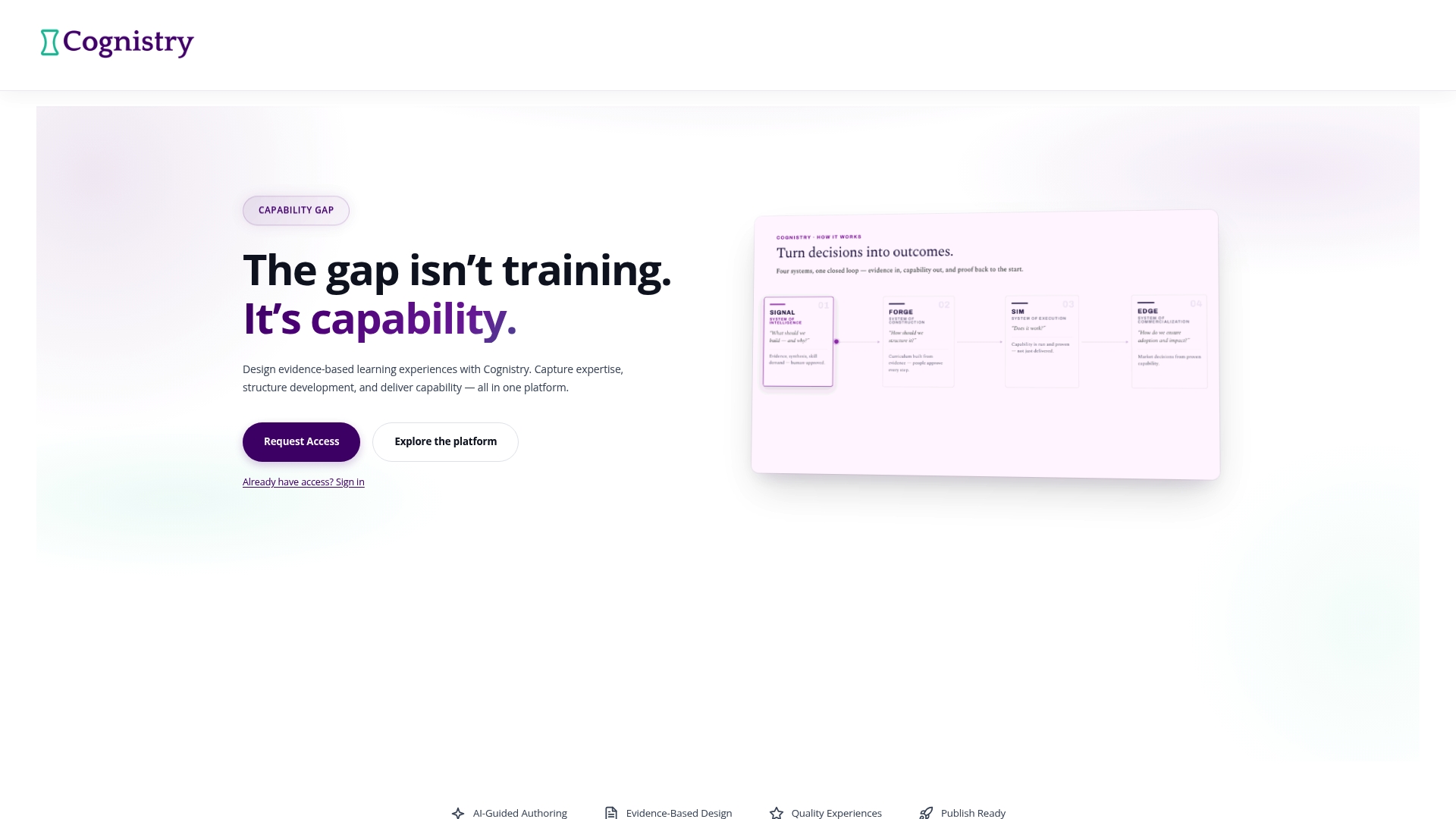
The Cognistry Platform is built for exactly the sequence this article lays out: diagnose the capability gap first, decide whether a learning response is warranted, and only then design the enablement play, whether that means capability signal mapping to locate where judgment actually breaks down or decision practice simulations that let teams rehearse a redesigned workflow before it goes live. Leaders managing organizational change alongside the technical rollout will also find the Edge product built specifically for activating adoption once the diagnosis is done. If your last AI initiative stalled at the Deployment Wall, start by requesting a demo of the platform and see what a capability diagnosis surfaces in your own operation.
Primary Sources and Further Reading
The adoption figures, sector patterns, and Deployment Wall framework referenced throughout this article draw on the following primary sources. Use them to validate the numbers and go deeper into methodology before presenting adoption data to your own leadership team.
- Monitoring AI Adoption in the U.S. Economy — Federal Reserve FEDS Notes
- Pulling back the curtain on enterprise AI adoption — MIT Initiative on the Digital Economy
- The Deployment Wall: A Diagnostic Framework and Instrument for Enterprise AI — arXiv
- The State of AI in the Enterprise — Deloitte US
- BTOS AI Question Wording Updates — U.S. Census Bureau
Sources
- Monitoring AI Adoption in the U.S. Economy — Federal Reserve FEDS Notes
- Pulling back the curtain on enterprise AI adoption — MIT Initiative on the Digital Economy
- The Deployment Wall: A Diagnostic Framework and Instrument for Enterprise AI in the Deployment Era — arXiv
- The State of AI in the Enterprise — Deloitte US
- BTOS AI question wording updates — U.S. Census Bureau
FAQ
What are the four stages of AI adoption?
Most enterprise frameworks describe a progression from pilot testing, to limited production use, to workflow-integrated deployment, to full operational embedding where AI shapes how decisions get made. MIT’s research found only about 11% of S&P 500 firms had reached the deepest stage by the end of 2025, while roughly 45% remained stuck at the pilot stage.
Why is AI not being adopted faster in some organizations?
The most common blocker is not the technology itself but governance and workflow gaps: unclear ownership for monitoring outputs, no escalation path when a model errs, and workflows that were never redesigned around the new tool. Deloitte’s enterprise research found governance and skills gaps are principal barriers even at organizations already reporting productivity gains.
How fast is AI being adopted across the economy?
It depends entirely on which survey you cite. Firm-level data from BTOS puts adoption at about 18% by year-end 2025, worker-level surveys show roughly 41% using generative AI for work tasks, and employment-weighted estimates reach as high as 78% because large employers adopt at much higher rates than small firms.
Which jobs are least likely to be displaced by AI?
Roles built around physical dexterity, in-person trust, and situational judgment under ambiguity, such as skilled trades, hands-on healthcare, and roles requiring real-time human negotiation, tend to be more resistant to full automation than routine information-processing tasks. The stronger pattern in the enterprise data is not which specific jobs survive, but that work centered on operational judgment rather than knowledge recall holds up best regardless of sector.
Does Cognistry help with AI adoption strategy specifically?
Cognistry diagnoses what capability a given AI-driven workflow actually requires and whether a learning response is warranted before any enablement play gets built. Current pricing and product details for the Cognistry Platform are available directly on the site.