
Operational AI governance is the set of continuous controls, inventory, monitoring, and human oversight practices that run inside your AI systems every day, not the policy binder that sits above them. The first move is simple: build an AI system inventory and name one accountable owner for it this week. Everything else, including NIST’s frameworks and the AIGF operating model, builds on that foundation.
TL;DR:
- Building an AI system inventory and assigning an owner is the immediate foundation for effective operational governance, not just policy documents.
- Monitoring involves continuous logging of interactions and provenance, enforcing least-privilege access, and having clear incident response authority to prevent silent model drift.
- Governance responsibilities require a designated system owner, operator, incident lead, and independent reviewer, with accountability embedded within the operational team.
- Tracking key metrics such as inventory coverage, detection speed, human oversight, evidence completeness, and remediation time ensures governance effectiveness over time.
- Start governance implementation with quick wins like inventory creation and basic controls within the first two to six months, focusing on tangible evidence and clear ownership.
Table of Contents
- What Does Operational AI Governance Mean In Practice?
- Which Frameworks Should Guide Your Operational Controls?
- What Operational Controls Should Run Every Day?
- Who Should Own AI Governance After Deployment?
- How Do You Measure Whether Governance Is Actually Working?
- What’s the Fastest Path to Operational Governance?
- Why Diagnosis Comes Before Any Governance Enablement Play
- What Leaders Consistently Get Wrong About Operational Governance
- How Cognistry Supports Operational Governance Work
- Sources
- FAQ
What Does Operational AI Governance Mean In Practice?
Most organizations already have an AI policy. Far fewer have governance that actually touches production systems on a Tuesday afternoon. That gap is the whole problem.
Policy-level governance answers “what do we believe about AI risk?” Operational governance answers “how do we know, right now, which systems are running, who owns them, and what happens when one misbehaves?” The first lives in a document. The second lives in your ticketing system, your access logs, and your incident response runbook.
Four concepts separate the two:
- Inventory: a living registry of every AI system, model, and agent in production, not a one-time audit.
- Evidence: logs, provenance records, and telemetry that prove a system behaved as designed, preserved in machine-readable form for audit and post-incident forensics.
- Human-in-the-loop: designated checkpoints where a person reviews or can override a model’s output before it affects a customer or a decision.
- TEVV-style practice: ongoing testing, evaluation, validation, and verification instead of a single pre-launch sign-off.
Embedding these into runtime, not just into a policy PDF, is what actually reduces risk and satisfies regulators asking for proof rather than intentions.
Which Frameworks Should Guide Your Operational Controls?
You do not need to invent an operating model from scratch. Three reference points cover most of what enterprise teams need, and they complement each other rather than compete.
The NIST AI Risk Management Framework organizes work into four functions: Govern, Map, Measure, and Manage. NIST treats GOVERN as cross-cutting, meaning it is not a phase you finish before moving to Map. It threads through every other function, feeding evidence into how you identify risks (Map), quantify them (Measure), and respond (Manage). NIST has since extended the core framework with a generative AI profile and a critical infrastructure concept note, both aimed at closing gaps the original 2023 framework left open for newer deployment patterns.
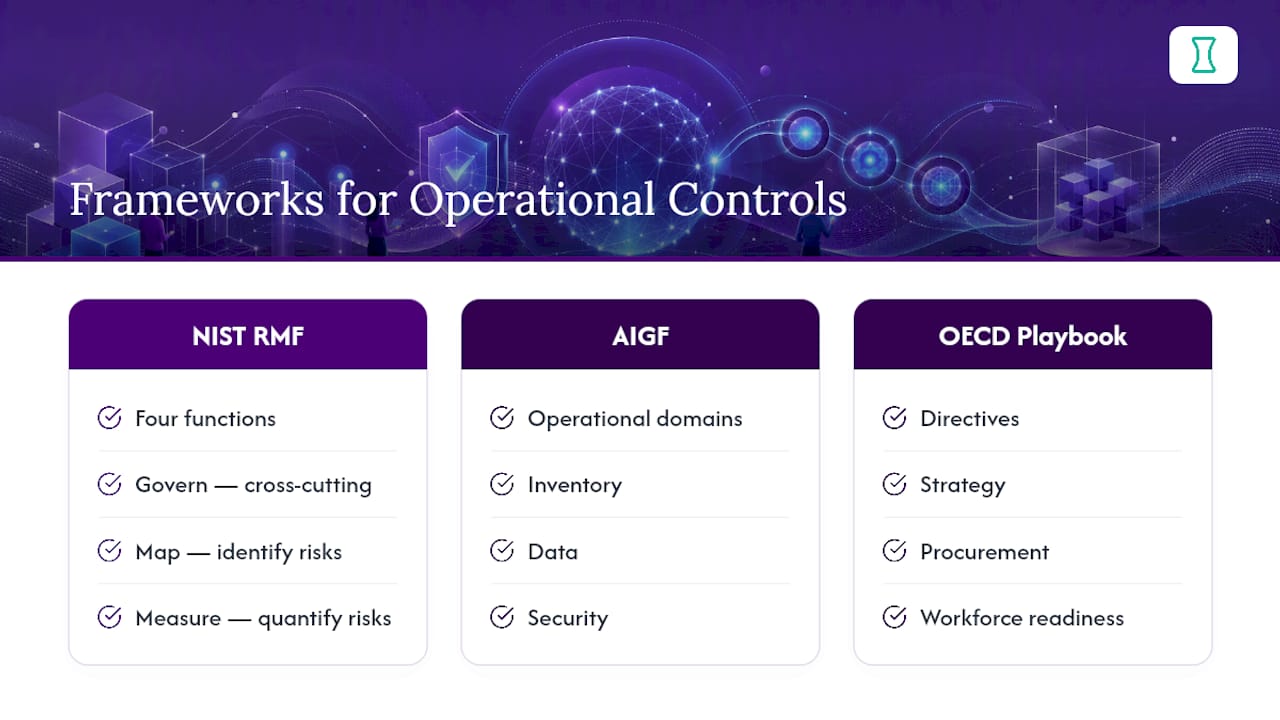
The Ozkaya AI Governance Framework (AIGF) picks up where NIST’s functions end and asks a harder operational question: who owns this, and how do we measure it day to day? AIGF organizes governance into operational domains, covering inventory, data, security, regulatory alignment, incident response, and workforce, paired with seven implementation pillars that turn each domain into a repeatable control. The framework’s own design goal is to make governance “ownerable and measurable,” which is the exact quality most policy documents lack.
One statistic worth internalizing: NIST’s framework defines four functions, and GOVERN is explicitly the one meant to run across all three others, not sit before them. Treating governance as a discrete kickoff phase is a structural misread of the framework itself.
Round out your reference shelf with the NIST AI RMF Playbook for engineering-level implementation detail and the OECD AI Governance Playbook, which breaks governance into directives spanning strategy, procurement, and workforce readiness.
What Operational Controls Should Run Every Day?
Frameworks tell you what to aim for. Controls are what you actually run. Here is the operating stack that separates governance that exists on paper from governance that catches problems before customers do.
- Build and maintain an AI system inventory. Capture system name, owner, purpose, data inputs, risk tier, vendor, and last review date. Triage by potential harm, not by how interesting the technology is.
- Enforce least-privilege data access. Every model or agent gets scoped access to only the data it needs. Runtime auditability and access partitioning matter more as agents reach into broader corporate data stores.
- Log prompts, outputs, and provenance. Every material interaction needs a record showing what went in, what came out, and which model version produced it.
- Monitor continuously. Track drift, anomalies, and vendor-side model changes that can silently alter behavior underneath you.
- Maintain incident response with pause authority. Someone must have the standing authority to roll back or shut down a system without waiting for a committee vote.
A few practices reinforce all five:
- Tie risk tier directly to review frequency, so a customer-facing credit decision model gets reviewed far more often than an internal drafting assistant.
- Require a documented decommissioning step that preserves logs and model artifacts even after a system retires.
- Route every third-party model update through the same change-control process as an internal deployment.
This is the plumbing research on operational AI discipline keeps pointing to: fairness and safety problems increasingly emerge from system-level dynamics, not just model weights, which means the controls above need to be embedded in the system’s design, not bolted on after launch.
Who Should Own AI Governance After Deployment?
Governance dies in committees. It survives with a named owner and a short chain of accountability.
Assign one accountable executive sponsor, typically someone who already owns risk, compliance, or technology at a senior level, and pair them with an operational owner for each system in the inventory. Legal, privacy, and security should not run governance from the sidelines; embed a representative from each directly into product and operations teams so reviews happen at the speed of deployment, not at the speed of a quarterly meeting.
Four operational roles keep the system running:
- System owner: accountable for the AI system’s performance and risk posture day to day.
- Operator: the person or team running the system and executing monitoring tasks.
- Incident lead: has standing authority to pause, roll back, or escalate.
- Assurance reviewer: independently checks evidence against the risk tier, separate from the team that built the system.
OECD guidance on responsible AI reinforces a human-centered model here: build oversight and stakeholder engagement into the workflow itself, not as an afterthought review. Before assigning training to close a gap, ask whether the gap is a capability problem at all. Sometimes it is a missing tool or an ambiguous process, not a human skills issue, and building an enablement play against the wrong diagnosis wastes budget and momentum.
How Do You Measure Whether Governance Is Actually Working?
A framework without metrics is a belief system. Executives need numbers that show whether operational controls are catching problems, not just whether a policy was published.
Five KPIs cover most of what matters:
- Inventory coverage: percentage of known AI systems formally registered and risk-tiered.
- Time-to-detect: how long between an anomaly occurring and someone noticing it.
- Human oversight coverage: share of high-risk systems with an active human-in-the-loop checkpoint.
- Evidence completeness: percentage of systems with current TEVV-style testing and documentation on file.
- Remediation time: median days from flagged issue to resolved fix.
None of these numbers means much as a single snapshot. Trend matters more than the absolute figure. Inventory coverage climbing from 60% to 85% over two quarters tells you the program is gaining ground; a static 85% for a year might mean stagnation or might mean you have genuinely mapped your environment. Read every KPI against its own trajectory before comparing it to a benchmark.
Report monthly to operational leadership and quarterly to the board, with the quarterly version condensed to a one-page scorecard: coverage, open high-risk items, and remediation velocity. Enterprise frameworks built for scale consistently point back to this same discipline: structured, recurring reporting across ethics, compliance, and operational monitoring is what keeps governance from quietly reverting to a documentation exercise. Our own risk-based roadmap for compliance leaders walks through how to build that scorecard against real evidence rather than self-reported status updates.
What’s the Fastest Path to Operational Governance?
You do not need eighteen months and a steering committee to start. Sequence the work in three horizons.
- Days 1 to 60: Inventory and ownership. List every AI system in use, including shadow deployments nobody flagged. Assign a risk tier and an accountable owner to each. Stand up basic logging even if it is manual at first.
- Months 3 to 6: Controls and monitoring. Implement least-privilege access, formal prompt and output logging, and a documented incident response process with real pause authority. Build human-in-the-loop checkpoints for every high-risk system.
- Scale phase: Automate assurance. Automate evidence collection where possible, formalize your KPI scorecard, and run TEVV-style testing on a fixed schedule instead of ad hoc reviews. Bring in periodic external audits once internal processes stabilize.
Quick wins matter for securing executive backing. A completed inventory, even a rough one, is often the single most persuasive artifact you can bring to a governance steering conversation, because it turns an abstract risk into a concrete number: “we found 40 AI systems in production and only 12 were documented.”
The OECD/CAIG playbook structures this same sequencing around procurement rubrics and cross-functional dashboards, which is worth reviewing before you finalize your own timeline.
Pro Tip: Start your inventory with a two-column spreadsheet before you buy any tooling: system name and business owner. You will be surprised how many “AI systems” turn out to be spreadsheet macros nobody ever risk-assessed, and how fast that first pass exposes your real exposure.
Why Diagnosis Comes Before Any Governance Enablement Play
Most organizations reach for training the moment a governance gap surfaces. That instinct is usually wrong. Before building a course on model risk or a workshop on incident response, ask what capability the work actually requires and whether learning is even the right response. Sometimes the gap is a missing access control, not a knowledge gap, and no training module fixes a system that lacks least-privilege data access.

Cognistry’s diagnosis-first approach grounds every enablement play in the organization’s own evidence, meaning frontline friction reports, quality findings, and subject-matter expertise, rather than a generic curriculum. When a genuine capability gap exists, particularly around judgment calls like “should I escalate this model output,” a decision practice simulation builds operational judgment far more reliably than a slide deck ever will.
Pro Tip: Whatever enablement play you choose, capture the decision telemetry from it. That data becomes assurance evidence later, showing regulators and auditors that human oversight was not just designed but exercised.
What Leaders Consistently Get Wrong About Operational Governance
Three priorities separate governance programs that stick from ones that decay into a binder nobody opens. First, fund the operational layer, not just the policy layer; a two-page AI ethics statement costs almost nothing to write and does almost nothing to prevent an incident. Second, name an owner before you write a single control, because ownerless governance evaporates the moment the person who cared about it changes roles. Third, measure trends monthly, not annually, since risk in production AI moves faster than most audit calendars.
The anti-patterns are predictable: policy-only programs that never touch runtime, governance councils with no single accountable owner, and KPI dashboards so focused on vanity metrics that a real incident sails past unnoticed. Start with the inventory. Everything durable gets built on top of it.
— Brian Lambert, PhD (www.DrBrianLambert.com)
How Cognistry Supports Operational Governance Work
Cognistry gives governance teams a way to run the diagnosis and evidence work that operational AI governance actually depends on, instead of jumping straight to a training rollout that may not fix anything. It starts by determining what capability a governance gap really requires, whether that is a missing control, an ownership vacuum, or a genuine decision-making skill gap, then grounds the response in your organization’s own frontline evidence rather than a generic curriculum.
Where a real capability gap exists, particularly around human oversight judgment calls, Cognistry structures decision practice simulations that build operational judgment and capture the telemetry your assurance function needs later. That is a meaningfully different starting point than buying a course library and hoping it maps to your actual risk surface. If you are building the human-in-the-loop layer of your governance program, see how Cognistry Forge approaches diagnosis-first capability work, or request a walkthrough to see how it fits your current inventory and control gaps.
Sources
FAQ
What Is the 30% Rule in AI?
There is no single, universally recognized “30% rule” in AI governance frameworks like NIST or AIGF; the phrase is used inconsistently across industry commentary, so treat any specific version you encounter with caution and verify it against a primary framework.
What Three Jobs Won’t Be Replaced by AI?
No authoritative governance framework, including NIST’s AI RMF or the OECD’s guidance, publishes a definitive list of “safe” jobs; the more useful governance question is which decisions require mandatory human-in-the-loop review regardless of how capable the underlying model becomes.
Can You Give an Example of AI Governance?
A retail company maintaining a registered inventory of every AI system, assigning a named owner and risk tier to each, logging model outputs for audit, and requiring human review before a customer-facing credit or pricing decision goes live is operational AI governance in practice, not just a written policy.
What Exactly Is AI Governance?
AI governance is the combination of policy, structure, and continuous operational controls, including inventory, monitoring, and human oversight, that organizations use to manage AI risk across a system’s entire lifecycle, from deployment through decommissioning.
Who Should Own AI Governance Inside a Company?
A single accountable executive sponsor, paired with a named operational owner for each system in the inventory, works better than a large committee, since committees rarely have the standing authority to pause or roll back a live system quickly.