
AI governance is risk-based oversight that keeps AI systems safe, lawful, and ethical across their entire lifecycle. Before you write a single policy, diagnose the risk profile of every AI system already in use. That diagnosis, not the control set, determines everything that follows. Reference points worth pinning to your wall right now: the NIST AI RMF, the OECD AI Principles, and the EU AI Act.
Start this week with:
- Build a live inventory of every AI system in production or pilot.
- Tier each system by risk (minimal, limited, high, unacceptable).
- Assign a named owner to each system, not a department.
- Apply stop-gap controls (human review, access limits) to anything high-risk with no owner.
- Set a timely review date to catch what the inventory missed.
Key Takeaways
Effective AI governance compliance requires risk-tiered oversight, cross-framework alignment with NIST, OECD, and the EU AI Act, and documented evidence at every stage of the AI system lifecycle.
| Point | Details |
|---|---|
| Diagnose before you build | Tier every AI system by risk before designing controls or training. |
| Anchor to multiple frameworks | Combine the NIST AI RMF, OECD due diligence guidance, and EU AI Act obligations rather than relying on one. |
| Build ten core components | Cover policy, inventory, risk assessment, data governance, model cards, oversight, monitoring, incident response, and vendor management. |
| Budget six to twelve months | Plan a 90-day risk-mapping sprint followed by phased rollout through the scale phase. |
| Evidence drives enablement plays | Cognistry helps teams capture incident logs, frontline friction, and performance data to decide whether training is even the right response. |
Table of Contents
- What Does AI Governance Compliance Actually Cover?
- Which Standards Should Anchor an AI Governance Program?
- What Regulations and Guidance Should Compliance Teams Track?
- What Components Belong in Every AI Governance Program?
- How Long Does It Take to Implement AI Governance?
- Who Should Own AI Governance Inside the Organization?
- What Technical Controls Actually Matter for Compliance?
- How Do You Prove Compliance During an Audit?
- Why Diagnosis Must Come Before Any Enablement Play
- Methods for Integrating Ethics and Bias Mitigation Into Compliance Frameworks
- Using a Capability Platform to Operationalize AI Governance
- Sources
- FAQ
What Does AI Governance Compliance Actually Cover?
AI governance compliance touches more of the organization than most executives expect. It spans the policy suite, the system inventory, risk assessment, data governance, model lifecycle controls, ongoing monitoring, incident response, and vendor management. Miss one of those, and you have a gap a regulator or a plaintiff’s attorney will eventually find.

The stakes are concrete, not abstract. A financial services firm that deploys an unmonitored credit-scoring model risks discrimination claims and regulatory penalties. A healthcare system that lets a vendor’s chatbot handle patient triage without human oversight risks both patient harm and privacy exposure. Compare that to a governed process: the same chatbot, but with documented risk tiering, a human-in-the-loop checkpoint, and logged decisions that can be reconstructed six months later.
That reconstructability is the real test. Governance failure usually isn’t a dramatic breach. It’s an inability to explain, after the fact, why a system did what it did. Compliance teams should treat governance as covering:
- Policy: written rules for acceptable AI use and prohibited applications.
- Inventory and risk assessment: what exists, and how risky is it.
- Data governance: where training and inference data comes from and how it’s protected.
- Lifecycle controls: testing, deployment approval, and retirement criteria.
- Monitoring and incident response: ongoing detection and a plan for when something breaks.
Which Standards Should Anchor an AI Governance Program?
Four instruments should anchor any serious program: the NIST AI RMF, the OECD AI Principles, ISO/IEC 38507, and the EU AI Act. They aren’t redundant. Each does a different job, and understanding the division of labor keeps you from over-building in one area while leaving another exposed.
| Framework | Type | Primary focus |
|---|---|---|
| NIST AI RMF | Voluntary framework | Risk management practices across the AI lifecycle |
| OECD AI Principles | Voluntary principles + due diligence guidance | Enterprise-level responsible AI conduct and record-keeping |
| ISO/IEC 38507 | Governance guidance standard | Board and executive oversight of AI use within IT governance |
| EU AI Act | Binding regulation | Legal obligations for high-risk systems and market conformity |
NIST’s ecosystem is the most operational of the four. Beyond the core AI RMF, NIST has published a companion Playbook with implementation suggestions, plus a Generative AI Profile (NIST-AI-600-1) that addresses risks specific to large language models and generative systems. Use the Playbook as your working document, not the RMF itself. The RMF sets the “what”; the Playbook gives you the “how.”
Voluntary doesn’t mean optional in practice. The OECD’s due diligence guidance ties AI governance directly to established responsible business conduct practices, which means regulators and auditors increasingly expect to see these voluntary controls even where no binding law demands them.
What Regulations and Guidance Should Compliance Teams Track?
Watch five things closely: the EU AI Act, national market surveillance authorities, NIST guidance updates, state-level privacy and AI statutes, and federal policy signals like the White House’s national framework. Miss any one, and your compliance posture has a blind spot.
The EU AI Act is the heaviest lift because it’s binding, not voluntary, and it reaches beyond EU borders. Its obligations vary by role and risk tier:
- Providers of high-risk systems must complete conformity assessments and maintain technical documentation.
- Deployers must conduct risk assessments proportionate to use case and maintain human oversight.
- General-purpose AI model providers face transparency obligations that phased in starting August 2025.
- All parties handling high-risk systems must be ready to report serious incidents to competent authorities.
Cross-border effect matters even if you never open an EU office. Any organization selling into the EU market, or whose AI vendor does, inherits exposure through the supply chain. Vendor contracts should now include AI Act compliance representations as standard language.
On the guidance side, European Commission implementation guidance clarifies documentation expectations under Articles 8 through 15, and notably states that providers may need to run current risk analyses when historical design records are incomplete. Domestically, keep an eye on the White House’s National Policy Framework, which signals where federal legislative priorities are heading. In regulated finance, Federal Reserve supervisory letters already treat AI model governance as an extension of existing model risk management expectations.
What Components Belong in Every AI Governance Program?
Ten components form the backbone: a policy suite, a system inventory, risk assessment procedures, data governance, model documentation, human oversight mechanisms, monitoring and logging, incident response, vendor management, and training positioned as an enablement play rather than a first response.
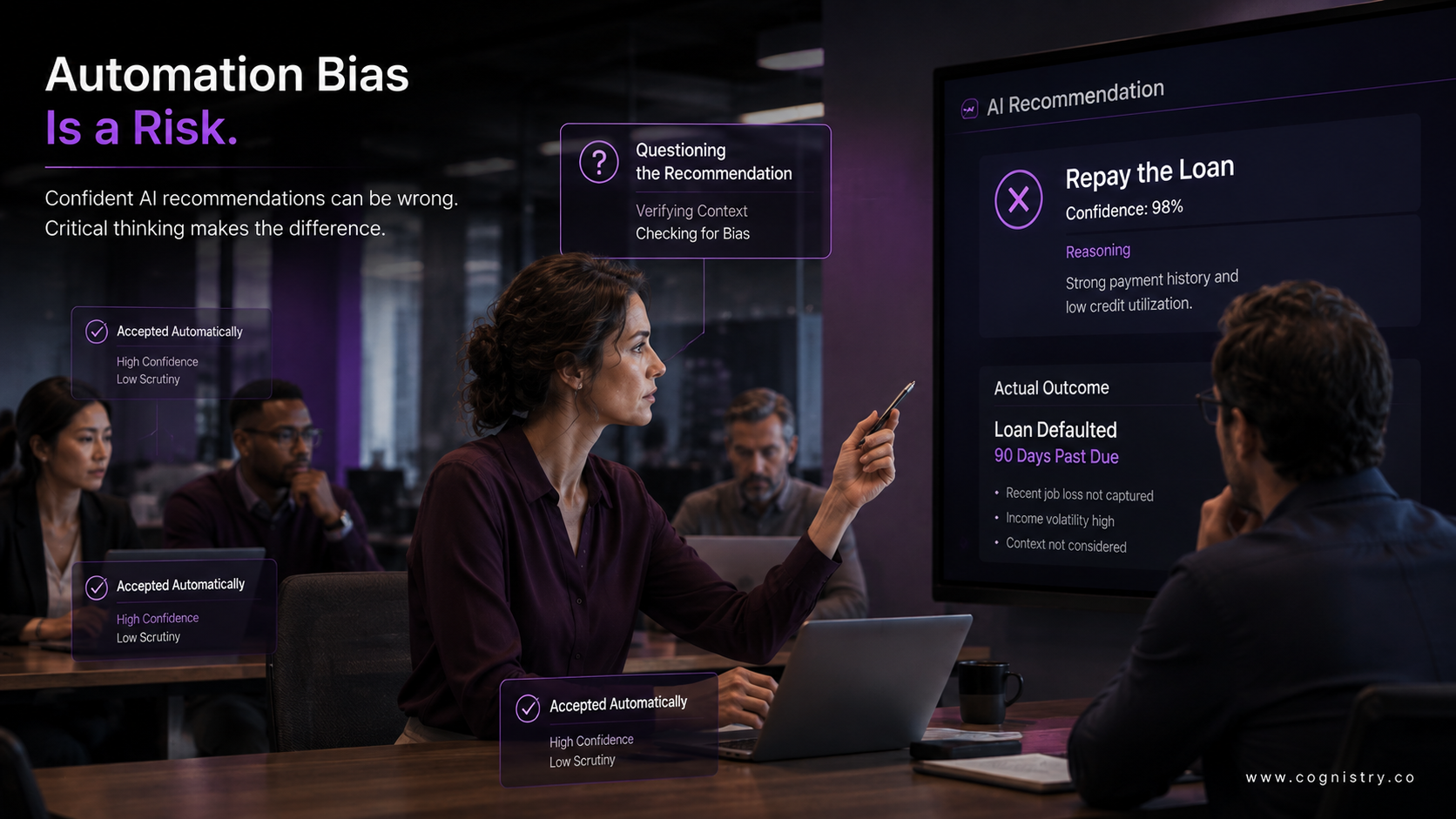
That last point deserves emphasis. Training is what you build after you’ve diagnosed a genuine capability gap, not a default reflex when a system misbehaves. If the frontline team keeps overriding a model’s recommendations, the fix might be a process change or a threshold adjustment, not a course.
A practical compliance tracker should include:
- Policy: written, versioned, and mapped to specific regulatory obligations.
- Inventory: every system, owner, risk tier, and last review date.
- Risk assessment: completed before deployment, refreshed on material change.
- Data governance: source, consent basis, and retention rules documented.
- Model documentation: a model card per system (see below).
- Human oversight: defined checkpoints where a person can intervene or override.
- Monitoring: drift detection and performance thresholds with alerting.
- Incident response: a runbook with named responders and reporting timelines.
- Vendor management: contractual AI-specific representations and audit rights.
A model card doesn’t need to be elaborate to be useful. Capture the system’s purpose, a summary of training data, evaluation metrics against defined benchmarks, known limitations, and an update policy stating how often the model is retrained or re-validated.
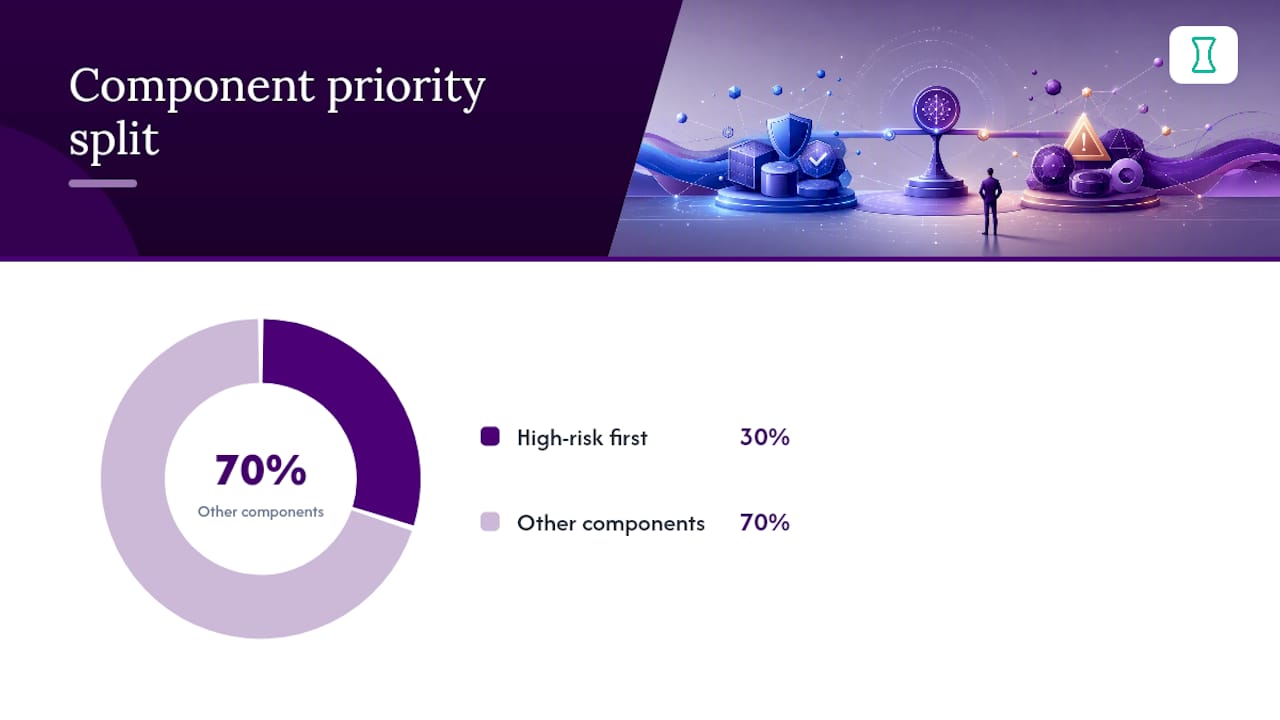
Pro Tip: Don’t try to build all ten components simultaneously. Sequence by risk tier: get inventory, risk assessment, and human oversight in place for high-risk systems first. Lower-tier systems can wait for the second pass without meaningfully increasing your exposure.
How Long Does It Take to Implement AI Governance?
Expect roughly six to twelve months to operationalize governance controls at meaningful scale, though initial risk mapping can happen in a 90-day sprint. The phases run in sequence, and skipping ahead is where most programs stall.
- Assess (0 to 90 days): Build the system inventory and complete initial risk tiering. Deliverable: a scored inventory and a gap list.
- Design (months 2 to 4): Draft policy, model card templates, and escalation procedures. Deliverable: an approved policy suite.
- Pilot (months 3 to 6): Apply controls to a small set of high-risk systems. Deliverable: audit-ready artifacts for that subset.
- Scale (months 6 to 10): Extend controls across the full inventory. Deliverable: enterprise-wide coverage.
- Sustain (ongoing): Monitor, re-assess on system change, and refresh training on a defined cadence.
Budget conversations should center on three cost drivers: tooling for inventory and logging, staff time for risk assessments, and third-party assessments for high-risk systems requiring external validation. What can wait for the sustain phase: broad organization-wide training rollouts and lower-tier system documentation. Neither belongs in the initial budget ask.
Who Should Own AI Governance Inside the Organization?
Ownership should be shared, not centralized in one function. An executive steering committee sets risk appetite, compliance and legal own policy and regulatory interpretation, model owners own day-to-day system performance, and security owns technical controls and access.
A simplified RACI helps clarify friction points before they become turf disputes:
- Inventory maintenance: model owner is responsible; compliance is accountable; security is consulted.
- Risk assessment: compliance is responsible; the steering committee is accountable; legal is consulted.
- Approval to deploy: the steering committee is accountable; compliance and security are consulted; model owner is responsible for submission.
- Incident response: security is responsible for containment; legal is accountable for external reporting; compliance is consulted.
Escalation thresholds should be numeric where possible, not discretionary. A high-risk system with a failed risk assessment or an incident affecting protected classes escalates to the executive committee within 24 hours. Set a reporting cadence, quarterly at minimum for the steering committee, with exception reviews triggered immediately whenever a system crosses a defined risk threshold.
What Technical Controls Actually Matter for Compliance?
Seven controls do most of the work: access controls, logging and observability, explainability tooling, input and output filters, model versioning, testing harnesses, and synthetic-data strategies for privacy-sensitive training scenarios.
Before adopting any tool, put these questions to the vendor:
- Does the platform produce exportable model cards or equivalent artifacts on demand?
- Are logs immutable and retrievable for audit purposes without engineering support?
- What service-level agreement exists for incident support and response time?
- Can the tool demonstrate data lineage from training source to deployed model?
- Does it support role-based access controls aligned to your existing identity system?
Whatever category you evaluate, stick to functional labels, model governance platforms, secure MLOps pipelines, rather than treating any single tool as a silver bullet. The artifact export requirement matters most at audit time: model cards, test results, and data lineage need to survive being handed to an external examiner with no additional context.
How Do You Prove Compliance During an Audit?
Compliance-ready measurement means every risk decision leaves a trace: traceable artifacts, retrievable logs, and documented rationale for why a system was approved, modified, or retired.
Keep these on hand at all times, not assembled retroactively when an audit notice arrives:
- Inventory snapshots taken at regular intervals.
- Model cards for every high-risk system.
- Completed risk assessments with sign-off dates.
- Test logs from pre-deployment and ongoing validation.
- Incident reports, including near-misses.
- Vendor contract terms with AI-specific representations.
Useful metrics to track over time include the percentage of high-risk systems with a completed risk assessment, average time to incident containment, and the percentage of systems with a current model card. None of these numbers matter in isolation. What matters is the trend line and whether it’s moving toward full coverage. When packaging evidence for external audit, organize by system rather than by document type. An examiner asking about one model wants everything on that model in one place, not scattered across five folders organized by artifact category.
Why Diagnosis Must Come Before Any Enablement Play
Start with the capability the AI use actually requires, and the organizational evidence that proves it, before deciding whether training, process change, or a technical fix is the right response. This is the step most compliance programs skip, and it’s why so many governance rollouts default to a training mandate that doesn’t fix anything.
- Pull incident logs and near-misses tied to the system in question.
- Interview the frontline team using or overseeing the system for friction points.
- Review performance metrics against the model’s stated evaluation criteria.
- Gather subject-matter expert notes on where the system’s outputs get overridden or ignored.
An enablement play, a targeted course, simulation, or job aid, only makes sense when that evidence points to a genuine capability gap, not a broken process or a poorly tuned threshold. A decision-capability lens helps separate the two.
Pro Tip: Pull incident logs first. They surface the fastest, most defensible evidence for whether you’re facing a training gap or a system design flaw, and regulators respond better to decisions grounded in documented cause analysis than to a generic training rollout.
Methods for Integrating Ethics and Bias Mitigation Into Compliance Frameworks
Bias mitigation works best as a lifecycle discipline, not a one-time audit before launch. Build fairness testing into the same risk assessment step you already run for legal compliance, rather than treating ethics review as a separate track that happens after the model is built.
Practical methods that hold up under scrutiny:
- Pre-deployment bias testing against protected-class proxies relevant to the use case, documented in the model card’s evaluation metrics field.
- Disparate impact review comparing outcomes across demographic groups, repeated whenever the model is retrained on new data.
- Diverse review panels for high-risk system approval, so a single team’s blind spots don’t become the organization’s blind spots.
- Explainability requirements proportionate to risk tier: a marketing recommendation engine needs less interpretability than a hiring or lending model.
- Continuous drift monitoring, because a model that was fair at launch can develop disparate outcomes months later as real-world data shifts.
The OECD’s due diligence guidance treats stakeholder engagement as a core governance practice, not an optional add-on, which means bias mitigation shouldn’t sit solely with a data science team. Legal, compliance, and representatives of affected user groups all belong in that review. Ethical AI governance succeeds when bias checks are baked into the same checkpoints as legal risk assessment, not bolted on as a separate ethics committee with no enforcement authority.
Using a Capability Platform to Operationalize AI Governance
Cognistry accelerates the diagnosis-first approach by capturing the organizational evidence, incident logs, frontline friction, performance data, that determines whether a capability gap actually exists before you commit budget to a fix. Where most platforms jump straight to authoring training content, Cognistry starts by structuring the evidence itself, so the enablement play you eventually build (if you build one at all) is grounded in what the work actually requires.
If you’re evaluating a capability platform for governance work, ask whether it can capture evidence in a structured, exportable format; whether it supports decision-centered practice environments rather than static content; and whether its outputs are audit-ready by design rather than requiring rework before an examiner sees them. Cognistry’s capability platform is built around exactly that sequence: diagnose, structure the response, measure the outcome. For compliance teams that need enablement plays to hold up under regulatory scrutiny, that order matters more than the authoring tools themselves. Explore the platform overview or request a walkthrough to see how evidence capture fits into your existing governance cadence.
A Compliance Leader’s Perspective
Most governance failures I’ve seen trace back to skipping the diagnosis step, not to a missing policy. Teams reach for a training mandate before they’ve confirmed the gap is a capability gap at all. Expect resourcing friction and cross-functional turf battles along the way. Start with the evidence anyway. It’s the only defensible starting point regulators and auditors will respect.
Sources
- AI Risk Management Framework | NIST
- OECD Due Diligence Guidance for Responsible AI (EN)
- Implementation Guidance for the EU AI Act
- National Policy Framework for Artificial Intelligence: Legislative Recommendations | The White House
This article is general information, not a substitute for advice from a qualified lawyer. Consult a qualified legal professional about your own circumstances before acting on anything here.
FAQ
What Is the 30% Rule in AI?
What Should AI Governance Include?
A complete program includes policy, a system inventory, risk assessment, data governance, model documentation, human oversight, monitoring, incident response, and vendor management, sequenced by each system’s risk tier.
Can You Give an Example of AI Governance in Practice?
A bank deploying a credit-scoring model with a documented risk assessment, a human review checkpoint before final denial, logged decisions, and a model card listing known limitations demonstrates governance in action, compared to the same model deployed with none of those controls.
What Is the ISO Standard for AI Governance?
ISO/IEC 38507 provides governance guidance for boards and executives overseeing organizational use of AI, focusing on oversight responsibilities within existing IT governance structures rather than technical risk controls.
How Does Cognistry Support AI Governance Compliance Work?
Cognistry helps teams capture the organizational evidence, incident logs, performance data, frontline friction, needed to diagnose whether a capability gap exists before committing to training or other enablement plays as part of a governance response.