

The first move in any AI adoption strategy is not picking a tool. It is running a capability diagnosis: figuring out what the work actually requires, whether AI changes that requirement, and where the real gap sits. From there, identify 1 to 3 priority use cases, check your data and readiness, and only then decide what to build.
TL;DR:
- Rank candidates by business impact, data and skills feasibility, and strategic fit; high impact but low feasibility belongs on the roadmap, not in a pilot.
- Keep each proof of concept to one workflow, one owner, and one outcome metric, and run it for about one to two months.
- Scale only after the outcome target holds over time; logins and queries can diagnose adoption, but they cannot justify production rollout.
- For governance, match review to consequence, document the data and logic behind decisions, and tell affected employees and customers when AI informs outcomes.
- Train only when diagnosis identifies a judgment or skill gap; if process or tooling causes the problem, redesign the workflow before building a course.
Table of Contents
- Start with strategy: convert business goals into AI priorities
- Compare useful adoption frameworks and when to use them
- Assess readiness: capability diagnosis, data, and skills
- Prioritize use cases and run focused PoCs to create a phased roadmap
- Data, architecture and procurement constraints that shape choices
- Governance and responsible AI: concrete actions leaders can take
- Capability and people: when enablement is the right play
- Measure value and plan how to scale successful pilots
- Cognistry’s diagnosis-first method: what it looks like in practice
- Where leadership ownership matters most
- Ready to diagnose before you build
- FAQ
- Sources
Start with strategy: convert business goals into AI priorities
Strategy comes before selection. Before any use case gets greenlit, we translate top-level business goals into measurable objectives: a cost ratio, a cycle time, a quality defect rate, a risk exposure number. An AI initiative with no attached metric is a guess wearing a strategy costume.
Once objectives are set, map candidate use cases against the business measures they could move:
- Revenue: faster quote-to-close, better lead qualification, improved cross-sell timing.
- Cost: reduced manual processing, lower rework, shorter handle times.
- Quality: fewer errors, more consistent decisions, better first-pass yield.
- Risk: faster anomaly detection, stronger compliance checks.
Then make one early, honest call: does this use case require redesigning the workflow around AI, or does it simply augment a step that already works? That decision shapes everything downstream, from the Cloud Adoption Framework for AI classification you choose to how long your pilot needs to run.
Compare useful adoption frameworks and when to use them
No single framework covers strategy, governance, and execution. Combine them deliberately:
- McKinsey’s “rewiring” lens pushes leaders to treat data as a product and build hybrid architectures, useful when the conversation turns to scaling beyond one pilot.
- Microsoft’s Cloud Adoption Framework for AI sequences plan, ready, govern, secure, and manage stages, and links use-case classification to deployment models, which helps when choosing between a Copilot, a low-code tool, or a custom build.
- NIST’s AI Risk Management Framework structures governance and risk tiering, best used once you have a use case worth governing.
Treat these as meeting structure and guardrails, not proof. Evidence from your own operation still decides what gets built.
Assess readiness: capability diagnosis, data, and skills
A capability diagnosis looks at where the process actually breaks: frontline friction, repeated errors, and the evidence those gaps leave behind in quality reports, support tickets, and manager observations. That diagnosis, not a tool demo, tells you whether a use case is feasible now.
- Confirm data availability. Does the data needed for this use case exist, and is it accessible to the system that needs it?
- Check lineage and quality. Do you know where the data came from and whether it is trustworthy enough to act on?
- Verify privacy and access constraints. Who is allowed to see this data, and does the proposed use respect that?
- Assess skills on both ends. Can managers interpret AI output, and can frontline staff practice the judgment calls the new workflow demands?
Pro Tip: Run the data checklist before the use-case pitch meeting, not after; a feasible idea with no data pipeline is just a wish.
Prioritize use cases and run focused PoCs to create a phased roadmap
Score every candidate on three axes: business impact, feasibility given your current data and skills, and strategic fit with the goals you set at the start. Use cases that score high on impact but low on feasibility go on the roadmap, not the pilot list.
- Scope the proof of concept tightly. One workflow, one owner, one metric to move.
- Set a timeline of several weeks, typically about one to two months. Longer pilots lose executive attention before they prove anything.
- Define the metric before you start. Usage numbers do not count; a business outcome does.
- Translate results into gates. A pilot that hits its target earns a scoped rollout; one that does not gets redesigned or dropped, never quietly extended.
Our guidance on diagnosing the deployment wall covers what typically stalls a pilot between proof and production.
Data, architecture and procurement constraints that shape choices
Before selecting a solution, validate the data governance and privacy checkpoints that will govern it in production, not just in the pilot. A use case that works on a clean sample set can fail the moment it touches live, messy data.
- Copilot or in-product tools fit augmentation use cases where the workflow already exists and needs a faster assist.
- Low-code platforms suit teams that need flexibility without a full engineering build.
- Custom models make sense only when the use case is core enough to justify the ongoing maintenance.
Procurement should press on service-level agreements, data access patterns, and who is accountable when the vendor’s system misbehaves in your environment. Lexic’s framework for building an AI risk register offers a useful outside check on continuous monitoring once a vendor is live.
Governance and responsible AI: concrete actions leaders can take
Governance works best as three habits: map where AI touches a decision, measure what it changes, and monitor it after launch. None of this requires a standing committee before you start; it requires discipline once you do.
- Tier risk by consequence. A customer-facing decision needs tighter review than an internal draft.
- Document the decision logic. Know what data informed a recommendation and why.
- Set a transparency policy. Tell affected employees and customers when AI is part of the decision.
NIST’s profile for generative AI organizes recommended actions by governance subcategory, including legal and regulatory alignment, data provenance checks, and stakeholder input, giving leaders a concrete starting checklist rather than a abstract principle. Our own practical governance guide walks through applying these actions without slowing a pilot to a crawl.
Capability and people: when enablement is the right play
Not every gap is a training problem. The diagnosis comes first: gather evidence from the workflow itself, decide whether the gap is a capability gap or an environment gap, and only then design an enablement play if the evidence supports one.
- Preserve manager judgment. Keep managers reviewing AI-assisted decisions, not rubber-stamping them.
- Build practice around real decisions. Simulations that mirror actual judgment calls build capability faster than static content.
- Keep people cognitively engaged. Microsoft Research’s analysis of the shift toward human-AI collaboration finds that organizations designing AI as a collaborative partner, rather than a replacement for judgment, capture more durable value.
Pro Tip: If the evidence points to a process or tooling gap rather than a capability gap, redesign the workflow before you design a course. Our piece on why AI adoption is a capability problem goes deeper on sorting one from the other.
Measure value and plan how to scale successful pilots
Usage metrics tell you adoption happened. Outcome metrics tell you it mattered. Track both, but gate scaling decisions on the second.
- Outcome KPIs: cost per transaction, error rate, cycle time, revenue per rep.
- Usage KPIs: logins, queries run, features touched, useful for diagnosis but not for a scale decision.
- Gating rule: move from pilot to production only when the outcome metric hits its target for a sustained period, not a single good week.
Watch for time-savings leakage: hours an AI tool frees up that simply evaporate into unstructured work instead of funding new output. Reinvest recovered time deliberately, with a named owner and a named next task, or the savings never show up on a balance sheet. Our readiness diagnostic on closing adoption gaps covers how to track this gap between adoption and realized value.
Cognistry’s diagnosis-first method: what it looks like in practice
Diagnosis-first means we start with your organization’s own evidence, strategy documents, frontline friction reports, quality findings, before deciding whether an enablement play is the right response at all. Decision-centered simulations differ from conventional training because they build the judgment a role actually requires, not just recall of a procedure. In the adoption lifecycle, that places us at the diagnose and design stage: deciding what capability the work needs, structuring the practice that builds it, then measuring whether it moved the business metric you set at the start.

Where leadership ownership matters most
Leaders who treat AI adoption as an enablement play, not a software rollout, own the outcome instead of the usage count. In the next 90 days: run one capability diagnosis, launch one scoped pilot, and attach one business metric to each.
— Brian
Ready to diagnose before you build
We offer a platform for the moment before the course gets built: diagnosing what capability the work requires, designing practice that mirrors real decisions, and measuring whether it moved a business number you actually track. If you are weighing an AI adoption strategy right now, that diagnosis is the cheapest step you can take before committing budget to tools or training.
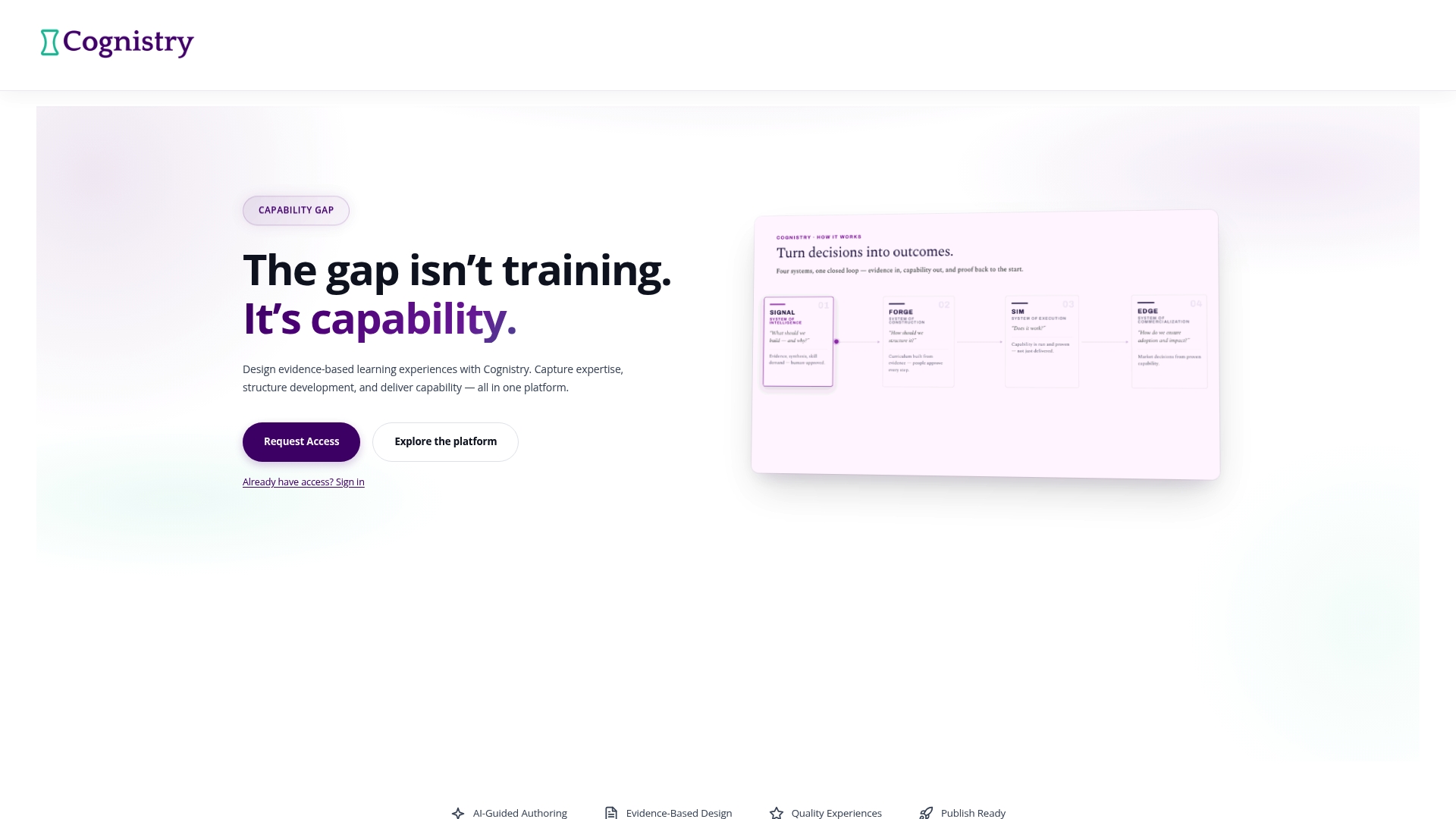
Visit the Cognistry Platform to see how capability diagnosis and evidence mapping work together, or explore Signal if readiness assessment is your immediate need. Request a demo to walk through your own use case before you build anything.
FAQ
What is the first step in an AI adoption strategy?
Run a capability diagnosis before selecting tools: identify what the work actually requires and whether AI changes that requirement. Pair this with 1 to 3 priority use cases tied to a measurable business objective, not a general goal like efficiency.
How do I know if my organization is ready for AI?
Readiness comes down to data availability, lineage, and access, plus whether managers and frontline staff can practice the judgment the new workflow demands. The Cloud Adoption Framework for AI frames this as a plan and ready stage before any governance or deployment work begins.
How long should an AI pilot run before scaling?
Keep proofs of concept to about one to two months with one owner and one metric, since longer pilots tend to lose executive attention before proving value. Scale only when the outcome metric hits its target consistently, not after a single strong result.
What does responsible AI governance actually require?
At minimum, tier risk by consequence, document the data and logic behind decisions, and disclose to affected employees and customers when AI informs an outcome. NIST’s generative AI profile organizes specific governance actions by subcategory, covering legal alignment, provenance, and stakeholder input.
When does an AI adoption challenge call for training versus a process fix?
Diagnose the gap before designing anything: if the evidence points to a tooling or workflow problem, redesign the process first. Build an enablement play only when the diagnosis shows the gap is genuinely about judgment or skill, not environment.
Sources
- AI Risk Management Framework (AI RMF) profile for Generative AI — NIST
- AI strategy and planning guidance — Microsoft Azure Cloud Adoption Framework
- New future of work: AI is driving rapid change, uneven benefits — Microsoft Research