Enterprise learning data privacy is not a course catalog problem. It is an evidence problem: before you build anything, you diagnose what what capability the work actually requires and whether learning is even the right response. Run a capability diagnosis before you build training. Some platforms exist to address privacy failures that trace back to skipped diagnosis, not missing content.
TL;DR:
- Diagnosing privacy capability takes two to four weeks and involves analyzing incident data, frontline interviews, DPIA notes, and tool telemetry.
- Most privacy issues stem from workflow or system barriers rather than knowledge gaps, so training alone often cannot resolve root causes.
- Effective enablement focuses on decision practice through real scenarios and simulations tied to actual evidence, not generic content or checklists.
- Privacy metrics like judgment scores and DSR turnaround times provide real insight into progress, unlike superficial completion rates.
- Scaling privacy training requires a network of trained champions reviewed regularly by central teams to prevent drift from policy.
Table of Contents
- How Do You Diagnose Whether Learning Is the Right Response?
- Designing an Evidence-Based Privacy Enablement Play
- Which Privacy Metrics Prove Impact and Win Budget?
- How Do Privacy Champions Scale Enablement Without Losing Control?
- How Should You Pilot and Scale a Privacy Enablement Play?
- What Are the Key Data Privacy Regulations to Know?
- What Are the Core Principles of Data Protection?
- What Are the Most Common Data Privacy Risks?
- What Are the Best Practices for Data Privacy Compliance?
- Why Does Employee Training Matter for Data Privacy?
- What Tools Support Ongoing Privacy Education?
- Skipping the Diagnosis Is the Costliest Mistake in Privacy Enablement
- How Cognistry Builds Evidence-First Privacy Enablement
- Sources
- FAQ
How Do You Diagnose Whether Learning Is the Right Response?
Before you build that the course, gather evidence. Strategy goals, frontline complaints, quality-control findings, data subject request (DSR) backlogs, DPIA notes, and tool telemetry all tell you something different about where privacy actually breaks down in your organization. A spike in DSR turnaround time might point to a workflow bottleneck, not an awareness gap. A cluster of near-miss incidents in one region might point to a tool that makes the wrong action easier than the right one.
Run this checklist over two to four weeks before you commit to any build:
- Pull the last two quarters of privacy incidents, near-misses, and DSR fulfillment times.
- Interview five to eight frontline employees about where privacy decisions actually stall.
- Review DPIA notes and audit findings for recurring root causes.
- Check tool telemetry for where people work around, rather than with, existing controls.
- Map each finding to one of three categories: knowledge gap, process gap, or tool gap.
The decision rule that follows is simple. If evidence shows people don’t know what to do, learning is primary. If evidence shows people know what to do but the process or system blocks them, learning is not the fix, redesign the workflow. Most real cases land in between, requiring a combined response: targeted enablement plus a process or tool change running in parallel.
Pro Tip: If your diagnosis surfaces more tool workarounds than knowledge gaps, don’t let anyone talk you into “just build a refresher course.” That course will not move the metric you actually care about.
Designing an Evidence-Based Privacy Enablement Play
Once diagnosis confirms learning is warranted, the design work starts with capability mapping, not content outlining. Map the actual decisions and judgment calls people face, not just the tasks listed in a job description. A customer service rep doesn’t need to “know GDPR.” They need to recognize the moment a request qualifies as a data subject right, judge whether an exception applies, and act within a deadline.
Three modalities tend to outperform generic e-learning for this kind of judgment building:
- Short scenario practice built around real, anonymized incidents from your own quality findings.
- Decision simulations that force a choice under ambiguity, then show the consequence.
- Role-based microlearning tied to the specific systems and workflows a team actually uses.
Write scenarios from your own evidence, not stock examples. If your DPIA notes flagged a marketing team repeatedly requesting more customer data than a campaign needs, that becomes a practice scenario about trade-off discussions between growth and limitation. Research on managing trade-offs between data use and privacy confirms this tension is structural, not a training failure. It needs to be practiced as a negotiation, not memorized as a rule.
Before rollout, build in governance gates:
- Legal and privacy teams sign off on scenario accuracy.
- Subject matter experts from the frontline validate realism.
- A small pilot group tests the simulation before wider release.
Skipping these gates is how technically correct training ends up practically useless.
Which Privacy Metrics Prove Impact and Win Budget?
Privacy metrics fall into six practical categories: individual rights (DSR fulfillment time, appeal rates), training and awareness (completion is the weakest of these, judgment scores in simulations are the strongest), commercial (deal delays tied to privacy review, vendor onboarding speed), accountability (DPIA completion rates, audit findings closed on time), privacy stewards (champion coverage, escalation response time), and policy (policy exception rates, time to update after a regulatory change).
Nearly all organizations now track at least one privacy metric, but tracking one metric and building a diagnostic loop are different things.
Pick three to six sentinel metrics per audience rather than reporting everything to everyone:
- Executives want commercial and accountability metrics: deal delays avoided, audit findings closed.
- Privacy operations wants individual-rights and policy metrics: DSR turnaround, exception rates.
- L&D wants judgment scores from simulations and time-to-competence, not completion rates.
Privacy metrics work best as a continuous diagnostic loop: a bad number should trigger a new diagnosis cycle, not just a report. As programs mature, the metrics that matter shift. Early-stage programs track completion and incident counts. Mature programs track judgment quality under simulation and time-to-competence against real operational thresholds, tracked through resources like operational performance metrics.
Pro Tip: If your only privacy metric is course completion, you have an activity report, not a maturity model. Executives can smell the difference.
How Do Privacy Champions Scale Enablement Without Losing Control?
Privacy champions are the layer between central policy and daily frontline decisions. Recruit them from teams with the highest DSR volume or the most flagged near-misses, not from whoever volunteers first. Their job is translation: turning a legal team’s policy language into a two-minute job aid a warehouse supervisor or sales rep can actually use.
Effective champion networks share a few traits:
- Champions get short, recurring enablement sessions tied to real incidents in their own team, not a generic annual refresher.
- Central privacy and legal teams review champion-created materials before they circulate, keeping local practice aligned with policy.
- Recognition is visible: champion contributions show up in performance conversations, not just a thank-you email.
Field reports on champion programs consistently find that decentralized ownership fails without this oversight loop. Champions without central review drift from policy. Central teams without champions never reach the frontline.
Pro Tip: Give champions a standing 15-minute monthly slot with the central privacy team. That single habit prevents more drift than any policy document.
How Should You Pilot and Scale a Privacy Enablement Play?
Pilot small and instrument tightly before committing to a full rollout.
- Choose one team or region with a clear, measurable pain point from your diagnosis.
- Set a timeboxed pilot, four to eight weeks, with a defined success gate agreed in advance.
- Define the gate concretely: a target reduction in DSR turnaround time, a minimum judgment score on simulation, or a drop in flagged near-misses.
- Get sign-off from privacy, legal, and the pilot team’s manager before you call it a success.
- Track a business indicator alongside the learning output, incident frequency, DSR fulfillment speed, or customer trust signals like complaint volume.
NIST’s guidance on security and privacy learning programs frames this as a lifecycle: strategic planning, role-based delivery, and measurement feeding back into the next planning cycle. Scaling decisions should follow the pilot’s sentinel metrics, not enthusiasm. A pilot that hits its DSR turnaround target scales. One that only improves completion rates needs another look, guided by frameworks like the time-to-competence metric.
Pro Tip: Write your success gate before the pilot starts, not after you see the results. A gate written after the fact always looks generous.
What Are the Key Data Privacy Regulations to Know?
Regulatory literacy matters, but only as context for the judgment calls your teams actually face. The General Data Protection Regulation (GDPR) governs personal data handling for organizations processing data tied to the European Union, with individual rights including access, erasure, and portability, and penalties that scale with revenue. The California Consumer Privacy Act (CCPA), expanded by the California Privacy Rights Act (CPRA), gives California residents rights to know, delete, and opt out of the sale of personal information, with enforcement through the California Privacy Protection Agency.
Beyond these two, a growing patchwork of state laws, Virginia, Colorado, Connecticut, and others, each with its own thresholds and exceptions, means a single national policy rarely translates cleanly into a single training module. Sector rules add another layer: HIPAA for health data, GLBA for financial data, each with distinct notification and consent requirements.
The practical implication for enablement design: don’t build a course that recites regulatory text. Build practice around the decision points where these rules actually intersect with a role, a customer service rep judging whether a request qualifies for erasure, a sales rep deciding what data a new contract can collect. Compliance with data privacy laws is demonstrated through consistent judgment at those decision points, not through a quiz score on statutory definitions.
What Are the Core Principles of Data Protection?
Most modern privacy law traces back to a handful of durable principles. Data minimization means collecting only what a specific purpose requires, not what might be useful someday. Purpose limitation means data collected for one reason cannot silently be repurposed for another. Storage limitation sets a shelf life on data instead of keeping it indefinitely. Accuracy requires correcting or removing outdated or wrong information. Accountability places the burden of proof on the organization to demonstrate compliance, not on regulators to catch violations.
These principles matter for enablement design because they describe the trade-offs your employees navigate daily. A product team wanting more customer data for a feature is running into purpose limitation. A sales team wanting to keep old leads “just in case” is running into storage limitation. Framing training around these five principles, instead of around a specific regulation’s article numbers, gives employees a mental model that survives when the regulatory text changes.
Understanding data privacy at the principle level, rather than the statute level, is what lets a single enablement play serve a workforce operating across multiple jurisdictions. A judgment scenario built around data minimization works whether the applicable law is GDPR, CCPA, or a state law passed next year.
What Are the Most Common Data Privacy Risks?
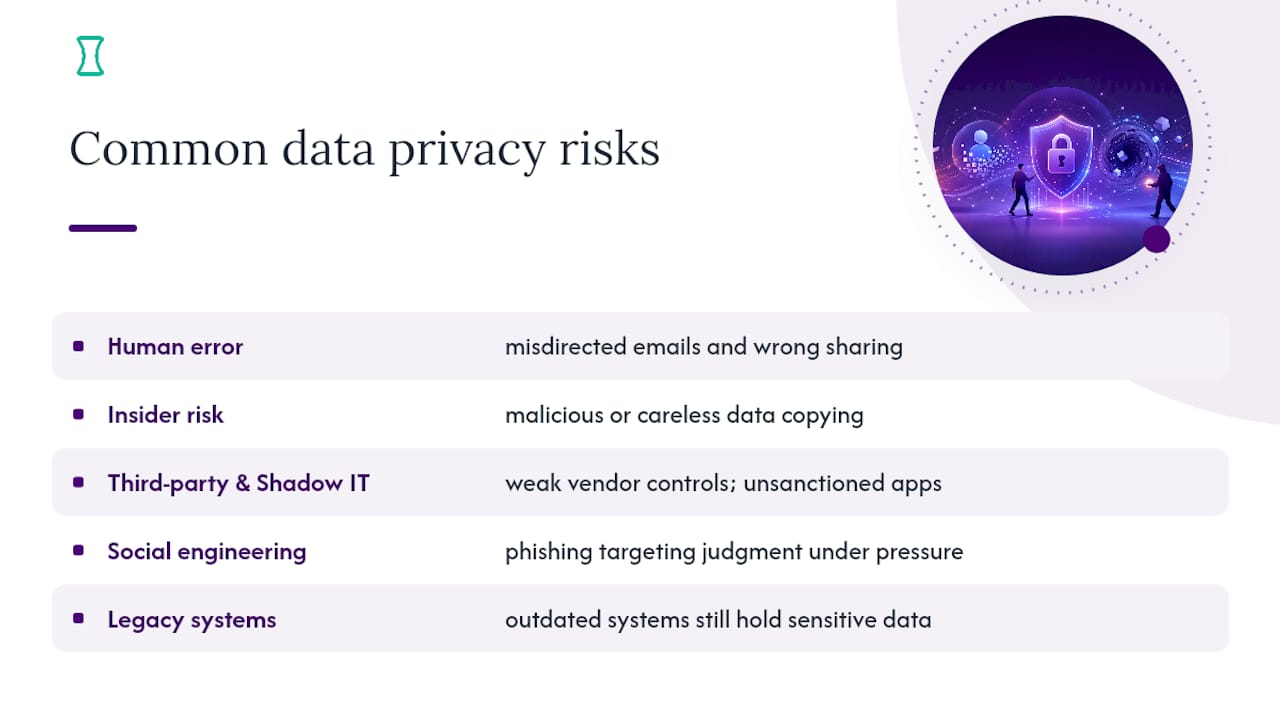
Human error remains the most persistent risk category: misdirected emails, misconfigured access permissions, and data shared with the wrong internal or external party. Insider risk follows closely, sometimes malicious, more often careless, an employee moving customer data to a personal drive for convenience.
Third-party and vendor risk has grown as more data flows through cloud tools and subprocessors. A vendor’s weak controls become your exposure the moment their system holds your data. Shadow IT, employees adopting unsanctioned apps to get work done faster, compounds this risk because privacy and security teams cannot govern what they cannot see.
Social engineering and phishing remain effective precisely because they target judgment under pressure, the same decision points that practice simulations are built to strengthen. Legacy system risk deserves more attention than it gets: outdated systems that were never designed with today’s privacy requirements in mind, still holding sensitive data because migrating it feels too disruptive.
Real-time visibility into where data moves and how it is accessed closes part of this gap. Real-time data monitoring gives privacy and security teams the telemetry needed to catch anomalies before they become incidents, feeding the same evidence base a capability diagnosis draws on. None of these risks are solved by a single training module. They are solved by pairing tighter access controls, built on least-privilege principles, with employees who recognize the moment a risk is forming.
What Are the Best Practices for Data Privacy Compliance?
Compliance holds up when it is built on documented evidence, not good intentions. Maintain a current data inventory: what you collect, where it lives, who can access it, and why. Run DPIAs before launching anything that processes personal data at scale, and treat the findings as design inputs, not paperwork to file away.
Build a documented incident response process with clear escalation paths and rehearsed timelines, most regulations attach hard deadlines to breach notification. Vet vendors against privacy requirements before signing, not after an incident reveals a gap. Apply the principle of least privilege to system access so that judgment errors have a smaller blast radius when they happen.
Best practices for data privacy compliance also mean treating audits as diagnostic input rather than a pass or fail exercise. A recurring audit finding in one department is evidence pointing straight at a capability gap or a broken process, feed it back into your diagnosis rather than closing the finding and moving on. Governance frameworks that connect policy, audit findings, and enablement design, like the approach outlined in a learning governance framework, keep these pieces from operating in isolation. Compliance sustained over years looks less like a checklist and more like a feedback loop between what the evidence shows and what the organization does next.
Why Does Employee Training Matter for Data Privacy?
Employees make the moment-to-moment decisions that either protect or expose personal data, no policy document makes that call for them. A privacy program can have flawless documentation and still fail at the point where a real person decides whether to forward a file, grant an access request, or flag a request as suspicious.
The role of employee training in maintaining data privacy is not to make everyone a privacy expert. It’s to build recognition, the ability to spot the moment a routine task has become a privacy decision, and judgment, knowing what to do once that moment arrives. Awareness training that stops at “here are the rules” rarely changes behavior under time pressure, which is when most privacy mistakes actually happen.
This is why decision practice, not information delivery, is the design center of an effective program. A support rep who has practiced five realistic erasure request scenarios responds differently under pressure than one who read a policy once. Importance of data privacy training shows up not in completion certificates but in fewer flagged incidents and faster, more consistent handling of real requests, exactly the operational signals a diagnosis-first program is built to track from day one.

What Tools Support Ongoing Privacy Education?
Privacy regulation and risk both move faster than annual training cycles. Static policy documents and once-a-year courses fall out of date the moment a new state law passes or a new attack pattern emerges. Ongoing data privacy training resources need to combine three things: a live source of regulatory change, a way to convert that change into practice quickly, and a way to measure whether the update actually reached judgment quality.
Regulatory tracking services and legal counsel remain the front line for knowing what changed. Internal knowledge bases and job aids, kept current by privacy champions rather than a central team alone, handle the day-to-day reference need. For the deeper layer, converting a regulatory update into a scenario people can actually practice, platforms built for decision simulation and capability mapping close the gap that a slide deck update cannot.
The NIST framework for aligning AI-guided capability engineering with workforce standards offers one structured way to think about keeping privacy learning current without rebuilding a course from scratch every time a regulation shifts. The goal is not more content. It’s a faster loop between “the rule changed” and “the team can act on it.”
Skipping the Diagnosis Is the Costliest Mistake in Privacy Enablement
The failure mode I see most often isn’t bad content. It’s teams building a full privacy course before confirming the real problem was a knowledge gap at all. One organization spent months producing a GDPR refresher when their DSR delays traced to a broken ticketing handoff, no course could have fixed that. A diagnosis run first would have caught it in weeks, not months.
Measure what predicts behavior change, not what’s easy to report. Completion rates flatter a dashboard. Judgment scores and DSR turnaround times tell you the truth.
— Brian
How Cognistry Builds Evidence-First Privacy Enablement
Cognistry is the alternative to slide-building for organizations that need privacy capability proven, not just delivered. Instead of starting with a course outline, Cognistry starts with diagnosis: capability signal mapping that pulls from your own strategy goals, frontline friction, and quality findings to determine whether learning is the right enablement play at all.
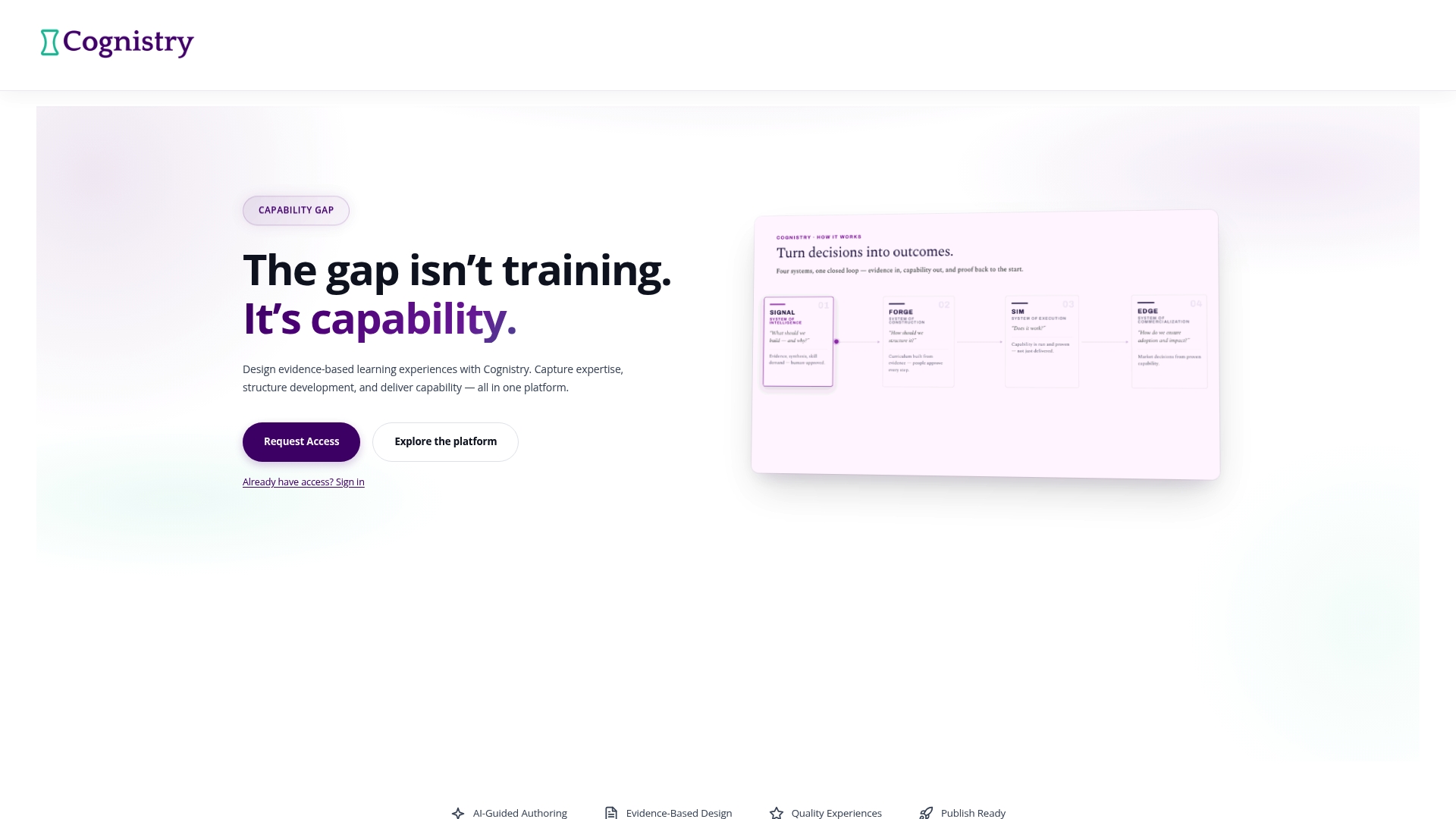
From there, the Cognistry Platform structures the response around decision practice, not knowledge recall, using AI-guided authoring, a learning architecture builder, and decision practice environments that mirror the actual judgment calls your teams face. Behavioral telemetry and quality assurance gates measure whether the enablement play worked, feeding straight back into the metrics your executives and privacy operations teams already track. If you’re ready to run a real capability diagnosis instead of another generic privacy course, explore Sim to see how decision practice environments are built and piloted.
Sources
- Privacy Metrics Report — Future of Privacy Forum
- Measuring privacy programs: The role of metrics — IAPP
FAQ
What Does “Learning Data Privacy” Mean for an Enterprise?
It means diagnosing what capability privacy work actually requires before building any training, then designing evidence-based enablement, decision practice, and measurement tied to business outcomes.
How Long Should a Privacy Capability Diagnosis Take?
Most diagnoses run two to four weeks, pulling incident data, DSR turnaround times, DPIA notes, and frontline interviews before any design work begins.
What Metrics Matter Most for Privacy Learning Programs?
Judgment scores from decision simulations and time-to-competence matter more than completion rates, alongside DSR fulfillment time and audit findings closed on time.
Do I Need a Privacy Champion Network to Scale Training?
Champions help translate central policy into team-level practice, but they need central review and recognition to stay aligned with policy rather than drifting from it.
How Does Cognistry Differ From a Course-Building Tool?
Cognistry starts with capability diagnosis and organizational evidence, before any build, structuring decision practice and measurement rather than generating slides or generic courses. Pricing details for the Cognistry Platform are available on the site.