
A knowledge transfer plan is a structured worksheet that names what critical knowledge exists, who holds it, who needs it, and how it moves before it disappears. Start today by listing the top one to three knowledge items whose loss would break operations, and assign each one an owner. Before scheduling training sessions, run a quick diagnosis: some of what looks like a knowledge gap is actually a process or access problem, and no amount of documentation fixes that.
TL;DR:
- Knowledge transfer plans should prioritize critical knowledge about customer impact, system access, and sole points of failure for effective risk mitigation.
- Creating a structured plan involves clearly defining objectives, transfer methods, timelines, verification criteria, and assigning owners responsible for progress.
- Diagnosis of environmental barriers like lack of access or process issues should happen before designing or providing training to address root causes directly.
- Managers must actively own and regularly oversee the transfer process, ensuring validation, documentation, and real task observation rather than relying solely on stored artifacts.
- Scaling successful knowledge transfer requires systematic templates and diagnosis-driven approaches, especially when managing numerous transitions across teams.
Table of Contents
- What Does a Knowledge Transfer Plan Cover?
- Core Components Every Knowledge Transfer Plan Needs
- How Do You Create and Run a Knowledge Transfer Plan?
- How Do You Prioritize What to Transfer First?
- What Templates Should You Actually Produce?
- Should You Diagnose Before You Build Training?
- What Managers Get Wrong About Owning a Knowledge Transfer Plan
- Where Cognistry Fits When You’re Ready to Scale This
- Sources
- FAQ
What Does a Knowledge Transfer Plan Cover?
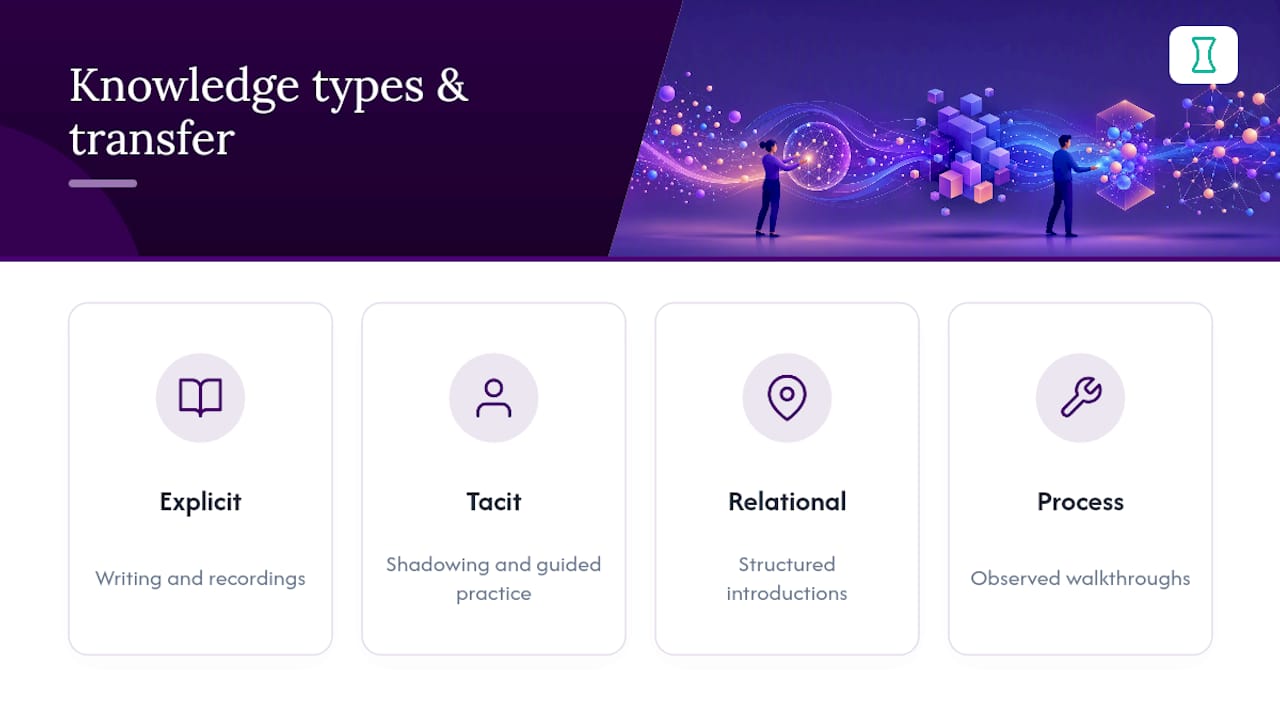
A working knowledge transfer plan accounts for four distinct kinds of knowledge, because each demands a different transfer method. Explicit knowledge lives in documents and manuals, so it transfers through writing and recordings. Tacit knowledge, the judgment calls a senior employee makes without thinking twice, only transfers through shadowing and guided practice. Relational knowledge, the “who to call” web of vendor contacts and internal allies, moves through structured introductions. Process knowledge, the actual sequence of steps behind a task, transfers best through observed walkthroughs.
A narrative review synthesizing 28 knowledge-transfer models found five recurring components: identifying the problem, developing and selecting the right knowledge, analyzing the context it lives in, running transfer activities, and confirming the knowledge gets used. That review also found the strongest KT processes are cyclical or multidirectional, not a straight line from expert to novice. Treating knowledge as a strategic asset rather than a farewell formality is what separates plans that hold up from ones that quietly fail six months later.
Core Components Every Knowledge Transfer Plan Needs
A knowledge transfer template earns its keep only if it captures the fields that actually get used later, not the ones that look thorough in a meeting. Practical guidance from eFront Learning’s KT template and similar frameworks converges on a consistent set of fields:
- Objective and scope: why this transfer matters and what’s explicitly out of bounds.
- Knowledge area and type: whether it’s explicit, tacit, relational, or process knowledge.
- Current owner and recipient: named individuals, not job titles.
- Transfer method: documentation, shadowing, mentoring, recorded walkthroughs, or joint workshops.
- Timeline and milestones: dates for each checkpoint, not a single deadline.
- Verification criteria: what “capable” looks like in observable terms.
- Storage location: where the artifact lives once captured.
- Systems and access: logins, permissions, and who approves new access requests.
- Contacts with context: not just names and numbers, but why each contact matters.
- Active projects and open risks: anything mid-flight that the recipient inherits.
Every row needs a manager attached to it. Without a named owner checking progress weekly, a knowledge transfer plan drifts into a document nobody updates. AlphaLearn’s practical KT template guidance makes the same point: store artifacts in a searchable central repository, not a scattered folder of email attachments, so the plan survives past the transition that created it.
How Do You Create and Run a Knowledge Transfer Plan?
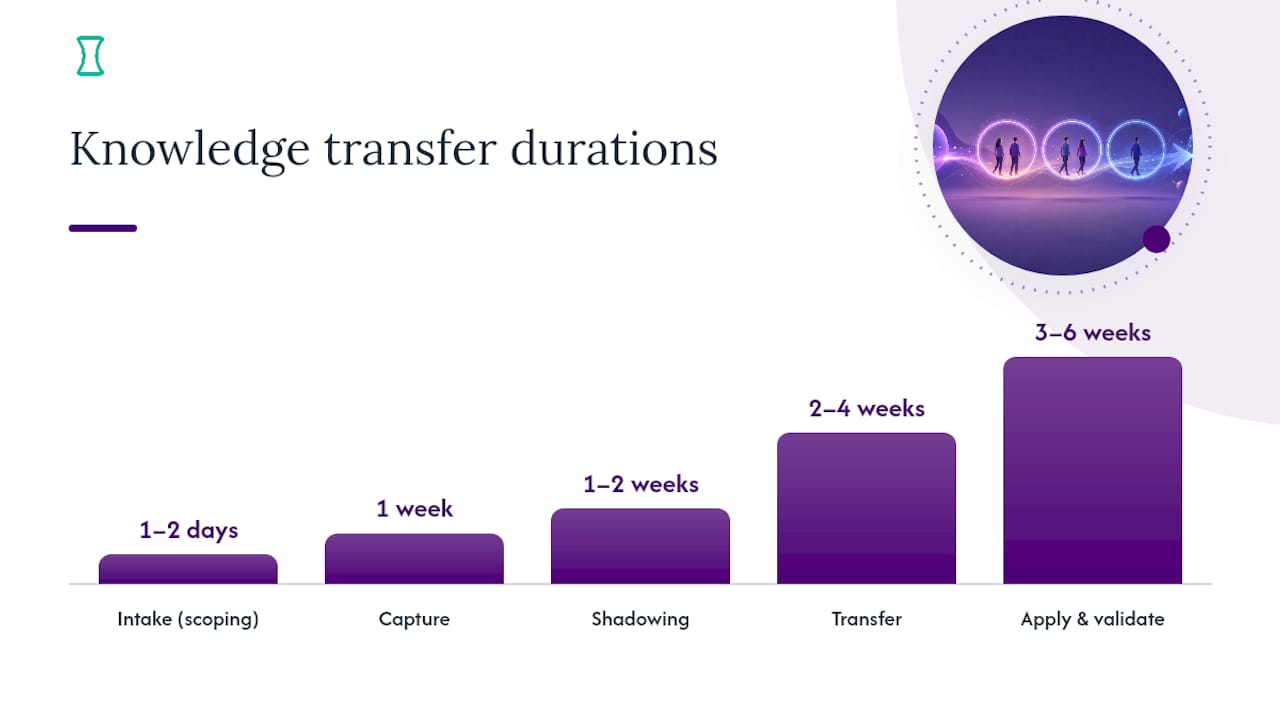
Running a knowledge transfer plan works best as a short operating project with a defined start and finish, not an open-ended handoff. Here’s the sequence that holds up under real deadlines:
- Intake and scoping (day 1 to 2). Meet with the departing employee or project lead, the receiving manager, and the recipient together. Confirm scope, timeline, and who owns what.
- Capture (week 1). Run structured knowledge capture interviews, pull existing documentation, and record screen-share walkthroughs of anything procedural. University offboarding guidance recommends holding this interview within the first week of notice, while memory and motivation are both still fresh.
- Shadowing (weeks 1 to 2). Have the recipient observe the expert perform the real task, not a simplified version of it.
- Transfer (weeks 2 to 4). Run joint sessions where the recipient attempts the task with the expert present, then supervised practice with the expert stepping back.
- Apply and validate (weeks 3 to 6). The recipient completes the task independently while a manager or SME observes and signs off.
- Retain (ongoing). File everything in a central repository with consistent tags, then schedule a 30-day and 90-day follow-up to catch what the plan missed.
Complexity dictates duration. A single-system handover might close in two weeks; a role with regulatory exposure, multiple systems, and external vendor relationships can reasonably take up to twelve weeks. Compressing either one to save time is how gaps survive the transition undetected.
Pro Tip: Don’t let “capture” become the finish line. A knowledge transfer plan that stops at documentation and skips supervised practice produces recipients who can recite the process but freeze the first time something goes wrong.
How Do You Prioritize What to Transfer First?
Not every piece of knowledge deserves equal urgency, and short-notice departures force hard choices fast. Rank knowledge areas against four risk factors: customer impact, financial or regulatory exposure, system access dependency, and whether one person is the sole point of failure for a process.
- Anything touching active customer commitments or payment processing goes first, regardless of how “boring” the task feels.
- System credentials and access permissions come second. A locked-out recipient can’t practice anything.
- Single-point-of-failure processes, the ones only one person on the team understands, outrank tasks with built-in backup coverage.
- Relationship knowledge (vendor contacts, key stakeholder history) ranks lower unless a deal or renewal is actively in motion.
Practitioner guidance on short-notice handovers consistently recommends this kind of rapid triage over trying to document everything: focus first on what would visibly disrupt customers, compliance, or operations if it disappeared tomorrow. Time-box each transfer item, even a rushed one. A tacit process crammed into a single afternoon rarely survives contact with reality; give it at minimum a few days of supervised practice, even under compressed notice.
What Templates Should You Actually Produce?
Three artifacts do most of the work in a functioning knowledge transfer plan, and each has a specific job.
- KT worksheet: one row per knowledge item, with owner, recipient, method, deadline, and verification status filled in as work happens, not backfilled at the end.
- Knowledge capture interview guide: a short, repeatable list of questions covering current responsibilities, undocumented shortcuts, key contacts, and “what would you tell your replacement on day one.”
- Validation checklist: an observed-task rubric with clear pass criteria and a manager sign-off line.
Practical KT templates for handovers treat the worksheet as a living project artifact updated in real time rather than a static form filed away after the fact. Adapt each template to the scenario: an exit needs a tighter timeline and heavier interview focus, a promotion allows for a slower handoff with more shadowing, and a project handover leans harder on documentation because the “expert” often stays reachable.
Should You Diagnose Before You Build Training?
Not every capability gap is a training problem, and treating it as one wastes weeks. Before converting captured knowledge into formal enablement, an organization needs to test whether the gap is environmental (broken process, missing access, unclear ownership) or genuinely a people-based capability gap that training can close.
The fastest fixes in a transition are rarely training fixes. A recipient who can’t complete a task often lacks system access or a documented decision rule, not instruction. Diagnosis before design keeps a knowledge transfer plan from becoming an expensive substitute for fixing the actual process.
Cognistry’s approach to capability engineering treats organizational evidence, strategy documents, frontline friction points, and quality findings as the material that should shape what gets built, not assumptions about what a role “should” know.
Pro Tip: If three recipients hit the same wall during validation, stop blaming the individuals. That pattern points to a process or access gap the whole team inherited, not a training failure.
What Managers Get Wrong About Owning a Knowledge Transfer Plan
Managers who treat a knowledge transfer plan as HR’s paperwork rather than their own operational responsibility are the ones who watch it fail. The plan works when a manager owns the weekly check-in, chases the SME for missed interview slots, and reviews the validation checklist personally instead of rubber-stamping it.
L&D can institutionalize this by keeping one standard worksheet, one interview guide, and one validation template across the organization rather than letting every department reinvent its own. Repetition is what makes a knowledge transfer plan measurable instead of anecdotal.
The most common failure isn’t a missing document. It’s skipping validation and assuming documentation equals competence. Success looks like a recipient completing the real task, observed, without the previous owner in the room.
— Brian
Where Cognistry Fits When You’re Ready to Scale This
Cognistry is the option for organizations that have outgrown spreadsheets and shared drives as their knowledge transfer system. In-house templates work well for a single handover; they buckle once you’re running dozens of transitions a year across teams that each captured knowledge differently. Cognistry starts by diagnosing what capability the work actually requires and whether learning is even the right response, grounding every recommendation in your own organizational evidence rather than a generic course template.
When a capability gap turns out to be real rather than environmental, Cognistry structures the response as practice simulations and decision environments built to develop judgment, not just recall. That’s the difference between a recipient who memorized a process and one who’s been tested against the messy version of it. Explore the Forge platform to see how diagnosis-first enablement scales past a single handover, or review how capability engineering works before requesting a demo.
Sources
The narrative review on transferring knowledge into action remains the clearest academic grounding for treating KT as cyclical rather than linear. For a ready-made starting point, Cal Poly’s offboarding knowledge transfer template offers concrete interview questions and a project-status format worth adapting directly. eFront Learning’s KT plan guide and Workhint’s handover template both provide practical field structures for teams building their first worksheet from scratch.
- A conceptual framework for transferring knowledge into action (narrative review)
- Offboarding Knowledge Transfer Plan (university template)
- How to Create a Knowledge Transfer Plan: Free Template (eFront Learning)
FAQ
What should a knowledge transfer plan include?
At minimum, it needs the knowledge area and type, a named owner and recipient, a transfer method, a timeline with milestones, verification criteria, and a storage location for the finished artifact.
What is a knowledge transfer program?
It’s the broader system, templates, cadence, and ownership rules an organization uses to run knowledge transfer consistently across every departure, promotion, or project handover, rather than improvising each time.
What is a KT checklist?
A KT checklist is a short validation tool, often paired with the worksheet, that confirms a recipient can perform a task independently before sign-off, rather than relying on documentation alone.
What are the four stages of knowledge transfer?
Most practical frameworks describe capture, transfer, apply, and retain: gathering the knowledge, moving it to the recipient through the right method, validating they can use it, and storing it centrally for future reference.