

If your people know the procedure but aren’t doing it, start with an evidence-led diagnosis before you build training. The gap is rarely a knowledge problem. It’s usually an environment problem: the workload, the tools, the incentives, or the documentation are quietly working against the behavior you want. Run a quick evidence collection first, then decide whether training is even the right enablement play.
TL;DR:
- Environment issues like workload, tools, incentives, and documentation are the main barriers, not knowledge gaps, requiring targeted evidence before building training.
- Collect evidence from existing logs, observations, and quick surveys to map the cause of non-compliance, such as practical drift, documentation issues, or incentive conflicts.
- Fix environmental problems first if metrics are misaligned, procedures are confusing, or tooling friction exists; develop training only when a genuine skill or judgment gap is confirmed.
- Use targeted pilots and behavioral signals, like behavior frequency and defect rates, to measure the impact of fixes within weeks, ensuring decisions are evidence-based.
- Involve supervisors early and regularly reinforce correct behavior, since culture and modeling have a stronger influence on procedure adherence than training alone.
Table of Contents
- What evidence to collect and how to interpret it
- Research-backed root causes that make known procedures go unused
- A short decision framework: when to build training and when to fix the environment
- Practical enablement plays: design, environment, and leadership actions
- Metrics, timelines, and governance to prove whether the fix worked
- Why diagnosis-first is the practical choice for leaders
- How Cognistry helps you act on the evidence
- FAQ
- Sources
What evidence to collect and how to interpret it
Before anyone opens a course authoring tool, collect evidence that shows where the breakdown actually happens. Guessing at causes wastes budget and burns credibility with the people you’re trying to help.
Start with signals you already have sitting in systems and logs:
- Incident and quality reports tied to the specific procedure
- Time-stamped task logs showing when and how often the step happens
- Observed behavior versus what’s recorded in the system of record
- Time-to-first-use after any prior training on this task
- Supervisor coaching frequency and what coaching conversations cover
Pair those signals with quick, low-cost methods: focused observations on the floor, a short micro-survey asking frontline staff what gets in the way, a review of the actual procedure documents and checklists, or a rapid pilot comparing two conditions. None of this requires a research department. It requires someone willing to look.
Once you have the evidence, map it to a cause category rather than jumping to a fix:
| Evidence pattern | Likely cause category |
|---|---|
| Steps skipped under time pressure, consistently | Workload or staffing |
| Procedure followed inconsistently across shifts | Documentation or ambiguity |
| Workaround matches what supervisors model | Social norms |
| Correct steps known, performance inconsistent under pressure | Skills or judgment |
| Metric rewards the shortcut, not the procedure | Incentives |
This mapping step is what separates a diagnosis-first enablement play from a reflexive course build. The Education for Life and Work report from the National Academies makes the same point about transfer: training effectiveness depends heavily on conditions outside the learning event itself, including whether the trainee has the opportunity and support to use the new competency at all.
Research-backed root causes that make known procedures go unused
Most “people aren’t following the procedure” situations trace back to a small set of recurring causes, and each one implies a different fix.
Practical drift is the most common. Procedures erode gradually under production pressure until the workaround becomes the normal way of working. A FAA technical report on procedural noncompliance in aviation maintenance found that noncompliance often stems from this kind of drift, combined with poorly written procedures and productivity pressure, rather than from individual carelessness.

Documentation usability is a close second. A procedure that’s technically correct but hard to follow in the middle of a shift gets abandoned, step by step, until nothing of the original intent survives.
Culture and incentives drive a third pattern. When supervisors model the shortcut, or when a metric quietly rewards speed over the correct sequence, the written procedure loses the argument every time.
- Practical drift: the procedure erodes under pressure until the workaround becomes routine.
- Documentation gaps: the written step doesn’t match the real working conditions.
- Incentive conflict: the metric that gets watched rewards a different behavior than the one documented.
- Social modeling: what supervisors and senior peers actually do outweighs what the manual says.
One sourced pattern worth flagging: the FAA’s analysis ties noncompliance directly to practical drift and productivity pressure rather than to individual willfulness, which matters because the fix for drift (simplify the procedure, close the pressure gap) looks nothing like the fix for a genuine skill gap.
Willful violations exist, but they’re rarer than most diagnoses assume, and treating an environmental cause as a willpower problem guarantees the fix won’t hold.
A short decision framework: when to build training and when to fix the environment
Once the evidence is mapped to a cause category, the decision about what to build gets much simpler.
- If the evidence shows misaligned metrics, a confusing procedure, no real opportunity to do the task correctly, or tooling friction, fix the environment first. Training won’t survive contact with a broken system.
- If the evidence shows a genuine knowledge, skill, or judgment gap, then an enablement play built around behavioral skills training and simulation is the right response.
- Before committing to either path, check three things: is there an opportunity to practice the corrected behavior within days, not months; will a supervisor reinforce it; and are tooling blockers small enough that the fix will stick.
Pro Tip: When evidence points to both a skill gap and an environment problem, fix the environment first. Training layered on top of a broken process just teaches people to work around two problems instead of one.
This is the core discipline of a diagnosis-first enablement play: the evidence decides the response, not the other way around.
Practical enablement plays: design, environment, and leadership actions
When the evidence does point to training, the design choices matter as much as the decision to build it.
- Behavioral modeling and deliberate practice. Research on active learning methods finds behavioral modeling and hands-on practice significantly outperform passive instruction, and they work best when the organization supports applying what was practiced.
- Decision-centered simulations. Practice environments that mirror real frontline conditions, including the pressure and ambiguity, transfer better than a scripted refresher course. Cognistry’s Sim product line is built around exactly this kind of practice environment, and the broader case for why simulation is becoming central to professional learning rests on the same evidence.
- Low-fidelity job aids. A one-page checklist at the point of work often beats a full course for closing a narrow judgment gap.
On the environment side, simplify the procedure itself, align the metric that gets watched with the behavior you actually want, and remove the two or three tooling steps that make the correct path slower than the workaround.
On the leadership side, a regular supervisor coaching cadence, short peer debriefs after a difficult case, and visible recognition for doing the procedure correctly all reinforce the new behavior far more cheaply than another course.
Pro Tip: Pilot one enablement play with a small group, watch the behavioral signals for two to four weeks, then decide whether to scale, adjust, or abandon it.
Metrics, timelines, and governance to prove whether the fix worked
Knowing what to measure, and for how long, is what turns a pilot into a defensible decision.
Prioritize behavioral signals over satisfaction scores: frequency of the correct behavior, quality check results, incident or defect counts tied to the specific procedure, and time-to-first-use after any training event. The NIOSH review of training effectiveness notes that research tends to focus on these intermediate behavioral outcomes precisely because ultimate outcomes, like injury reduction, take longer and are harder to isolate.
- Set a baseline before changing anything.
- Run a short pilot, weeks rather than months, with a control group where feasible.
- Set a decision gate in advance: what result triggers scaling, adjusting, or stopping.
| Stage | What it answers |
|---|---|
| Baseline | What is the current behavior frequency and defect rate |
| Pilot | Does the enablement play change behavior within the pilot group |
| Decision gate | Does the signal justify scaling, adjusting, or stopping |
Governance matters as much as measurement. One owner should hold the evidence end to end, a routine review cadence keeps the pilot from drifting unexamined, and every result, including a failed one, should get codified so the next diagnosis starts from a stronger base.
Why diagnosis-first is the practical choice for leaders
I’ve come to think the biggest waste in enablement isn’t a bad course. It’s a good course built for the wrong problem. Diagnosis takes a few days. A course nobody needed takes months and still leaves the original gap untouched.
Starting with evidence doesn’t slow anything down. It prevents the far slower cycle of building, launching, watching adoption stall, and starting over. Cognistry’s approach, diagnose, decide, design, measure, exists because that cycle is so common and so avoidable.
Start small. Pull one week of evidence on one procedure that isn’t being followed, and let the pattern tell you what to build next.
— Brian
How Cognistry helps you act on the evidence
Most teams jump straight to building a course. Cognistry starts earlier: it helps you figure out what capability the work actually requires, whether learning is the right response at all, and grounds that decision in your own operational evidence rather than a generic template.
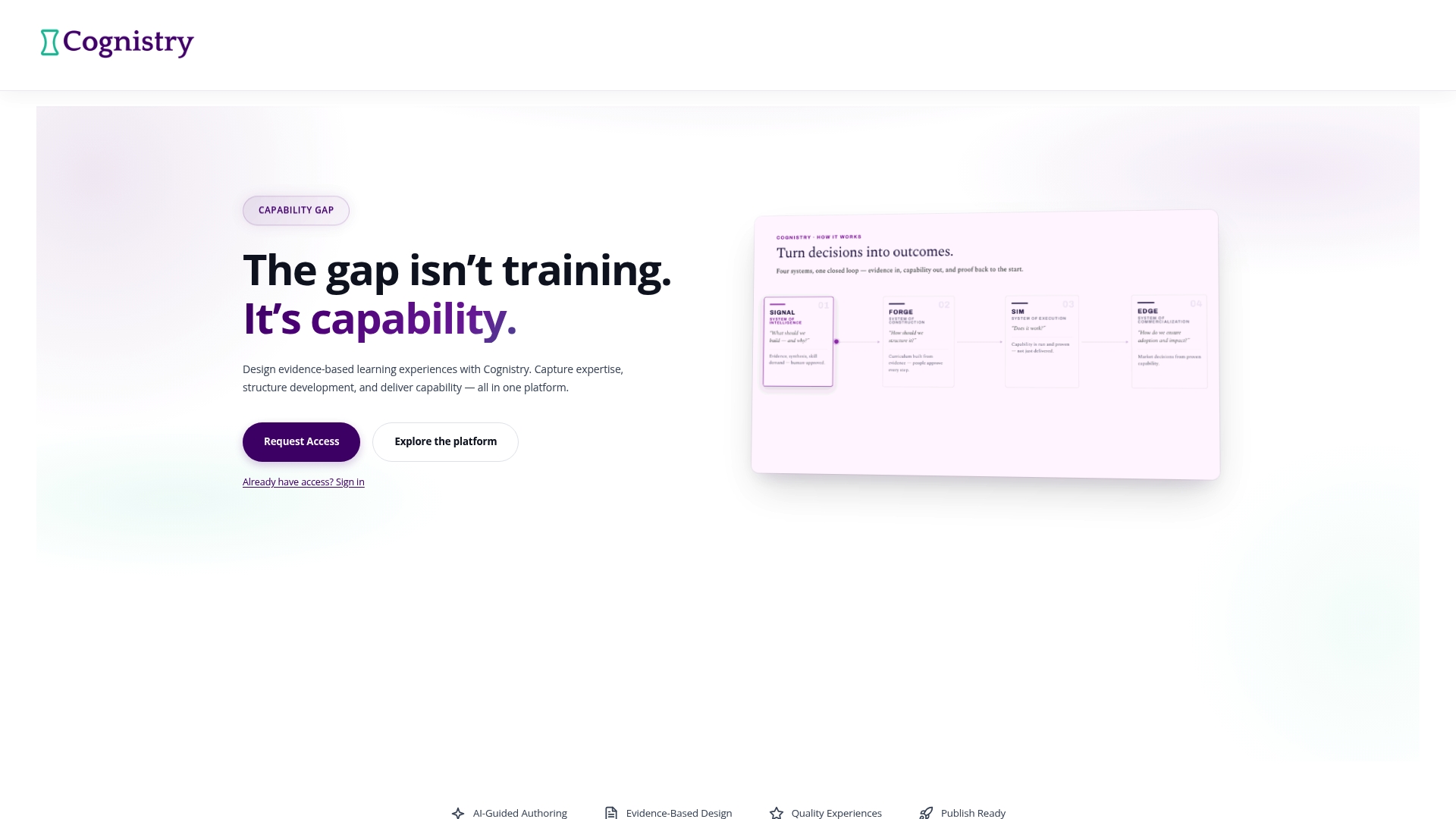
Once the diagnosis points to a genuine skill or judgment gap, decision-centered practice and pilots can be designed to tie directly back to business signals, not just completion rates.
- Signal maps the evidence that should drive the decision in the first place.
- Sim builds the practice environment once training is the right answer.
- The Cognistry Platform connects diagnosis, design, and measurement in one governed workflow.
If you’re looking at a procedure that isn’t being followed and wondering whether a course will fix it, that’s the question Cognistry is built to answer first. Start with the platform overview and see how the diagnosis step works before anything gets built.
FAQ
Why does training alone often fail to change behavior?
Training alone fails when the environment around it doesn’t support the new behavior: no opportunity to practice soon after, no supervisor reinforcement, or a procedure that’s still impractical on the floor. The National Academies report on transferable skills ties transfer directly to conditions outside the learning event itself.
How quickly should we expect to see behavior change?
Expect to see early behavioral signals within a few weeks of a well-targeted pilot, not months. The NIOSH training effectiveness review recommends short pilots with clear behavioral signals specifically because they make scaling decisions faster and more defensible.
What’s the minimum evidence we need before deciding on a fix?
At minimum, pull task logs, a handful of direct observations, and a quick look at the actual documentation the procedure relies on. That combination is usually enough to sort the problem into an environment cause or a genuine skill gap, which is the decision that matters most.
How should supervisors be involved in closing the gap?
Supervisors should be involved from the diagnosis stage, not just the rollout, since their coaching cadence and the behavior they model directly shape whether a fix sticks. Peer and supervisor support are consistently tied to whether a new behavior holds over time rather than fading after the initial push.
Is this problem usually about individual willpower or the system around the person?
It’s usually the system. Evidence on procedural noncompliance points to practical drift, workload pressure, and poor documentation far more often than individual carelessness, which is why diagnosing the environment before blaming the person leads to fixes that actually hold.
Sources
- Education for Life and Work: Developing Transferable Knowledge and Skills in the 21st Century (Chapter 8)
- Training methods and transfer: evidence for active learning approaches (PMC)
- Procedural noncompliance in aviation maintenance (FAA technical report)
- NIOSH review: Training effectiveness and measurement (2010)