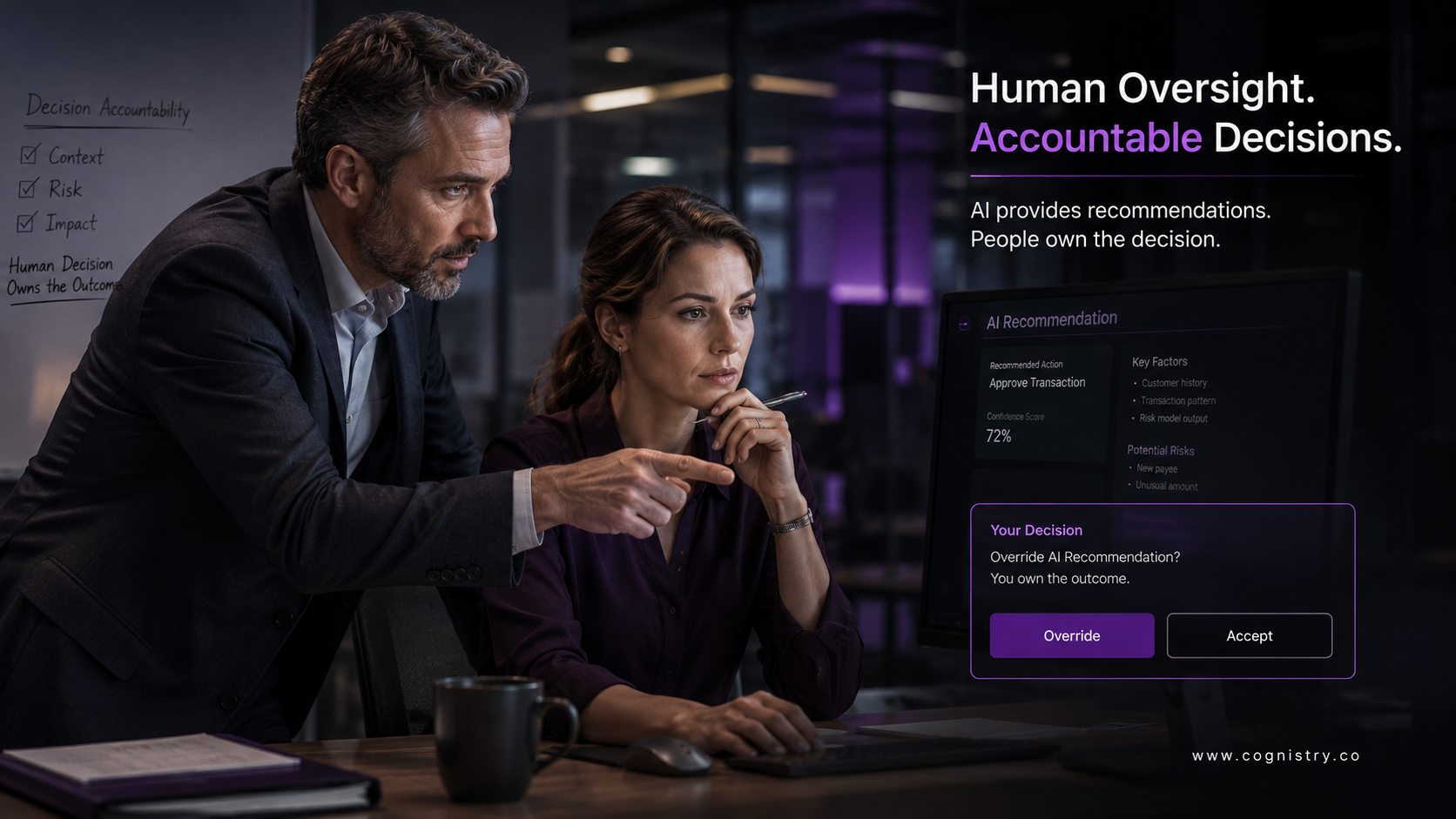

A leadership team holds a decision for next quarter’s data. The data arrives, clean and convincing. By then the option it was meant to inform has closed. Nobody chose to lose it. The team chose to wait, and waiting was the choice.
Waiting for certainty is a decision, and in a system that keeps moving it is often the most expensive one on the table. The fix is not speed for its own sake. It is classifying the decision first: is it reversible or not? Then act in proportion, using small moves to produce the information you are waiting for.
TL;DR
- Deferring a decision is a decision. It carries costs: lost options, delayed learning, and conditions that shift while you wait.
- Certainty is rarely on offer. Complex organizations are dynamic and interdependent, and only partly predictable.
- Slow down to classify, not to wait. Reversible decisions deserve speed. Irreversible ones deserve deliberation.
- The trap is the belief “I cannot act until I know the correct answer.” More data does not dissolve it.
- Small, reversible moves generate the information the big decision needs.
Table of Contents
- Why waiting feels safe and is not
- Certainty, risk and uncertainty are different things
- The Right Tangle: “I cannot act until I know the correct answer”
- Organizations are dynamic, so delay compounds
- Slow down to classify, not to wait
- When waiting is the right call
- Act to decide: small reversible moves
- What this means for capability, not just strategy
- Perspective
- Where Cognistry fits
- FAQ
- Sources
Why waiting feels safe and is not
Waiting feels like the neutral option. No one signs off on a mistake. No one owns an outcome. But a delay has consequences just as an action does. McKinsey’s guidance for leaders in fast-moving conditions makes the point directly: in an environment defined by urgency and imperfect information, waiting to decide is a decision in itself. Its example is a hospital system that delays cancelling noncritical surgeries and so fails to free capacity when it is needed.
The National Academies make a similar warning in their decision-making guide for agency leaders. Leaders make hundreds of decisions without perfect information, and waiting for it can produce a default decision of inaction when the point of no return passes quietly.
That phrase is the one to hold on to: passes quietly. Delay rarely announces itself as a choice. It shows up as “let’s get one more analysis,” “let’s revisit after the pilot,” “let’s align once the reorg settles.” Each sounds prudent. Together they hand the decision to events.
Certainty, risk and uncertainty are different things
Part of the confusion is vocabulary. Three situations get lumped together.
- Certainty: each option has one known outcome.
- Risk: several outcomes are possible, and their probabilities are known, as with a lottery ticket.
- Uncertainty: some probabilities are unknown or not well defined, as with a business investment. This is how Harsanyi’s decision-theory chapter draws the line.
An EBSCO overview of the topic describes a decision under uncertainty as one where there is no meaningful probability distribution behind the outcomes, so the decision maker simply does not know what will happen. Good practice there means combining judgment with analytical technique.
Most enterprise choices sit in that third category. Restructuring a service team, changing a quality process, rolling out a new workflow before go-live: no reference class gives you the odds. Waiting for certainty is waiting for a state that this kind of decision never reaches.
The Right Tangle: “I cannot act until I know the correct answer”
We call the underlying belief the Right Tangle. It says a better decision needs more certainty, and so the responsible move is to gather more until the correct answer reveals itself.
The tangle is hard to see because it looks like rigor. It is not. Two things go wrong.
The answer is not hiding. In a complex system, the right answer depends on how the system responds, and the response depends partly on what you do. Information that would settle the question does not exist until someone acts.
More is not the same as better. The National Academies guide reasons that a small amount of information from a very reliable source can serve a leader better than reams of input from armchair experts. A related analysis of the value of information puts the test plainly: if reducing uncertainty would not change the decision, the research is standing in for judgment.
A 2007 study in Judgment and Decision Making shows how people behave once delay gets costly. When the penalty for delay was high, deferral on uncertain information fell to 3% of participants, while delay on certain information fell only slightly. In other words, people already weigh the cost of waiting when it is visible. The work for leaders is making that cost visible.
Organizations are dynamic, so delay compounds
An organization is not a static puzzle. It is a set of interdependent parts that are dynamic and partly predictable. That phrase matters. Partly predictable means you can reason about direction and likely reactions. It also means responses can be delayed or amplified: a small signal from the front line grows, or a fix takes two quarters to show up.
In that kind of system, waiting changes the problem you are waiting to solve. Competitors move. Frontline workarounds harden into habit. The people who held the context leave. A Harvard Business Review piece on strategy under uncertainty warns that hesitating for clarity can open a door for competitors.
This is true inside the enterprise too. When a team waits for perfect clarity before changing how decisions get made, the old way of working keeps running. Our own view of why transformation programs stall rests on the same observation: digital transformation often fails to change how decisions are made, because the work around the technology stays as it was.
Slow down to classify, not to wait
The alternative to waiting is not recklessness. “Speed up by slowing down” has one meaning here: spend a short, deliberate moment classifying the decision before you choose how much evidence it deserves. Slowing down to classify is not slowing down to wait.
The central question is reversibility. Farnam Street’s two-way rule, as Shane Parrish describes it, splits decisions this way:
| Reversible | Irreversible | |
|---|---|---|
| Dominant risk | Dragging your feet | Making the wrong call |
| Value of extra information | Low, it rarely pays for the delay | High, reducing uncertainty is worth the time |
| Right posture | Decide fast, adjust | Deliberate, test assumptions first |
The National Academies guide offers a fuller screen. It lists six factors for judging whether information is enough: experience level, information quality, importance, changeability, urgency and risk. Run a decision through those six and it usually sorts itself within an hour.
A quick classification routine
- Name the decision in one sentence. If you cannot, you are not waiting for data; you are waiting for clarity about the question.
- Ask what it costs to undo. Money, trust, time, people. If the answer is “a week and an apology,” treat it as reversible.
- Ask what would change your mind. If no plausible new fact would change the choice, stop gathering.
- Set a trigger. Decide now what evidence, by what date, converts the choice to action. Passive delay becomes active learning once it has a trigger.
- Run a premortem. Wharton’s Maurice Schweitzer recommends imagining a bad outcome and tracing what contributed to it to surface overlooked problems. Use it on irreversible choices.
Sensemaking and OODA (observe, orient, decide, act) are both ways of naming this loop. The label matters less than the habit: orient first, then move, then reorient.
When waiting is the right call
Waiting is not always wrong. The same value-of-information analysis lays out when it earns its keep. Waiting is most attractive when the information is likely to be decisive, delay is not too costly, the decision is hard to reverse, and the uncertainty actually affects the choice. Acting now is better when delay is costly, the same action would win under many evidence outcomes, inaction causes harm, or early action preserves options.

So the discipline is to make waiting an explicit, priced choice. Write down what you expect to learn, what it will cost to learn it, and what you will do differently as a result. If you cannot fill in the last blank, you are not waiting. You are avoiding.
Act to decide: small reversible moves
The way out of the Right Tangle is to stop treating action and information as sequential. Action produces information. Deloitte’s research on ambiguity recommends “acting to decide” rather than deciding to act: invest in small actions that improve understanding and surface options, let some wither and others crystallize into the logical next step.
What small moves look like in an enterprise:
- A pilot with one team before a company-wide change.
- Staged investment in tranches tied to what each stage shows.
- A time-boxed trial of a new decision rule, with a date to review.
- A scenario exercise to expose assumptions without committing resources. Structured methods such as climate scenario analysis show how teams can stress-test choices without freezing them.
Wharton’s executive-education guide adds a useful expectation to carry into any of these: expect to be wrong a meaningful share of the time, and learn through small experiments. A good decision does not guarantee a good outcome. The National Academies guide says to trust a process that engaged the right people and checked the right information.
The point is the cadence. Small moves, short feedback loops, and a standing willingness to reverse.
What this means for capability, not just strategy
Everything above applies to a leadership team. It applies more sharply to the people who must make decisions every day under the same conditions: frontline staff, managers, product teams, operators.
If those people have been trained to recall the correct answer, they will wait for it. They will escalate, hold, or ask for one more approval. That is the Right Tangle at scale. A course on knowledge recall cannot fix it, because the gap is not what they know. It is whether they have practiced judging a situation, classifying it, and moving.

This is why we begin earlier than most. Before you build that course, ask what capability the work requires, and whether learning is even the right enablement play. Sometimes the cause sits in the environment: unclear authority, conflicting signals, approvals that make waiting the safe default. Sometimes it sits with the person: the judgment has not been practiced. Telling the two apart, using your own evidence from strategy, frontline friction, quality findings and subject-matter expertise, comes before any build. Our piece on why decision practice matters more than training goes deeper on the second case, and building judgment and decision-making capability at work covers how teams develop it.
Perspective
We built Cognistry on a simple observation: organizations rarely fail to train. They fail to diagnose. They reach for a course because a course is a known thing, then measure completion and call it progress.
The same reflex drives the certainty trap. A team that cannot decide is usually told it needs more information, more alignment, more training. Sometimes it does. Often the work is environmental: the system rewards waiting. Our job is to find out which, using the organization’s own evidence, before anything gets built.
When the answer is capability, we structure the response around operational judgment: decision environments where people practice classifying a situation, acting on partial information and seeing what follows. The goal is not a person who knows the right answer. It is a team that knows how to move when no one does, and a business that can see whether that changed anything.
Waiting for certainty is a decision. Let it be a deliberate one.
Brian Lambert, PhD
Where Cognistry fits
If your teams are stalled by decisions that keep getting held, the Cognistry Platform is where we diagnose what capability the work requires, decide whether learning is the right response, and ground the design in your organization’s own evidence. From there it structures courses, practice simulations and decision environments built for operational judgment, and measures results back to the business.
If you are accountable for a specific function, our pages for product and delivery teams and operations teams show how the approach applies in practice.
FAQ
Is waiting for certainty really a decision?
Yes. Choosing not to act commits you to whatever happens while you wait. Leaders who defer are choosing the status quo, and in a moving system the status quo changes without their input.
How do I tell prudent evidence-gathering from avoidance?
Ask what result would change your mind, and by when you will have it. If no plausible finding would change the choice, or no date is set, the gathering has become delay. Setting a trigger turns it back into learning.
What if the decision is irreversible?
Slow down, but with a purpose. Irreversible choices justify more evidence, a premortem and a clear view of what you cannot undo. Even then, ask whether a smaller version can be tested first.
Does this mean acting without data?
No. It means matching the evidence you demand to the cost of being wrong and the cost of waiting. A little reliable information often beats a mountain of weak input, and small moves create the data that analysis alone cannot.
Sources
- Decision making in uncertain times, McKinsey
- Advancing the Art and Science of Decision-Making, National Academies
- Decision Making Under Uncertainty, EBSCO Research Starters
- Rational behavior under certainty, risk, and uncertainty, Cambridge University Press
- Value of Information and When to Wait, Sustainable Catalyst
- Weighing waiting, Judgment and Decision Making
- Make Better Strategic Decisions Amid Uncertainty, Harvard Business Review
- Reversible and Irreversible Decisions, Farnam Street
- Decision Making Under Uncertainty, Wharton Executive Education
- Flourishing in ambiguity, Deloitte Insights
- Make Better Decisions Under Uncertainty, Wharton Executive Education
- Climate Scenario Analysis: A Practitioner’s Guide to the Method