
Skills Ontology for HR Leaders: A Practical Guide
A skills ontology is a structured knowledge graph that defines skills as nodes, connects them through typed relationships (such as “implies,” “requires,” and “similar to”), and attaches metadata like proficiency levels, context, and evidence sources. For HR, L&D, and workforce planning teams, it is the shared capability language that makes talent matching, internal mobility, and targeted upskilling actually work at scale. Before you commission a build, the first step is evidence collection: pull your strategy documents, frontline quality findings, and subject-matter expert interviews to determine what capability the work genuinely requires. Only then does it make sense to decide whether an enablement play, a process change, a hiring push, or a full ontology investment is the right response.
Table of Contents
- How a skills ontology functions in practice
- Skills ontology vs. skills taxonomy: which one do you need?
- What can a skills ontology actually do for your organization?
- How to build a skills ontology: best practices and a checklist
- Authoritative standards and public resources worth knowing
- When to build an ontology vs. when to act with an enablement play
- Governance and maintenance: keeping your ontology alive
- How to measure the impact of your skills ontology
- A concrete skills ontology snippet
- A 90-day plan HR leaders can start this quarter
- Key Takeaways
- Why the diagnosis-first frame changes everything
- Cognistry brings diagnosis-first capability engineering to your skills work
- Useful sources and further reading
How a skills ontology functions in practice
The operational anatomy has five layers, each feeding the next.
Canonical skill registry. A single authoritative list of skill nodes with stable identifiers. Without this, every system invents its own label and matching breaks down.
Metadata and proficiency schema. Each node carries structured attributes: proficiency levels (typically three to five tiers), context tags, and evidence requirements. The schema must be defined before data collection begins, not after.
Relationship graph. The graph layer is where the ontology earns its name. Automated methods, including techniques like latent semantic analysis and clustering, help surface candidate relations from job postings, learning content, and project records. Human subject-matter experts then validate and prune the graph.
Evidence links. Skills are connected to the artifacts that confirm them: completed certifications, project outcomes, assessment scores, and manager observations. This is what separates a skills graph from a skills wish list.
Integration layer. The ontology does not live in isolation. Typical integrations include:
- HRIS — (e.g., Workday, SAP SuccessFactors): contributes role profiles, org structure, and workforce data
- AI learning platforms: AI-powered learning platforms increasingly consume skill-graph data to personalize content recommendations
Data flows in a loop: source systems feed raw skill signals, the ontology normalizes and enriches them, and downstream processes (search, matching, pathway generation) consume the enriched output. The ontology is the translation layer that makes every system speak the same language.
Pro Tip: Start with one critical function or a single hire-to-deploy pipeline rather than attempting enterprise-wide coverage on day one. A focused pilot produces cleaner data, faster validation, and a proof of value that earns the budget for scale.
Skills ontology vs. skills taxonomy: which one do you need?
The terms are often used interchangeably, but they describe meaningfully different structures with different capabilities.
| Dimension | Skills taxonomy | Skills ontology |
|---|---|---|
| Structure | Flat list or strict hierarchy (parent/child) | Graph with multiple typed relations |
| Relationships | “Is a type of” only | Implies, requires, similar to, part of, and custom types |
| Metadata | Minimal (label, category) | Rich (proficiency, context, evidence, provenance) |
| Machine reasoning | Limited | Supports inference, matching, and pathway generation |
| Maintenance complexity | Low | Higher; requires governance roles |
| Best for | Simple tagging, content categorization, small orgs | Complex matching, mobility, automation, large orgs |
A taxonomy is the right call when your primary need is consistent labeling: tagging job postings, organizing a content library, or producing a skills inventory report. It is faster to build, easier to maintain, and sufficient for organizations with fewer than a few hundred roles.
An ontology becomes necessary when you need the system to reason. If you want to identify that an internal candidate is 80% qualified for a role because their confirmed skills imply three of the five required skills, a taxonomy cannot do that. If you want to recommend a learning path that accounts for what someone already knows, you need implied-knowledge relations. If you are running a talent marketplace across a large enterprise, you need the graph.
A practical decision rule: start with a taxonomy if you are still building your data foundation. Upgrade to a full ontology when matching accuracy, internal mobility, or redeployment decisions are the primary business problem.
What can a skills ontology actually do for your organization?
The core benefit is visibility. Most organizations cannot answer “what can our people do right now?” with any precision. A well-governed skill graph changes that, and the downstream effects are concrete.
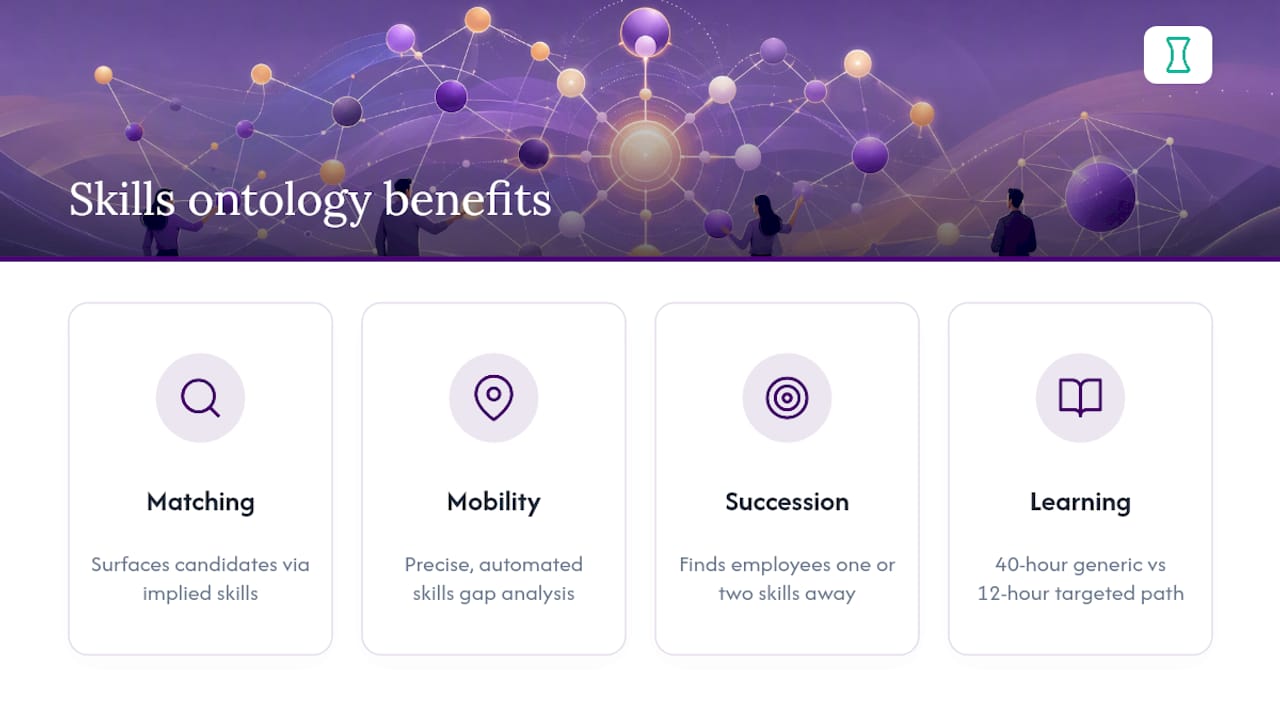
Talent matching and hiring. When job requisitions are tagged with ontology-coded skill requirements and candidate profiles carry validated skill nodes, matching improves. The graph surfaces candidates whose confirmed skills imply the required ones, not just those who used the exact keyword in a resume.
Internal mobility. Skills gap analysis compares current capabilities to what a role requires and identifies the delta. With an ontology, that comparison is precise and automated. A finance analyst who has confirmed Python skills and implied data modeling knowledge becomes a visible candidate for a data operations role, even if she has never applied internally.
Succession planning. Graph traversal can identify which employees are one or two skills away from readiness for a critical role, making succession pipelines more accurate than subjective manager nominations.
Learning personalization. When the LMS knows which skills a learner already has (and which are implied by those skills), it can skip redundant content and surface exactly the gap-closing modules. That is the difference between a 40-hour generic curriculum and a 12-hour targeted path.
Workforce redeployment. During restructuring or rapid market shifts, the ontology answers “who can do what, and how quickly?” before the organization defaults to external hiring. That question, answered fast and accurately, is where the graph pays for itself.
Upskilling prioritization. When the skills gap analysis is grounded in business strategy and multiple data sources, L&D can prioritize the skills that close the largest gaps between current capability and future business needs, rather than building programs based on survey popularity.
How to build a skills ontology: best practices and a checklist
The sequence matters. Organizations that skip evidence collection and jump to schema design end up with an ontology that reflects assumptions, not reality.
- Define business outcomes first. What decision will the ontology improve? Hiring accuracy, internal fill rate, redeployment speed? The answer determines scope, priority domains, and success metrics.
- Select core domains. Choose two to three functional areas for the pilot. Avoid trying to cover the entire organization in version one.
- Collect organizational evidence. Pull strategy documents, job architectures, quality findings, project post-mortems, and SME interviews. This is the raw material that grounds the schema in real work, not generic frameworks.
- Design the schema. Define node types, relation types, proficiency levels, and required metadata fields before importing any data.
- Model relations with SME validation. Draft implied and required relations using automated extraction, then validate every relation with a subject-matter expert. Unvalidated relations are the primary source of matching errors.
- Pilot with a defined scope. Run the ontology against one function or pipeline. Measure match accuracy and coverage against a baseline.
- Iterate before scaling. Fix schema gaps, prune bad relations, and add missing nodes based on pilot findings. Scale only after the pilot metrics meet your go/no-go criteria.
Implementation checklist:
- Data sources identified and access confirmed (HRIS, LMS, ATS, project records)
- Schema fields defined: node ID, preferred label, synonyms, proficiency levels, context tags, evidence type
- Relation types documented with definitions and examples
- SME review panel assigned per domain
- Validation protocol written (who approves a new node, who retires one)
- Pilot scope and success metrics agreed in writing
- Integration touchpoints mapped (which systems read and write to the ontology)
Pilot success metrics to track:
- Skill coverage rate (percentage of roles with fully mapped skill requirements)
- Match accuracy (percentage of ontology-recommended candidates rated “qualified” by hiring managers)
- Internal fill rate improvement for the pilot function versus the pre-pilot baseline
- Time-to-deployment reduction for roles filled through ontology-driven matching
Authoritative standards and public resources worth knowing
You do not need to build from scratch. Several public frameworks give you a validated starting point.
- Global Skills Taxonomy
- Skills ontology software helps close competency gaps | SHRM
- How to Conduct a Skills Gap Analysis [Step by Step] | Paycor
- How to Conduct a Skills Gap Analysis | Workday US
- MIND-TechAI/MIND-tech-ontology
- Lightcast Skills Taxonomy
- What’s in a name? (ADP Research)
- Skills Gap Analysis: Build the Capabilities You Need | Mindtools
- How to run a skills gap analysis | BambooHR
The recommended approach: adopt O*NET or Lightcast as your baseline for role-to-skill mapping, use the MIND ontology as a structural pattern for relation design, and map to the WEF Global Skills Taxonomy for external benchmarking. Customize the 20–30% of your skill graph that is genuinely organization-specific.
When to build an ontology vs. when to act with an enablement play
This is the question most organizations skip, and it is the most expensive mistake in workforce planning.
A skills ontology is a technical investment. It requires data, governance, and sustained maintenance. Before committing to that build, the diagnosis-first question is: what is the actual capability gap, and is a skills architecture the right response?
The decision flow looks like this:
- Collect organizational evidence. Strategy documents, frontline quality findings, project outcome data, and SME interviews. This is not a survey. It is a structured review of what the work actually requires.
- Classify the gap. Is the gap a person gap (people lack knowledge or skill) or an environment gap (the process, tools, or incentives prevent performance)? An ontology addresses person gaps. Environment gaps require process change, not a skills graph.
- Decide the response. If the gap is a person gap and the organization is large enough that matching and mobility decisions are breaking down, an ontology investment is justified. If the gap is narrow and the organization is small, a targeted enablement play, a structured learning path, or a focused hiring push may deliver faster results with less overhead.
Evidence to collect before committing to an ontology build:
- Strategy signals: which capabilities does the business plan require in the next 12–24 months?
- Frontline quality findings: where are performance errors occurring, and what is causing them?
- Project outcome data: which roles or functions are consistently under-delivering, and why?
- SME interviews: what do your best performers know and do that average performers do not?
The Mindtools skills gap analysis framework recommends starting with strategy and aggregating individual assessments to produce an organizational capability picture. That sequence is right. Strategy first, data second, architecture third.
Pro Tip: Structure your early pilots as “decision capability” tests, not training pilots. Ask whether the ontology improves the quality of a specific decision (who to hire, who to redeploy, what to build next) rather than whether it produces a complete skills inventory. Decision quality is the outcome that justifies the investment.
For a deeper look at why AI adoption is fundamentally a capability problem, not a technology problem, the same diagnosis-first logic applies to ontology projects.
Governance and maintenance: keeping your ontology alive
An ontology that is not maintained becomes a liability faster than a spreadsheet does. The most common failure mode is not a bad schema; it is a governance vacuum.
| Role | Responsibility | Cadence |
|---|---|---|
| Skills steward | Owns the canonical registry; approves new nodes and retirements | Ongoing; reviews weekly |
| Taxonomy owner | Maintains relation types and schema definitions; manages versioning | Quarterly schema reviews |
| Data engineer | Manages integrations, data pipelines, and deduplication | Ongoing; monitors daily |
| Business SME | Validates relations and proficiency levels within their domain | Per update cycle |
Versioning rules. Every change to the ontology should be versioned. A new node is a minor version. A changed relation type or a retired node is a major version. Downstream systems must be notified of major versions so their matching logic can be updated.
What triggers an update:
- A new role or job family is added to the organization
- A technology or methodology becomes standard practice in a domain
- A skill node is consistently returning poor match results (a signal of a bad relation or a missing synonym)
- An annual review against O*NET or Lightcast reveals drift from market-standard labels
Maintenance checklist:
- Provenance documented for every node (source, date, approver)
- Synonym handling: all known aliases mapped to the canonical node, not stored as separate nodes
- Deduplication run quarterly against the canonical registry
- Retirement policy defined: nodes that have not appeared in a job requisition or learning object for 24 months are flagged for review
- Change log maintained and accessible to all system owners
SHRM’s coverage of skills-ontology tools notes that implementations fail most often for governance and data hygiene reasons. Assign clear stewardship and a small, frequent update cadence from day one.
How to measure the impact of your skills ontology
Measurement starts before the ontology goes live. Establish baselines during the pilot design phase so you have something to compare against.
Suggested KPIs:
- Match accuracy: Percentage of ontology-recommended candidates rated “qualified” by the hiring manager or panel. Baseline this against your current manual process.
- Internal fill rate: Percentage of open roles filled by internal candidates. Track this for the pilot function versus the rest of the organization.
- Time-to-deployment: Days from role opening to a qualified candidate starting. An ontology-driven process should reduce this by surfacing internal candidates earlier.
- Training time savings: Hours of learning content completed per role versus hours required before the ontology-driven personalization was in place.
- Internal mobility rate: Percentage of employees who move to a new role within the organization in a 12-month period. This is the long-term health metric.
Pilot design:
- Define a control group (a comparable function not using the ontology) and a pilot group
- Measure baseline KPIs for both groups before the pilot launches
- Run the pilot for a minimum of 90 days before evaluating results
- Set go/no-go criteria in advance: what match accuracy or internal fill rate improvement justifies scaling?
Connecting skills gap analysis to ontology-driven decisions means making the gap analysis recurring, not a one-time exercise. The ontology should feed a quarterly gap report that compares current confirmed skills against the skills the business strategy requires for the next planning period.
A concrete skills ontology snippet
Here is a compact example showing the shape of real nodes and relations. This is a simplified JSON-like structure, not production code, but it illustrates the fields HR systems actually consume.
{
  "skill_node": {
    "id": "SKL-0042",
    "preferred_label": "Structured Query Language",
    "synonyms": ["SQL", "T-SQL", "ANSI SQL"],
    "domain": "Data Engineering",
    "proficiency_levels": ["Awareness", "Working", "Expert"],
    "evidence_types": ["certification", "project_record", "assessment_score"]
  },
  "relations": [
    {
      "from": "SKL-0042",
      "type": "implies",
      "to": "SKL-0031",
      "to_label": "Relational Database Concepts"
    },
    {
      "from": "SKL-0042",
      "type": "required_by",
      "to": "ROLE-0017",
      "to_label": "Data Analyst"
    },
    {
      "from": "SKL-0042",
      "type": "similar_to",
      "to": "SKL-0089",
      "to_label": "NoSQL Query Languages"
    }
  ]
}
What each field does in practice:
preferred_labelandsynonymsensure that a resume listing “T-SQL” and a job posting requiring “SQL” resolve to the same node. This is where most matching systems break without an ontology.proficiency_levelslet the system distinguish between a candidate with awareness-level SQL and one with expert-level SQL when filtering for a senior data role.- The
impliesrelation means that a confirmed SQL expert is automatically credited with Relational Database Concepts knowledge, reducing the number of explicit assessments required. required_bylinks the skill to the role, so any change to the Data Analyst role profile propagates to the skill node automatically.
At enterprise scale, a snippet like this maps to a graph of thousands of nodes and tens of thousands of relations. The MIND Tech Ontology demonstrates this at scale, with thousands of skills and relations modeled in a publicly inspectable format. The structural pattern is the same; the volume and domain coverage expand.
A 90-day plan HR leaders can start this quarter
This plan follows diagnosis-first principles. Evidence comes before architecture, and architecture comes before build.
-
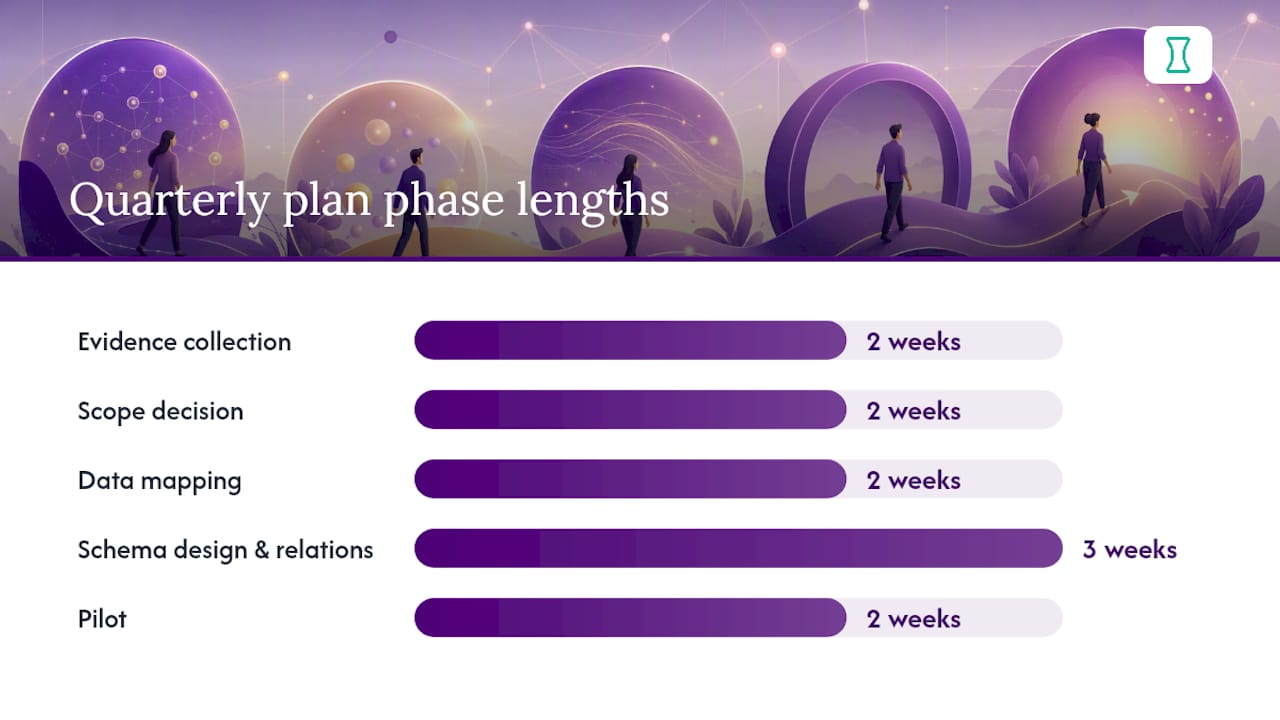
Weeks 1–2 (Evidence collection, owner: HR lead + L&D lead). Pull strategy documents, frontline quality findings, and project outcome data. Conduct five to eight SME interviews in the target function. Document the capability gaps the evidence reveals and classify each as a person gap or an environment gap.
-
Weeks 3–4 (Scope decision, owner: HR lead). Based on evidence, confirm whether an ontology investment is the right response or whether a targeted enablement play addresses the gap faster. If the ontology is justified, define the pilot function, the two to three priority skill domains, and the success metrics.
-
Weeks 5–6 (Data mapping, owner: data engineer + HRIS admin). Audit existing data sources: HRIS role profiles, LMS completion records, ATS requisition data, and any existing competency models. Map what you have to the schema fields the ontology requires. Identify gaps.
-
Weeks 7–9 (Schema design and relation modeling, owner: taxonomy owner + SMEs). Define node types, relation types, and proficiency schema. Draft the initial relation graph for the pilot domains using O*NET and Lightcast as reference baselines. Validate every relation with a domain SME.
-
Weeks 10–11 (Pilot launch, owner: HR lead + data engineer). Load the validated schema into the target system. Run the ontology against the pilot function’s open roles and current workforce. Measure match accuracy and coverage against the baseline.
-
Week 12 (Evaluation and go/no-go, owner: HR lead + executive sponsor). Review pilot KPIs against the pre-agreed criteria. Document what worked, what broke, and what the next iteration requires. Make the scale/pause/stop decision based on evidence, not enthusiasm.
Risk mitigation:
- If SME availability is the bottleneck, reduce the pilot to one domain and one relation type (implied knowledge only)
- If data quality is poor, run a data-cleaning sprint in weeks 3–4 before schema design begins
- If integration access is blocked, run the pilot as a manual matching exercise to validate the schema before committing to system integration
Fast-fail signals: If match accuracy in the pilot is below 60% after 90 days, the schema or the evidence base needs rework before scaling. Pause, diagnose, and fix the root cause. Do not scale a broken model.
For teams evaluating how decision capability fits into this architecture, the 90-day plan above is the foundation, not the ceiling.
Key Takeaways
A skills ontology delivers its full value only when it is grounded in organizational evidence, governed with clear ownership, and measured against the business decisions it is meant to improve.
| Point | Details |
|---|---|
| Ontology vs. taxonomy | A taxonomy labels; an ontology reasons. Use a taxonomy for simple tagging and upgrade to an ontology when matching, mobility, or automation is the goal. |
| Diagnosis before build | Collect strategy signals, frontline quality findings, and SME interviews before committing to any architecture or enablement play. |
| Governance is the failure point | Assign a skills steward, a taxonomy owner, and a data engineer from day one. Most ontology projects fail from data drift, not bad schema design. |
| Measure decisions, not completions | Track match accuracy, internal fill rate, and time-to-deployment. These are the KPIs that connect the ontology to business outcomes. |
| Cognistry’s approach | Cognistry starts with diagnosis, not design, grounding every capability decision in organizational evidence before any build begins. |
Why the diagnosis-first frame changes everything
Most organizations treat a skills ontology as a data project. They hire a consultant, map their job families to a taxonomy, and declare the work done. Six months later, the graph is stale, the matching results are mediocre, and the L&D team is still building programs based on survey data.
The problem is not the ontology. The problem is the sequence.
When you start with evidence, the ontology reflects what the work actually requires, not what HR thinks it requires or what a vendor’s generic framework suggests. That distinction sounds subtle. It is not. An ontology built on organizational evidence surfaces the skills that separate high performers from average performers in your specific context. A generic framework surfaces the skills that appear most frequently in job postings across your industry. Those are different lists, and the difference shows up in every matching decision the system makes.
The other thing most guides understate is the cost of skipping the environment-versus-person classification. If your customer service team is producing poor outcomes because the process is broken, building a skills graph of customer service competencies will not fix it. The gap is environmental. An enablement play, a process redesign, or a tooling change is the right response. The ontology is not wrong; it is just answering the wrong question.
The diagnosis-first frame is not a philosophy. It is a decision filter. It keeps organizations from spending 18 months building a capability architecture that addresses a symptom rather than a cause. And it keeps L&D from defaulting to courses that build knowledge but not capability, which is the most common and most expensive mistake in enterprise enablement.
Cognistry brings diagnosis-first capability engineering to your skills work
Before your organization commits to a skills ontology build, Cognistry helps you answer the question that determines whether the investment is justified: what capability does the work actually require, and is a technical architecture the right response?
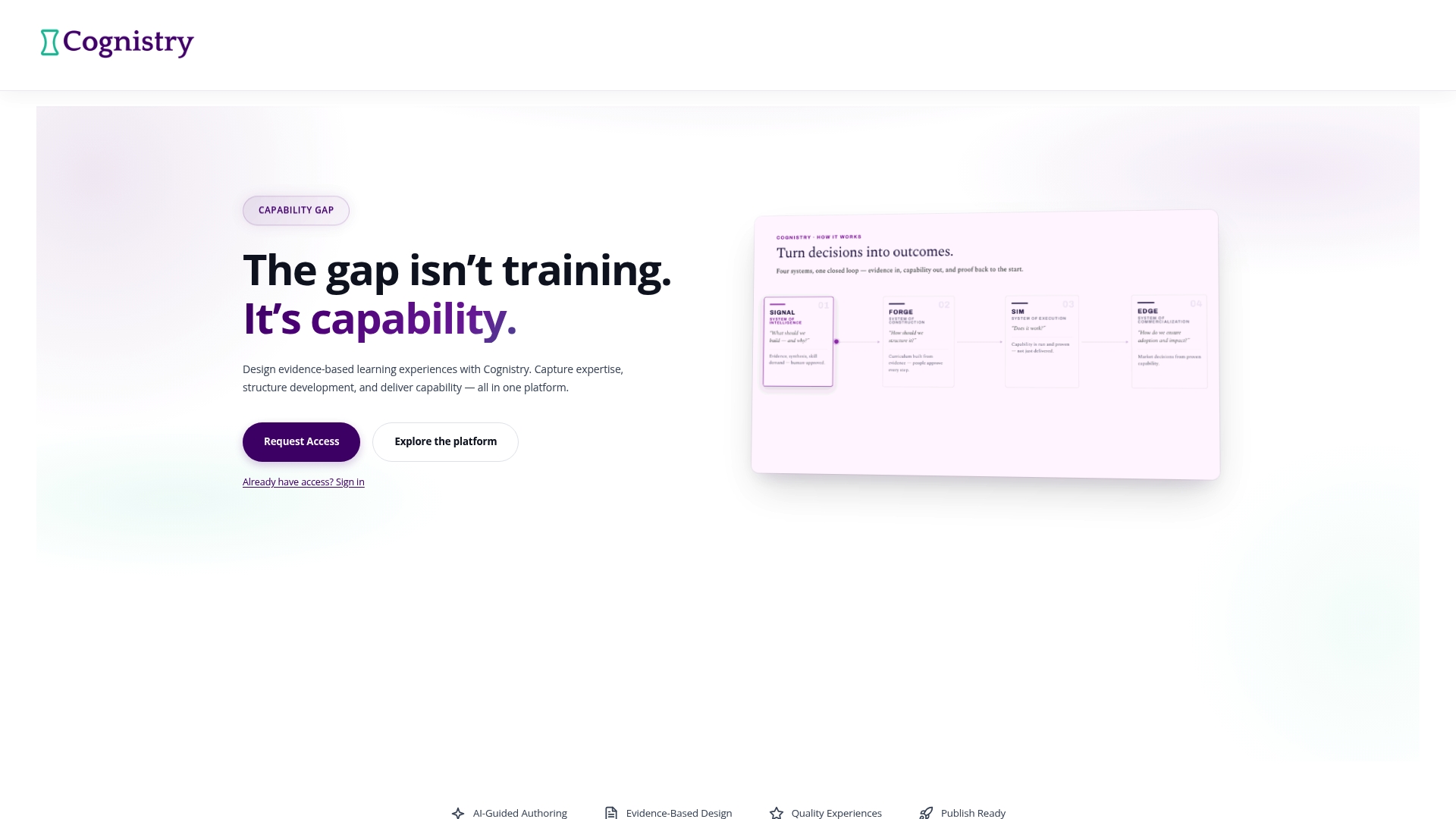
Cognistry’s capability engineering platform starts with your organizational evidence, not a vendor template. It maps capability signals from strategy documents, frontline quality findings, and SME knowledge, then structures the response: whether that is a decision-centered simulation, a targeted learning path, or the schema design for a skills graph. The platform includes AI-guided authoring, capability signal mapping, and behavioral telemetry that connects learning design to operational performance. It is built for organizations that need to prove why they built what they built, not just show that people completed it.
If you are ready to move from assumption-based skills mapping to evidence-grounded capability engineering, request a diagnostic conversation with Cognistry to see where the gaps in your current approach actually are.
Useful sources and further reading
- O*NET OnLine: The U.S. Department of Labor’s occupational database. Best used for role-to-skill mapping and benchmarking your job architecture against national standards.
- WEF Global Skills Taxonomy: A shared reference framework for reskilling and workforce planning across industries. Best for external benchmarking and cross-industry alignment.
- SHRM: Skills Ontology Software: Practical coverage of how ontology tools close competency gaps in HR workflows.
- MIND Tech Ontology (GitHub): Open-source skill graph showing relation modeling at scale. Best used as a structural reference for relation schema design.
- Lightcast Open Skills: A large, continuously updated skills taxonomy. Best for consistent labeling and labor market trend signals.
- ADP Research: What’s in a Name?: Research on skill categorization and role-to-skill mapping. Best for understanding general versus unique skill structures.
- Paycor: Skills Gap Analysis: Step-by-step guide to conducting a skills gap analysis. Best for pilot design and KPI selection.
- Workday: Skills Gap Analysis: Framework for grounding gap analysis in business strategy. Best for connecting ontology work to workforce planning.
- Mindtools: Skills Gap Analysis: Strategy-first approach to gap analysis. Best for linking skills architecture to organizational capability goals.
- BambooHR: Skills Gap Analysis: Practical guidance on recurring gap analysis and integration with L&D decisions.