
AI NIST is the NIST AI Risk Management Framework (AI RMF), hosted alongside implementation tools at the NIST AI Resource Center (AIRC). The AI RMF is voluntary, lifecycle-focused guidance for building trustworthy AI systems, not a regulation. Organizations getting started should read the framework core, then move to the AIRC’s Playbook and use-case profiles to translate it into action.
TL;DR:
- Implement governance with clear ownership to establish risk decision pathways before mapping AI systems or applying measurements.
- Focus on mapping AI contexts and stakeholder impacts to identify potential risks, especially fairness gaps, in real operational environments.
- Use outcome-based metrics that connect risk management efforts directly to business impacts rather than solely relying on model accuracy scores.
- Approach RMF adoption as an iterative cycle, continuously revisiting governance, mapping, measuring, and managing to maintain trustworthiness over time.
- Diagnosis-first capability assessment helps identify operational risk gaps early, enabling focused interventions rather than generic policy or training solutions.
Table of Contents
- What NIST’s AI Work Covers, and Where the AI Resource Center Fits
- The AI RMF Core: Four Functions, Not a Checklist
- NIST’s Toolkit: Matching the Resource to the Job
- How to Start Implementing the AI RMF
- Standards, Consortiums, and How the Framework Keeps Changing
- Where Diagnosis-First Capability Work Fits the RMF
- Treat the Framework as Scaffolding, Not a Finish Line
- Turning NIST Guidance Into a Working Capability Program
- Sources
- FAQ
What NIST’s AI Work Covers, and Where the AI Resource Center Fits
NIST’s job in artificial intelligence is measurement science, not enforcement. The agency develops the metrics, terminology, and testing methods that let organizations compare AI risk claims against something concrete, and it does this as a neutral convener rather than a regulator, per its Information Technology Laboratory AI program. That distinction matters for how you read everything else NIST publishes: none of it is a legal mandate, but all of it reflects consensus input from industry, academia, and civil society.
The AI Resource Center is where that output gets organized for actual use. It hosts:
- The AI RMF core document and its supporting profiles
- The RMF Playbook, with suggested actions mapped to each function
- Crosswalks linking the RMF to other standards
- Use cases and worked examples from real deployments
If you want the formal technical report, go to the PDF publications. If you want a template you can hand to a project team this week, go to the AIRC.
The AI RMF Core: Four Functions, Not a Checklist
The AI RMF core organizes risk management into four functions: Govern, Map, Measure, and Manage. Each one describes an ongoing practice, and NIST is explicit that the functions loop rather than run in sequence.
- Govern sets the culture and accountability structure: policies, roles, and escalation paths for AI decisions.
- Map identifies context: what the system does, who it affects, and what could go wrong.
- Measure applies quantitative and qualitative tools to test those risks against defined criteria.
- Manage allocates resources to treat the risks the first three functions surfaced.
Alongside the four functions, the RMF lists characteristics of trustworthy AI: valid and reliable, safe, secure and resilient, accountable and transparent, explainable and interpretable, privacy-enhanced, and fair with harmful bias managed. A fraud-detection model might score well on validity but fail on fairness if training data underrepresents certain transaction patterns. That gap is exactly what the Map function is built to catch.
Pro Tip: Don’t treat the four functions as a one-time audit. Teams that revisit Map and Measure only after an incident lose the early-warning value the framework is designed to provide.
NIST’s Toolkit: Matching the Resource to the Job
NIST built several resources under the RMF umbrella, and each solves a different problem. Sequencing them in the wrong order is the most common way organizations stall out.
- The AI RMF core gives you the organizing model. Start here to understand vocabulary and structure before touching anything else.
- The Playbook breaks each function into suggested actions and practices your team can actually assign to owners.
- Profiles, including the generative AI profile discussed below, apply the core to a specific context, whether that’s a sector, a use case, or a technology type.
- Crosswalks map the RMF against standards you may already follow, so you’re not rebuilding governance from scratch.
For downloadable templates and worked examples, the AIRC is the right stop. For the formal, citable technical report, go to the PDF publication.
How to Start Implementing the AI RMF
Adopting the AI RMF works best as a short, deliberate sequence rather than a parallel scramble across every function at once.
- Establish governance first. Assign clear ownership for AI risk decisions before you map a single system. Skipping this step is the top reason RMF rollouts stall, since mapping, measuring, and managing all need a governance foundation to stick.
- Map the system and its stakeholders. Document what the AI does, who touches it, and which profile or scope applies.
- Define measurements tied to operational outcomes. Pick metrics that connect to business impact, not just model accuracy scores.
- Run a targeted pilot. Test the mapped system against your defined measures in a contained environment before wider rollout.
- Manage controls and monitoring. Build incident response paths and ongoing checks based on what the pilot revealed.
- Iterate and document. Feed pilot findings back into governance and mapping, then repeat.
Pro Tip: Resist the urge to write your Govern policy in the abstract. Draft it against one real AI system already in production, then generalize once you see what actually breaks.
For a structured way to sequence this inside a larger organization, Operational AI Governance walks through a 60-day starting model.
Standards, Consortiums, and How the Framework Keeps Changing
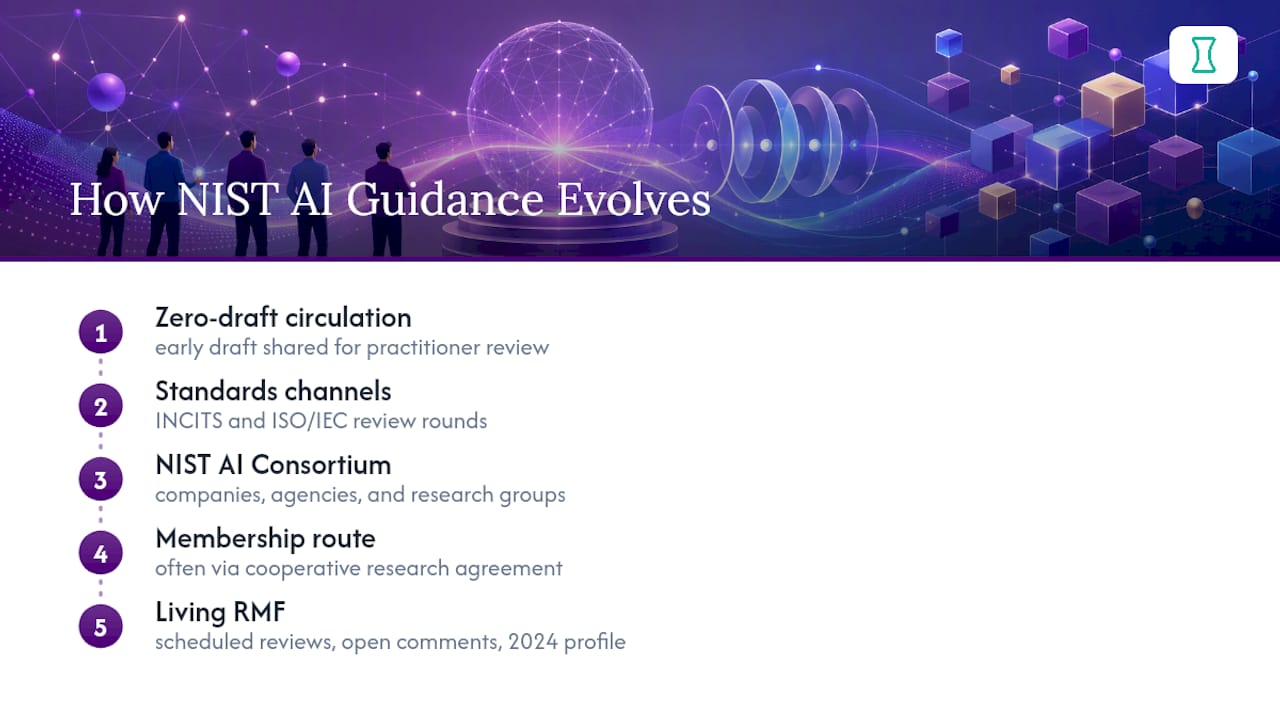
NIST doesn’t finalize AI guidance in isolation. Draft language, sometimes called a zero-draft, circulates through private-sector standards channels like INCITS and ISO/IEC before formal publication, giving practitioners a chance to flag problems early.
Organizations can participate directly through the NIST AI Consortium, which brings together companies, agencies, and research groups to develop measurement science and standards collaboratively. Membership routes typically involve a cooperative research agreement.
The AI RMF itself is a living document. NIST built in scheduled reviews and an open comment channel, and the 2024 generative AI profile is the clearest example of that versioning in practice. Watch for further profile updates and concept notes as NIST responds to new AI risk categories.
For a security-team-oriented breakdown of how the RMF functions map to existing risk programs, the CISO Safe explainer on the NIST RMF offers a useful cross-check.
Where Diagnosis-First Capability Work Fits the RMF
Most AI governance failures aren’t framework problems. They’re capability problems: teams told to “manage AI risk” without the operational judgment to recognize when a risk is materializing. That’s a Govern and Measure gap, not a documentation gap.
Cognistry’s diagnosis-first approach starts by determining what capability the work actually requires before anyone builds a course, a policy deck, or a simulation. That sequencing maps directly onto the RMF:
- Govern needs people who understand escalation triggers, not just a policy PDF.
- Measure needs outcomes tied to real operational decisions, not just model benchmarks.
- Manage needs practiced judgment under pressure, which is what decision-practice simulations are built for.
A reasonable starting pilot: diagnose one capability gap tied to an AI-touching workflow, build a focused decision-practice simulation around it, then measure the result against a business-relevant outcome instead of a completion rate. That’s a smaller, more honest first move than building an intervention around every function at once. For more on connecting NIST standards to workforce capability specifically, see AI-Guided Capability Engineering.
Treat the Framework as Scaffolding, Not a Finish Line
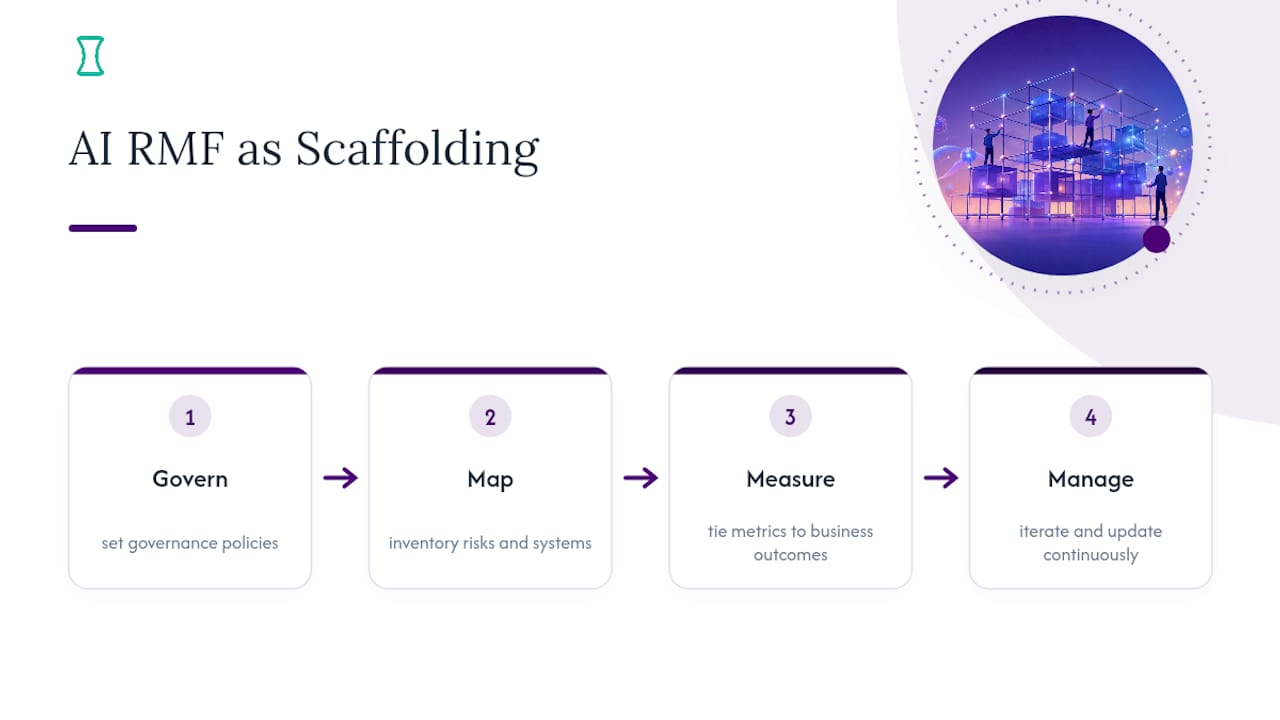
The organizations that get the most out of the AI RMF are the ones that never expect to “finish” it. Govern, Map, Measure, and Manage are meant to keep cycling, and the moment a team treats a completed Playbook activity as done work, the framework stops doing its job.
The bigger risk isn’t ignoring NIST guidance. It’s implementing it once, filing the documentation, and calling the risk managed. Pilots should tie measurement directly to an operational outcome someone in the business actually cares about, and organizations serious about staying current should engage NIST’s public comment process directly rather than wait for a summary to trickle down secondhand.
— Brian
Turning NIST Guidance Into a Working Capability Program
Reading the AI RMF tells you what trustworthy AI requires. It doesn’t tell you whether your teams can actually recognize a Map-stage risk before it becomes a Manage-stage incident, and that gap is where most governance programs quietly fail.
Cognistry is built for that specific problem: a diagnosis-first capability-engineering platform that determines what capability an AI governance rollout actually requires before anyone builds training around it. Instead of assuming a course fixes a Govern gap, Cognistry grounds the design in your organization’s own evidence, structures a decision-practice simulation where judgment is genuinely tested, and measures the outcome against the operational result you’re trying to protect. It’s one implementation path among several, but it’s built specifically for teams trying to make RMF adoption stick past the first quarter. If you’re mapping an AI governance rollout right now, start with a capability diagnosis through Cognistry’s operational AI governance offering and see what a focused 60-day pilot looks like for your team.
Sources
Keep these open in a tab before you start any RMF rollout:
- AI Risk Management Framework | NIST
- Artificial Intelligence Risk Management Framework: Generative Artificial Intelligence Profile
Use the AIRC for practical templates; use the PDFs when you need a citable technical reference.
FAQ
What is NIST in AI?
NIST, the National Institute of Standards and Technology, develops measurement science and voluntary standards for AI, including the AI Risk Management Framework, rather than acting as an AI regulator.
Is the NIST AI RMF a standard?
No. It’s voluntary guidance built through consensus and public comment, not a mandatory standard, though organizations often use it alongside standards like ISO/IEC frameworks.
Which jobs are least likely to survive AI disruption?
There’s no NIST-backed list of specific jobs, and reliable projections vary widely by task type, not job title. The RMF itself focuses on managing AI risk, not forecasting employment shifts.
What is the 30% rule in AI?
This isn’t a NIST-defined concept, and no consistent industry definition exists. Be cautious of guides presenting it as an established standard.
How do I start implementing the AI RMF?
Begin with governance and accountability, then map your system and stakeholders, define outcome-tied measurements, run a pilot, and build ongoing monitoring, cycling back through each function as your AI use evolves.