Manufacturing & industrial
Operators overriding AI-driven quality and maintenance calls
The system flags a batch as within tolerance. The operator has seen this pattern fail before. Who wins, and can you show they were trained for it?

EU AI Act — Article 4 is enforceable as of 2 August 2026
If you sell into the EU, the AI Act reaches you through your customer's procurement process. They must evidence a sufficient level of AI literacy across everyone operating AI on their behalf — and that phrase includes your people, on their contracts.
Cognistry captures the operating context, builds the capability, and produces the evidence. Not a completion certificate. A record that survives review.
A customer just sent us an AI Act annex. We have 14 days and no idea what to put in it.
Then we start from the regulation and your actual operations — not a template. Give me both.
Evidence intake
What Article 4 actually asks of you
Everyone touches AI now. Do we really have to cover all 900 people?
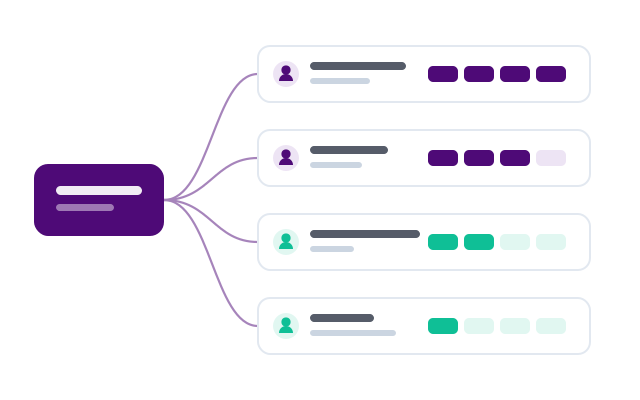
No. The Act says calibrate. Four exposure tiers, not one blanket module.
Exposure map
Who is actually in scope, and how deep
Where does the evidence come from? We can't invent it.
It's already in your SOPs, incident logs and SME judgment. Pulling it now.
Evidence agents
Four agents against your operating record
If they audit us in two years, does this still hold?
Sealed and dated. Every decision traces back to the evidence behind it.
Signal Snapshot
EU AI Act evidence package — sealed
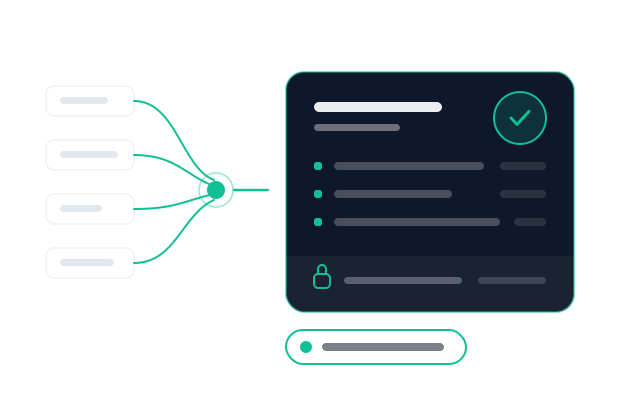
A compliance lead describes an AI Act procurement demand and Cognistry Signal ingests the regulation and the company's own operating evidence, identifies which roles are exposed, and seals a dated evidence snapshot.
The clock that actually matters
Article 4 AI literacy — enforceable now
Article 26(2) oversight competence required
Article 99 exposure tier for deployer breaches
How Cognistry works
No theory. This is the actual sequence — capture, build, practise, evidence — and what you are looking at in the product at each stage.
You have the security answers. You have the data-protection answers. Then comes a question about the AI literacy of the people delivering the contract, and there is nothing to put in the box.
This is how the AI Act reaches companies that are not based in the EU. Not through a regulator. Through your customer. They carry the Article 4 obligation, that obligation covers “other persons dealing with the operation and use of AI systems on their behalf,” and on their contracts that is your team.
A generic AI-awareness certificate does not close this. The Act asks for a sufficient level — calibrated to the person and the context. A certificate evidences neither.
Article 4 requires literacy calibrated to “the context the AI systems are to be used in.” A bought-in course cannot satisfy that, because it does not know your context.
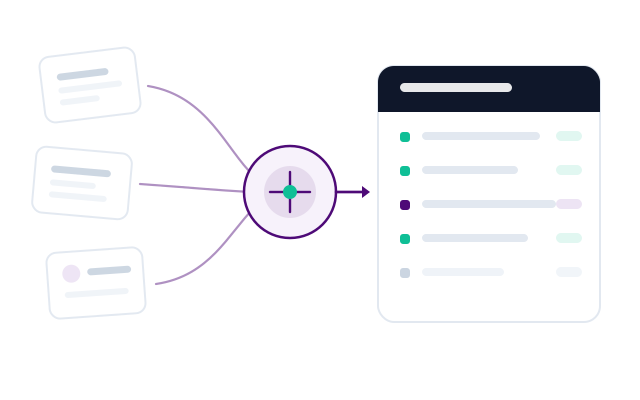
Signal ingests what you already have — standard operating procedures, incident and escalation logs, expert frameworks, decision scenarios, SME interviews — and derives which capabilities your people actually need to demonstrate.
The output is a Skill Demand Register: a defensible statement of what good judgment looks like in your operation, sourced from evidence rather than assumed from a syllabus.
Two years from now, someone will ask why you trained these people on these things. “It seemed sensible” is not an answer that survives a review.
Signal seals its findings into an immutable, dated Snapshot. Every capability requirement traces back to the specific document, interview or incident that produced it — so the reasoning is inspectable long after the people who did the reasoning have moved on.
This is the difference between having done training and being able to show why that training was the right training.
This is the actual authoring surface. You describe the gap in plain language; Forge argues back about what would genuinely close it.
It does not start writing slides. It establishes the capability, the audience, the evidence that would prove it, and the real constraint — then structures the programme against that.
What you are watching: a compliance lead and Cognistry agreeing what an Article 4 programme has to contain before a single word of content exists.
Legal wants everyone to sit a 40-minute AI awareness module.
That evidences attendance. Article 4 asks for a level. Different thing — let's build for the level.
Architecture
Judgment when the AI is confidently wrong
Does tier 3 get the same thing?
No. They supply inputs, they don't override. Two moments, not five.
Structure
Calibrated by exposure, as Art. 4 requires
How long until I can see something real?
Four agents on the spec now. Drafts back for your review in minutes.
Build agents
Building against the approved spec
A compliance lead and Cognistry Forge agree the capability an Article 4 programme must build, structure it into role-specific moments, and specify what gets built for the highest-exposure tier.
Read the operative wording: literacy sufficient “taking into account their technical knowledge, experience, education and training and the context the AI systems are to be used in, and considering the persons or groups of persons on whom the AI systems are to be used.”
That is a specification for differentiation. An organisation that puts 900 people through one identical module has not read it — and has produced a record that reads, to a reviewer, as exactly what it is.
Forge builds the tiers separately. The person who can override an AI output goes deep. The person who supplies inputs to it does not. Both are covered, and the difference is on the record with the reasoning attached.
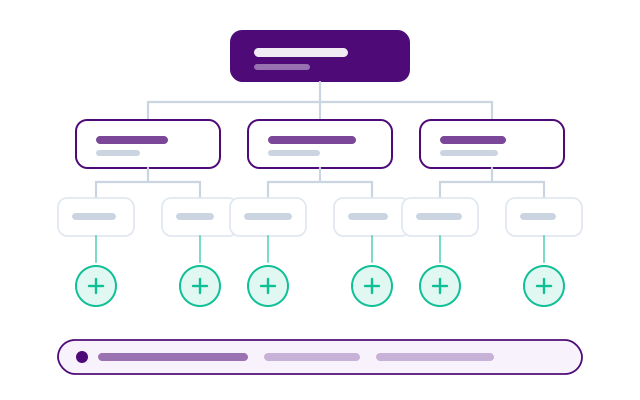
Programme → module → section → interaction → decision practice. Every branch of the structure terminates in a moment where a person has to decide something.
That matters for evidence. A module you can only report on at programme level tells a reviewer that someone finished it. A structure that resolves to individual decisions lets you say which judgments were practised, by whom, and how they went.
It also makes the programme maintainable. When the regulation shifts — and it has already shifted once via the Omnibus — you amend the affected moments rather than rebuilding the course.
How do you test whether someone over-trusts the AI? You can't ask them.
You don't ask. You hand them a confident recommendation that's wrong and watch.
Simulation run
The recommendation is 94% confident and wrong
Be honest — how did they do?
Two in three deferred to it. That's your automation bias, measured.
Behavioural signals
What people actually did under pressure
After the programme — did it move?
Override rate 36% to 81%. That's a capability change you can evidence.
Evidence
Capability formed, not attendance logged
Cognistry Sim runs a decision simulation in which the AI recommendation is confidently wrong, scores whether each person overrode it, and reports which cohorts deferred.
Article 14(4)(b) requires overseers who “remain aware of the possible tendency of automatically relying or over-relying on the output produced by a high-risk AI system (automation bias).”
You cannot train that by explaining it. Telling people about automation bias does not stop them deferring — that is precisely why the regulation names it.
The only thing that works is putting a person in front of a confident, plausible, wrong recommendation while the clock runs, and letting them find out what they do.
What you are watching: the measurement running, the baseline coming back uncomfortable, and the re-test proving the programme worked.
Article 14(4)(d) requires that an overseer be able to “decide, in any particular situation, not to use the high-risk AI system or to otherwise disregard, override or reverse the output.”
Think about what that asks of a person. Contradicting a system that is right most of the time, in front of colleagues, under time pressure, with no certainty they are correct. Someone who has never done it once has not demonstrated they can.
A simulation is the only place they can practise it before it counts — and the only place you can capture proof that they did.
Most training platforms can export a completion report. A completion report answers a question nobody asked.
Cognistry exports the chain: the regulation, the operating evidence behind your scope decision, the calibration reasoning per tier, the decisions people practised, and how they performed.
What you are watching: the pack being assembled, the gap being caught before the customer catches it, and the export going out.
Their annex is due Friday. What can I actually send?
All of it. Scope, calibration, practice, results — with the reasoning attached.
Evidence pack
AI Act Article 4 — supplier response
Anything that won't hold up?
One gap. Your contractors are in scope and have no evidence. Fix it before they ask.
Gap check
Caught before the customer catches it
Send it.
Exported. And it stays live — next customer asks, it's already current.
Export
Reusable across every EU deal
Cognistry assembles the customer-facing evidence pack, flags a contractor cohort with no evidence before the customer finds it, and exports the completed pack.
The work in steps 1 to 9 is not per-deal work. It is a capability system you build once and maintain.
The next EU customer sends their annex and the answer already exists — current, sourced, and specific to how your people actually operate. The deal stops stalling in review.
Companies treating this as a form-filling exercise will do it again for every customer, badly, forever. The ones that build the capability once turn a procurement blocker into something closer to a reason to pick them.
Every sector selling into the EU
Article 4 attaches to anyone providing or deploying AI systems — with no sector carve-out and no risk threshold. What changes by industry is which judgment your people have to demonstrate.
Manufacturing & industrial
The system flags a batch as within tolerance. The operator has seen this pattern fail before. Who wins, and can you show they were trained for it?
Financial services
Model risk governance already demanded challenge. Article 4 now demands evidence that the challengers are capable of challenging.
Healthcare & life sciences
Automation bias in diagnostic support is the most-studied failure mode there is. It is also the one Article 14(4)(b) names explicitly.
Technology & SaaS
Your customers inherit obligations from your product. Their procurement pushes it straight back to you, in writing.
Professional services
You are the textbook case of 'persons dealing with the operation and use of AI systems on their behalf.' Your client's obligation is your problem.
Logistics & supply chain
Optimisation output looks authoritative. Local knowledge that contradicts it needs practised confidence to be voiced.
Energy & utilities
Safety-critical operations where deferring to a confident system has consequences that do not stay inside the organisation.
Public sector suppliers
Public-authority deployers face a hard 2 August 2030 compliance date under Article 111(2) — and they will pass the requirement down the chain.
“We are not in the EU.”
Neither is the obligation, directly. But your EU customer holds it, it explicitly covers people acting on their behalf, and their procurement team will ask you in writing. The AI Act reaches exporters through contracts, not through regulators.
“The deadline moved to 2027.”
The high-risk rules moved. Article 4 did not — it has been binding since February 2025 and became enforceable on 2 August 2026. The one obligation that got harder this year is the one about your people.
“We already ran AI training.”
Then you can evidence attendance. Article 4 asks for a sufficient level, calibrated to each person's experience and context. A completion record does not evidence a level of anything, and a reviewer knows it.
“We will handle it with policy.”
Policy tells people what to do. Article 14(4) requires that they be able to — interpret output, recognise their own automation bias, override a confident system under pressure. No document has ever produced that.
The AI Act's obligations about training data, model documentation, conformity assessment and general-purpose AI models — Articles 10, 15, 53 and 55, and Annexes IV and XI — belong to whoever builds the model. We have no role in any of them, and we will not pretend otherwise.
Cognistry addresses the half of the Act that is about your people: Article 4 literacy, Article 26(2) oversight competence, and the Article 14(4) capabilities an overseer has to actually possess. Even there, Article 26(2) asks for competence, training, authority and support — and the last two are organisational design, not a learning problem. We will tell you that in the first meeting.
No product makes you AI Act compliant. Ours makes the people half evidenceable.
Article 4 exposure assessment
A working session against your actual operations. We map which roles are in scope, what evidence you already hold, and where the gaps are that a procurement reviewer would find.
You leave with the exposure map whether or not you buy anything.